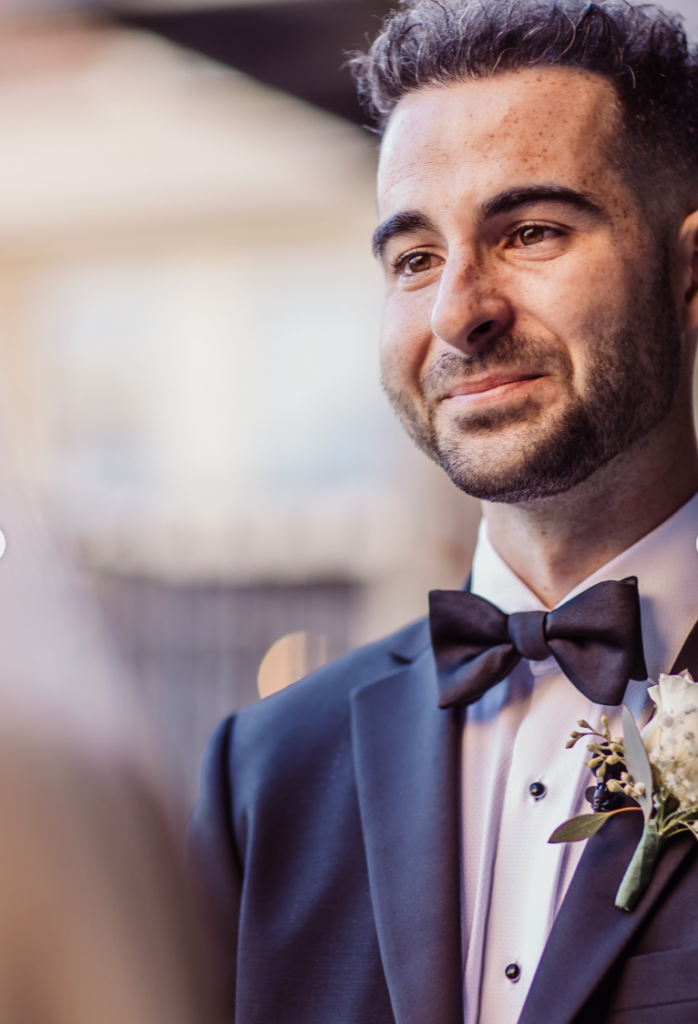
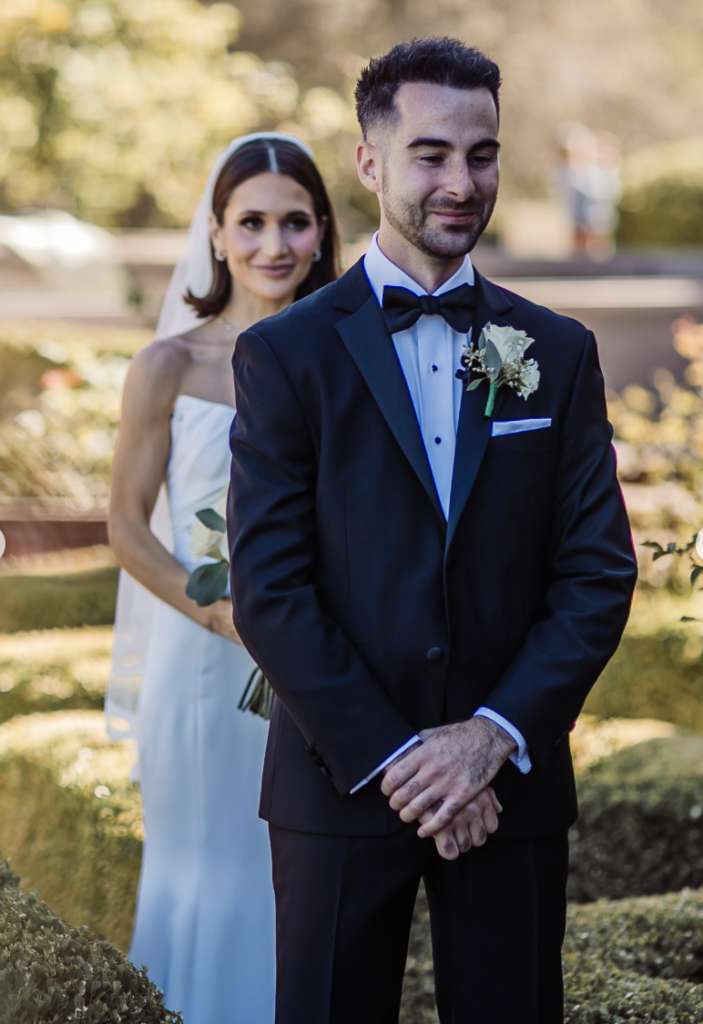
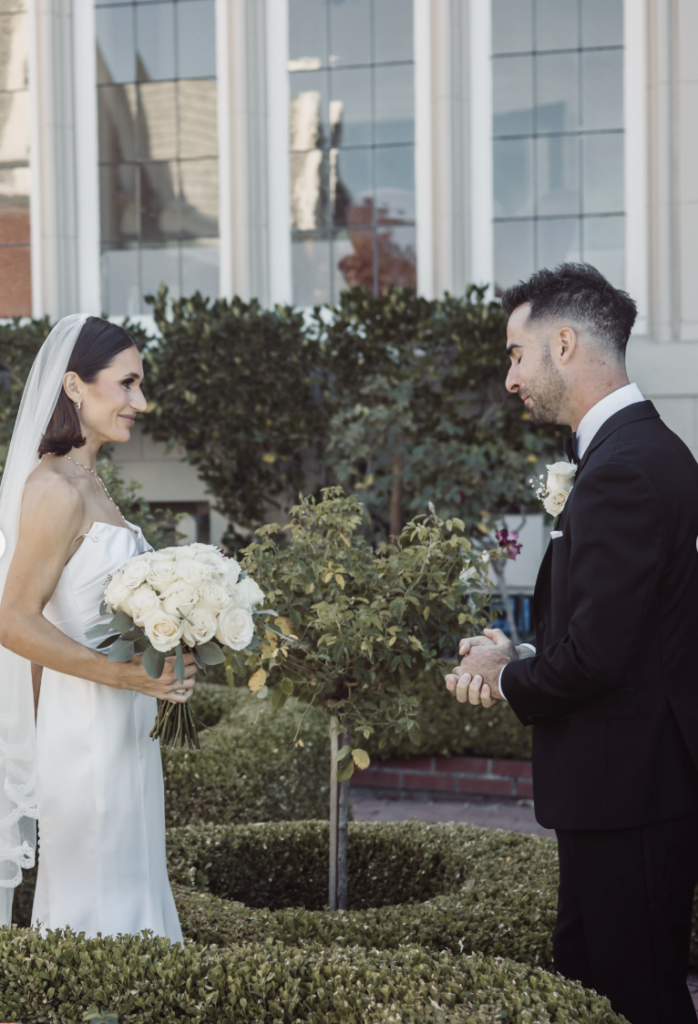
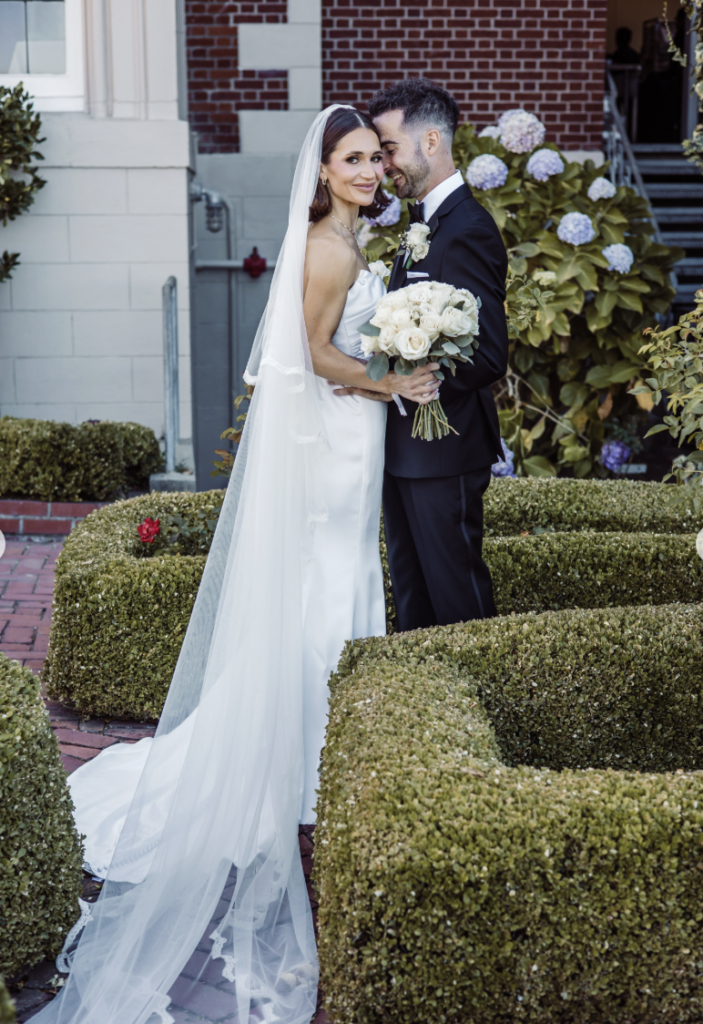
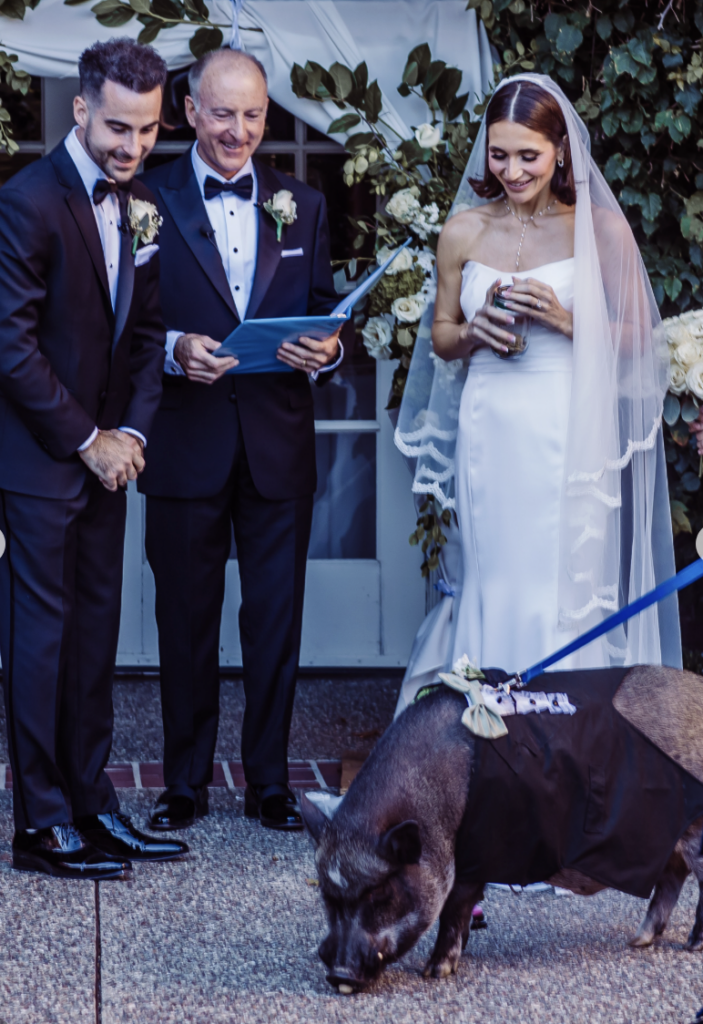
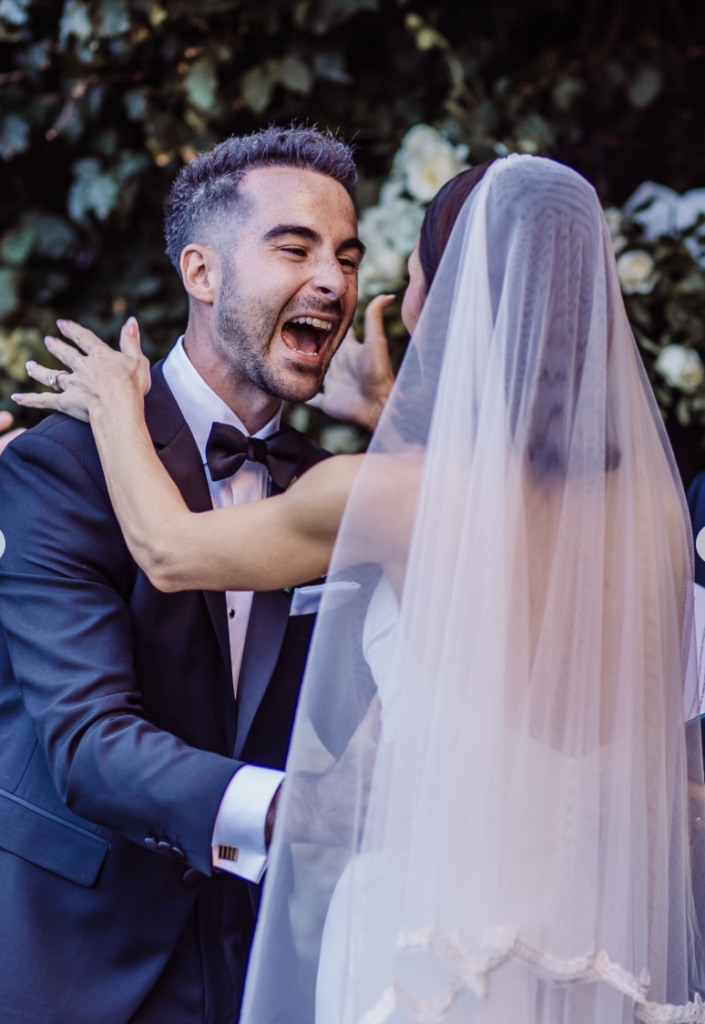
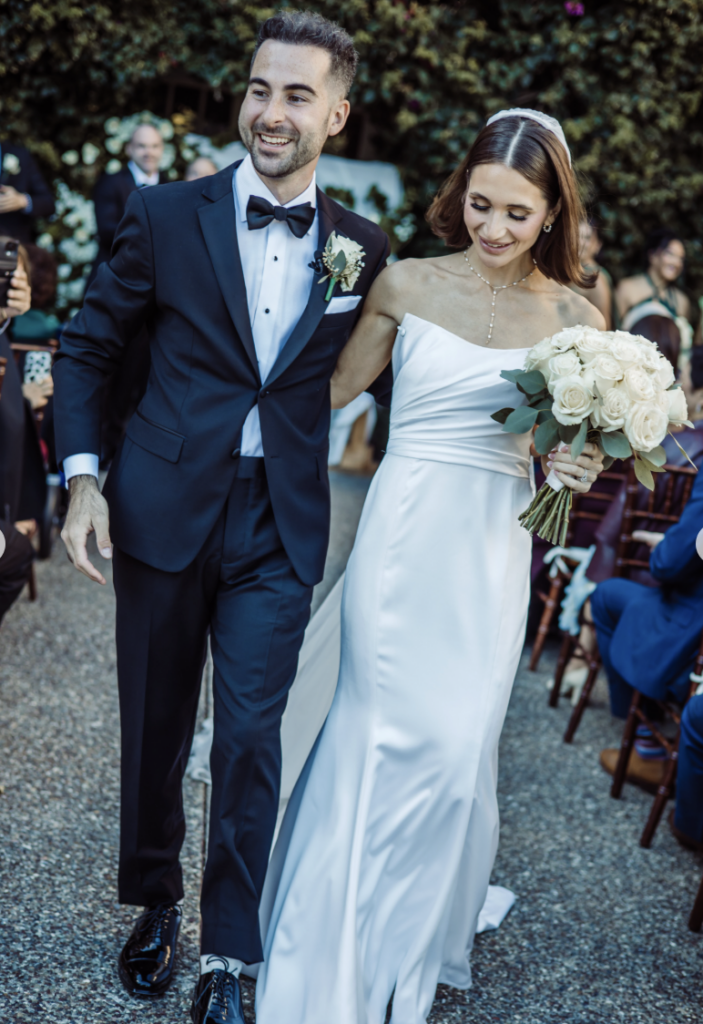
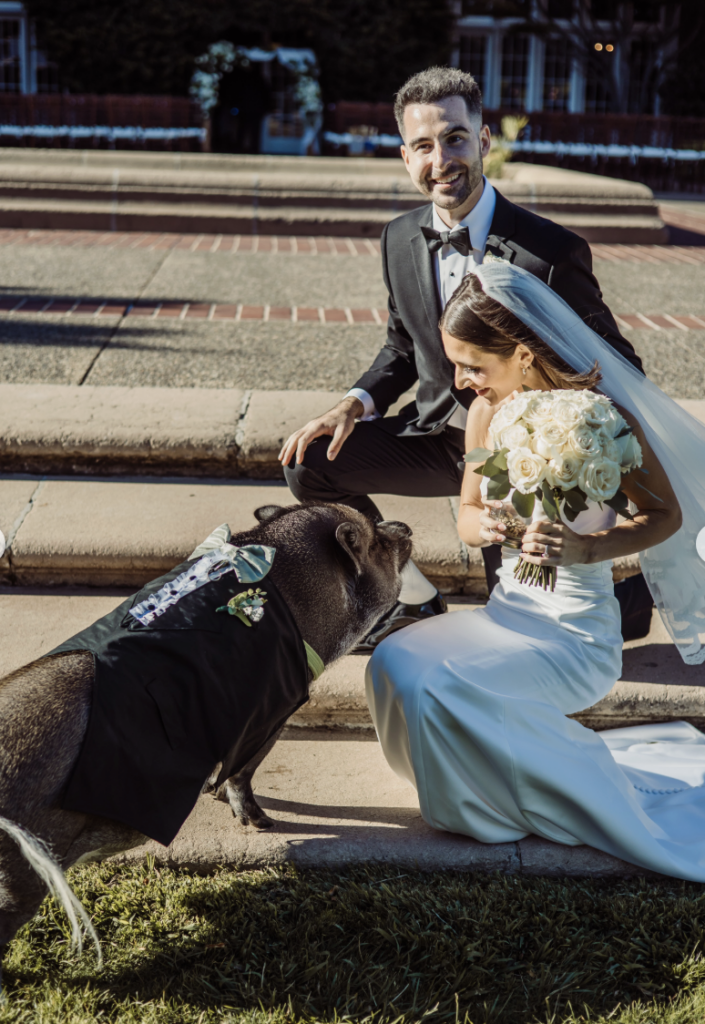
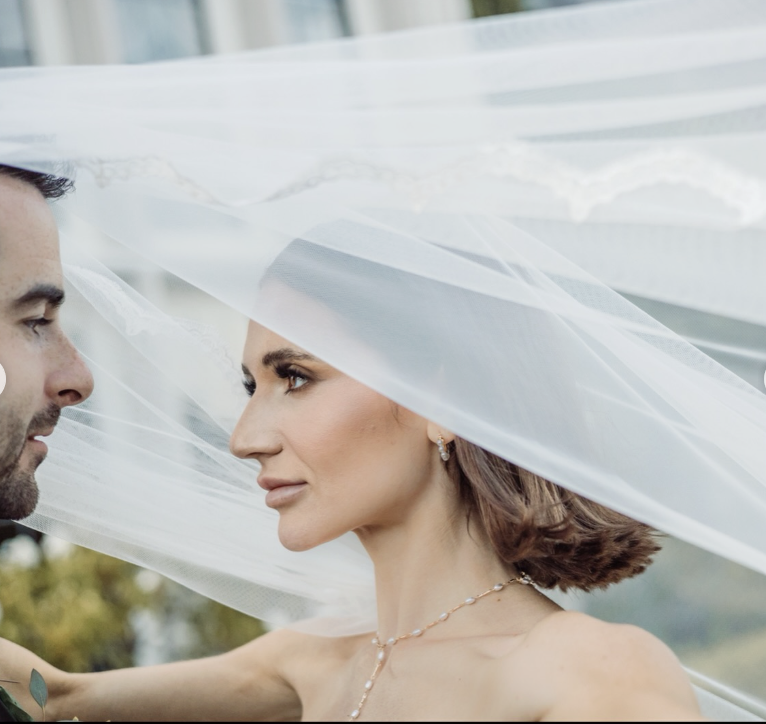
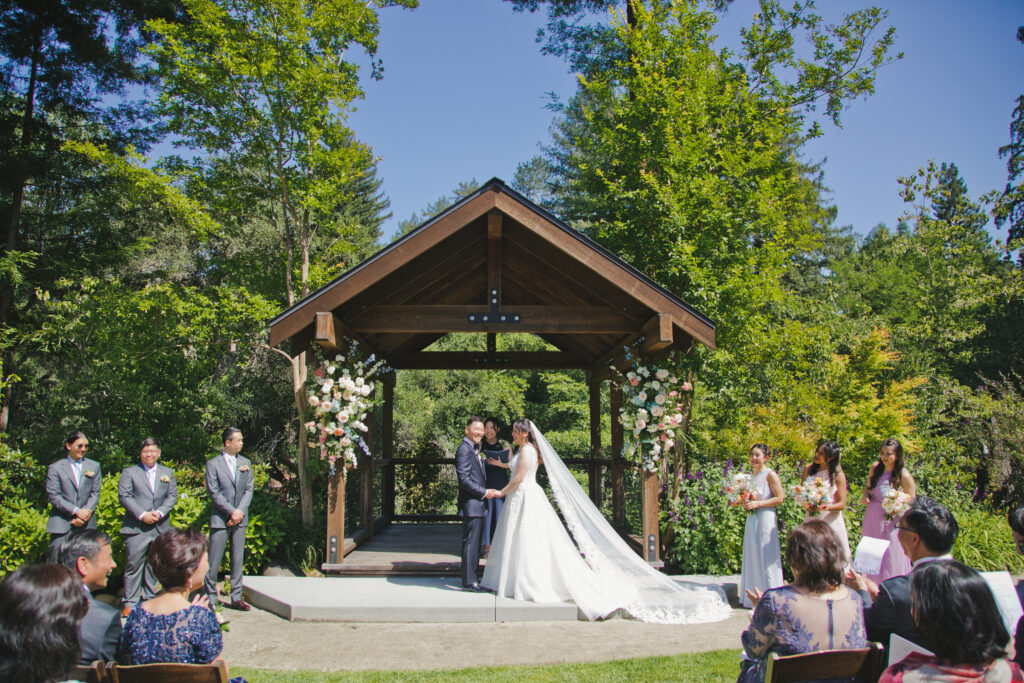
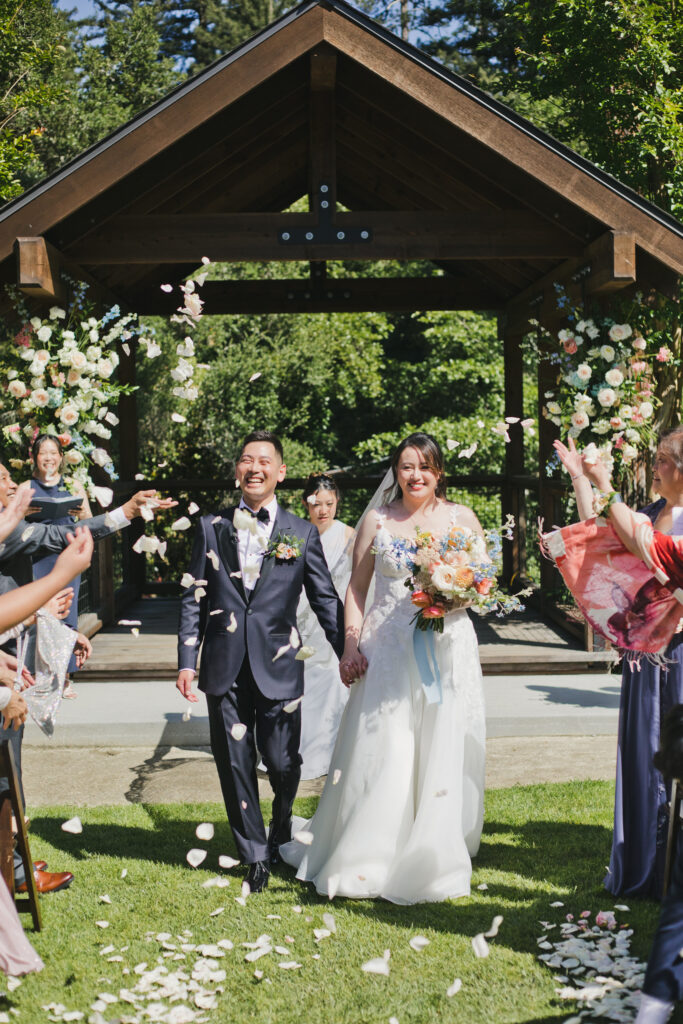
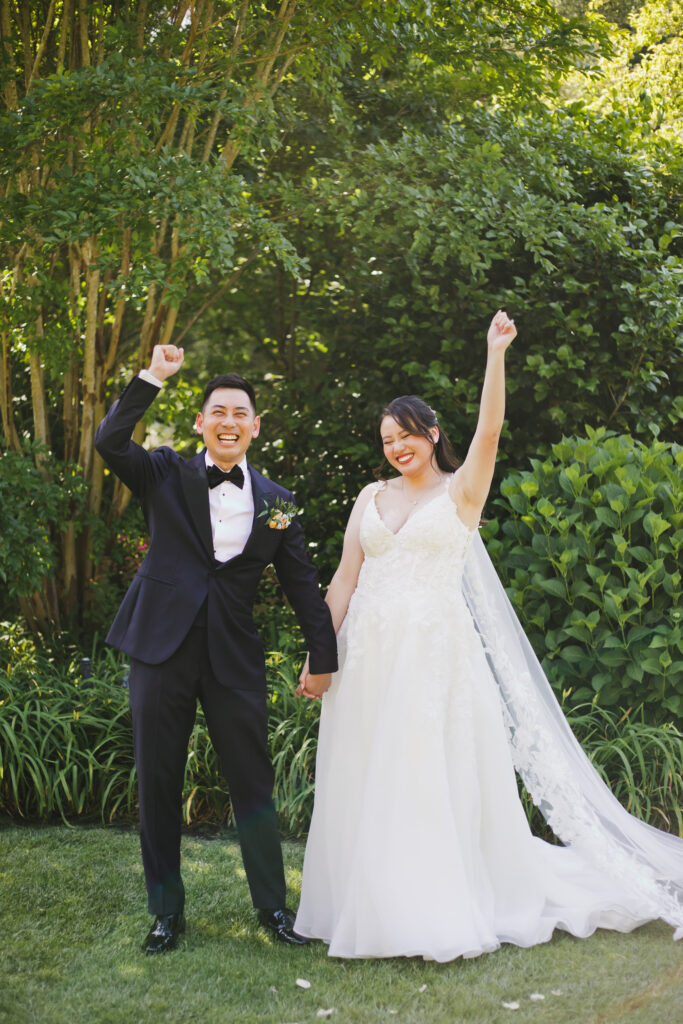
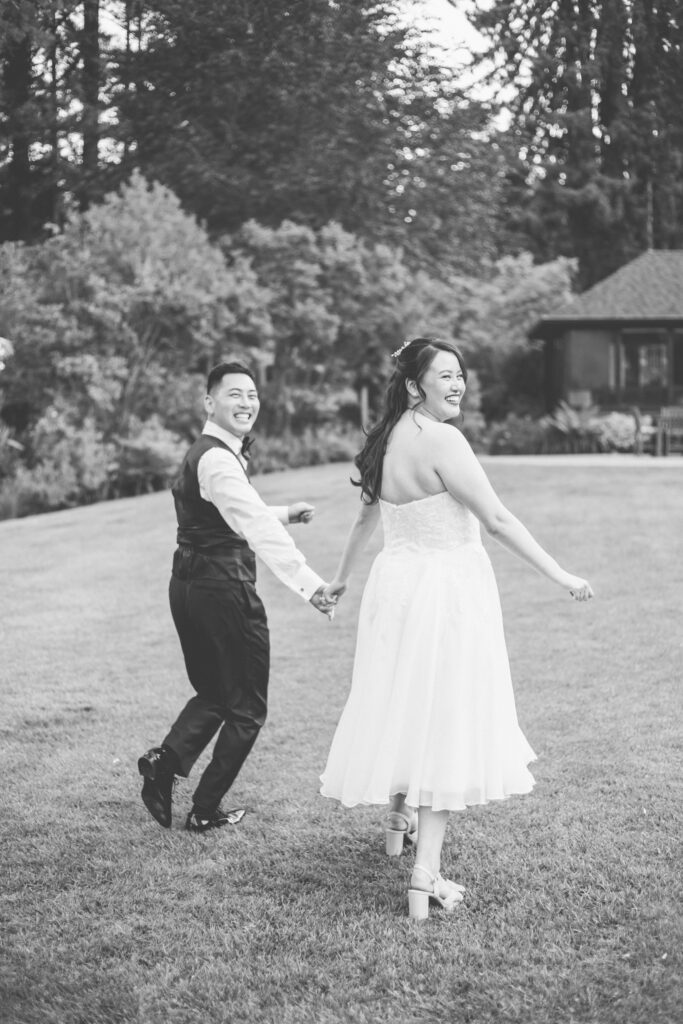
Bride Mina is a woman of many talents. A singer-songwriter turned animal activist, a children’s book author and allround creative – and a social media influencer. How that came to pass? Mina had adopted an adorable piglet, named him Merlin and raised him in her house as her pet. And then – she created social media accounts for him, just to share HOW adorable he was… and his fame grew from there. Merlin, now fully grown at 180 lbs, has millions of social media followers, and Mina with him.
And why that matters? Because one of their followers was Alex. He fell in love with Mina ONLINE, proposed… and here they are getting married! But wait… they actually got married before that – in all secrecy. Not even their parents knew – although their secret was hidden in plain view in one of Mina’s songs, “All Set.” No matter; nobody found out until – last Saturday! But we are getting ahead of ourselves…
For their wedding planning and design, Mina and Alex had turned to my company, A Day Like No Other, nine months before their wedding date, and we had a lot of work to do in that time! Including, of course, ordering a tux for Merlin who was promoted to ring bearer. And we got everything done JUST in time!
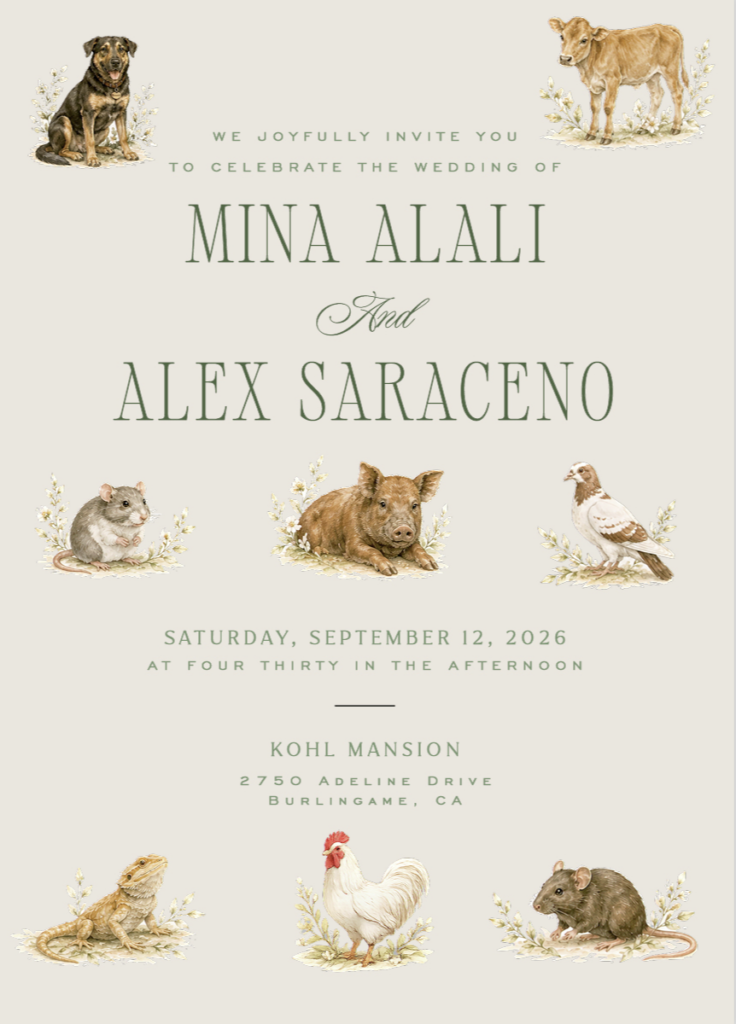
Quick detour – Mina, Alex and I worked intensely on creating invitations and wedding day stationery befitting their love for their (many) rescue animals; and in collaboration with minted.com we came up with a design as unique as these two are:
Unsurprisingly, these two did not ask for any wedding gifts for themselves, but for contributions toward their newly founded nonprofit organization to build an animal shelter!
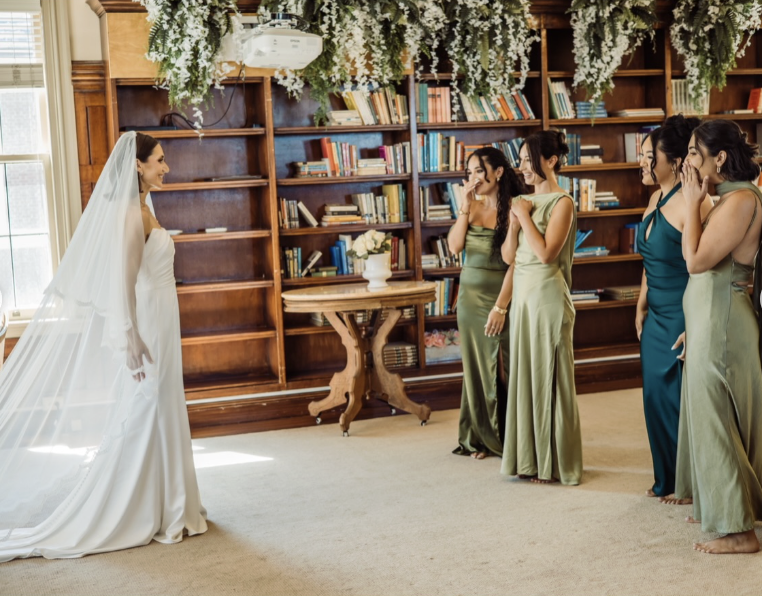
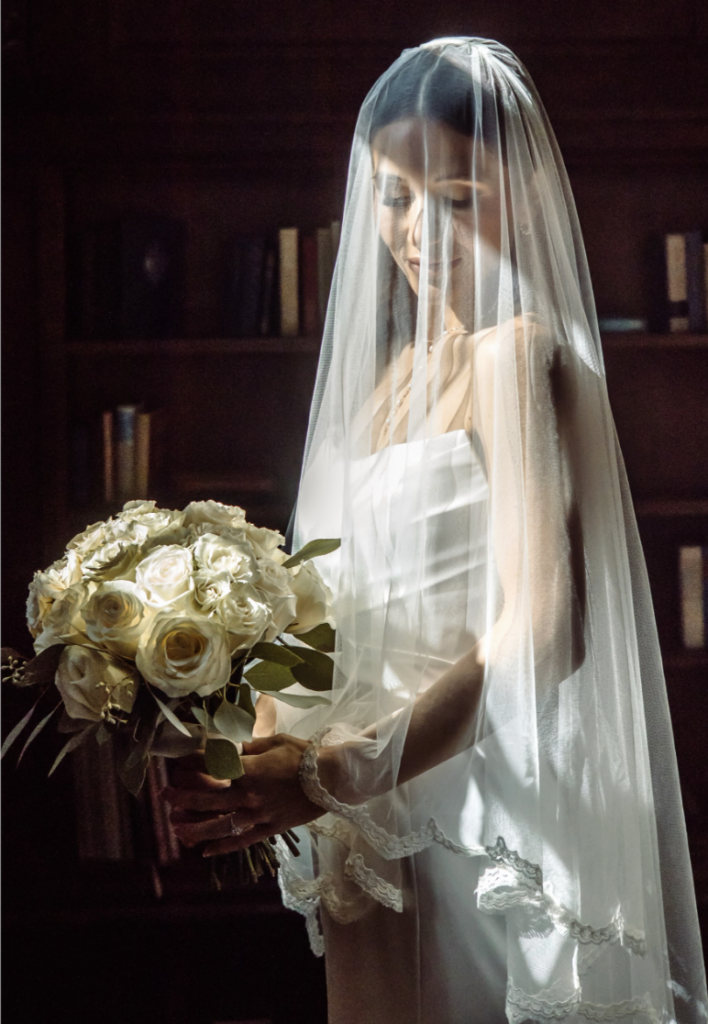
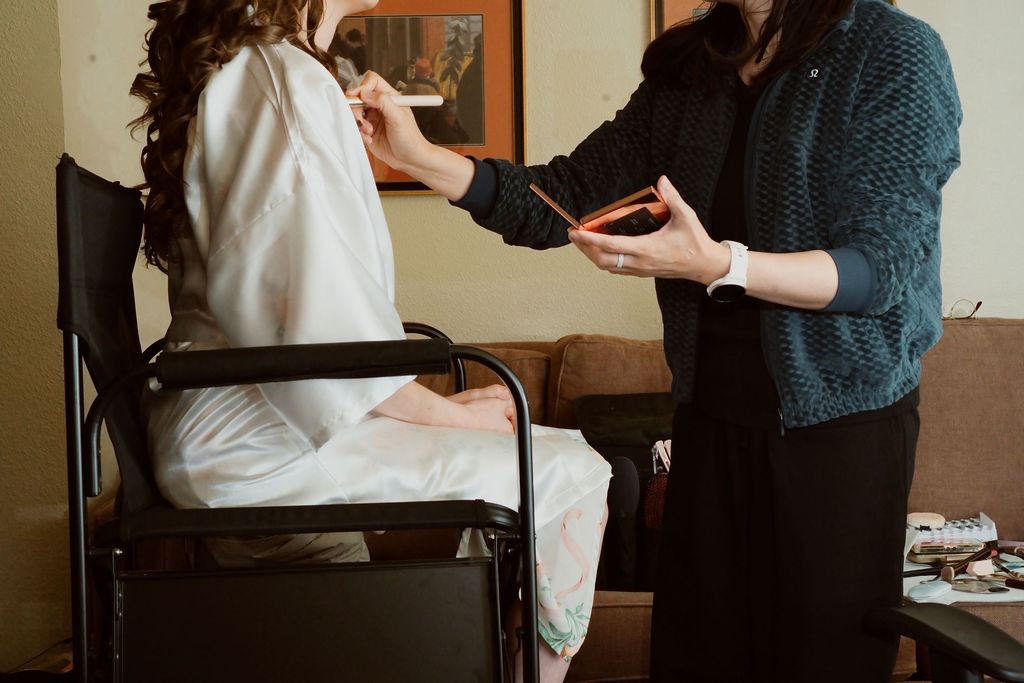
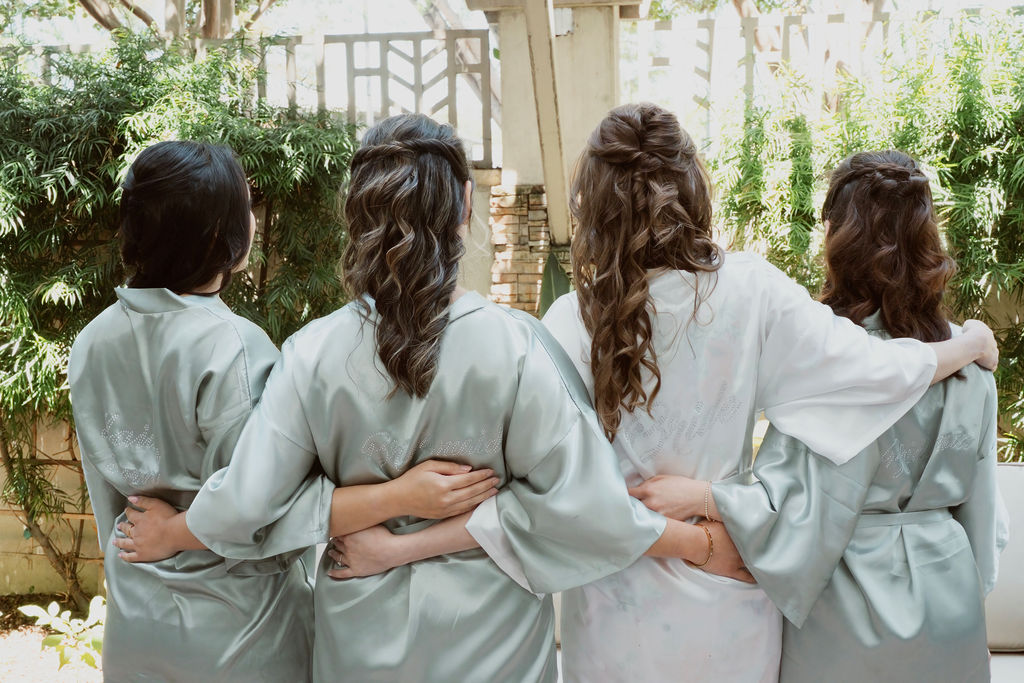
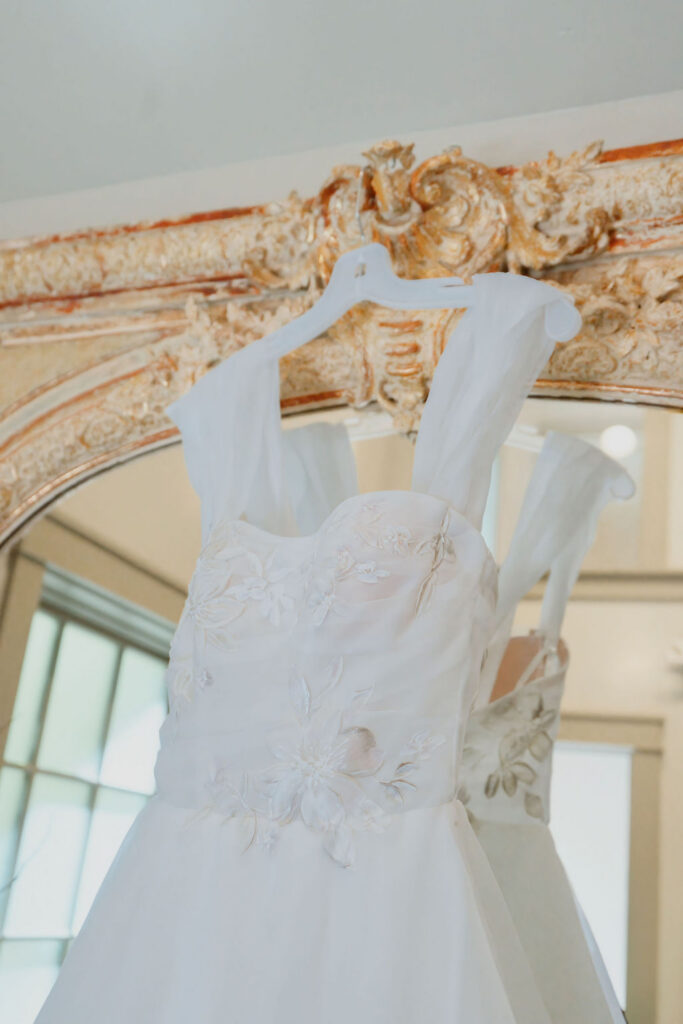
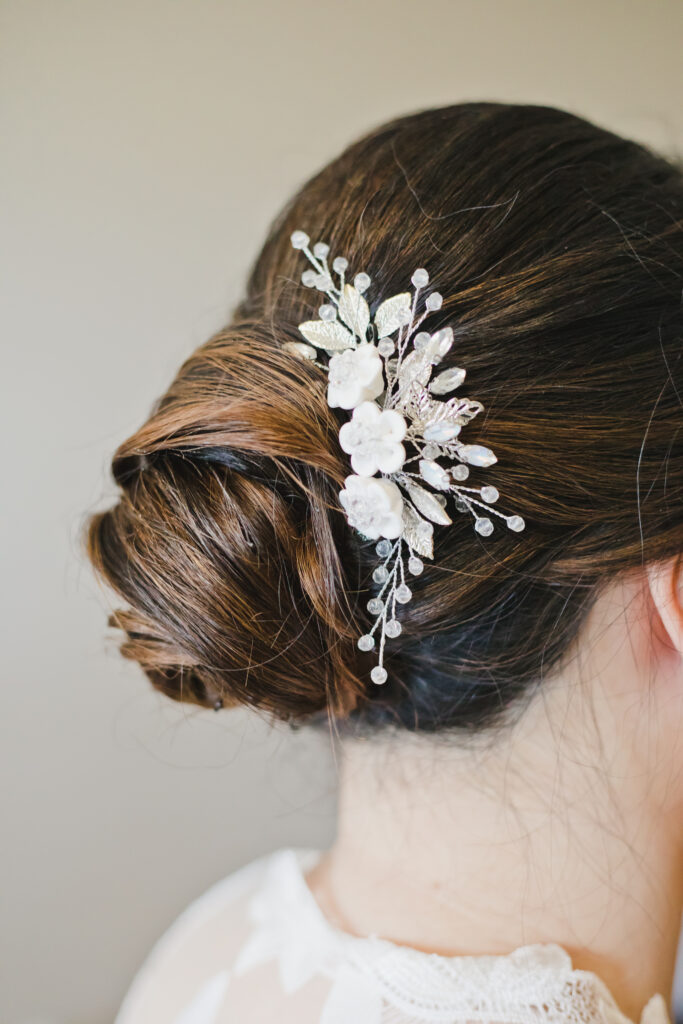
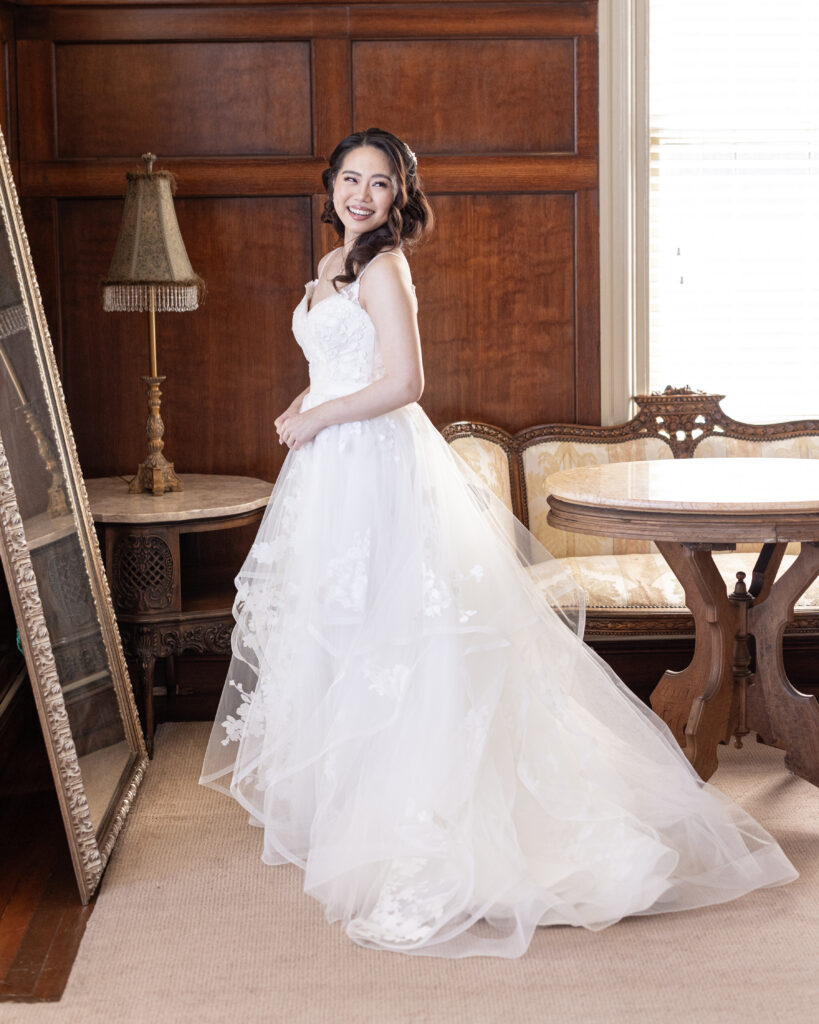
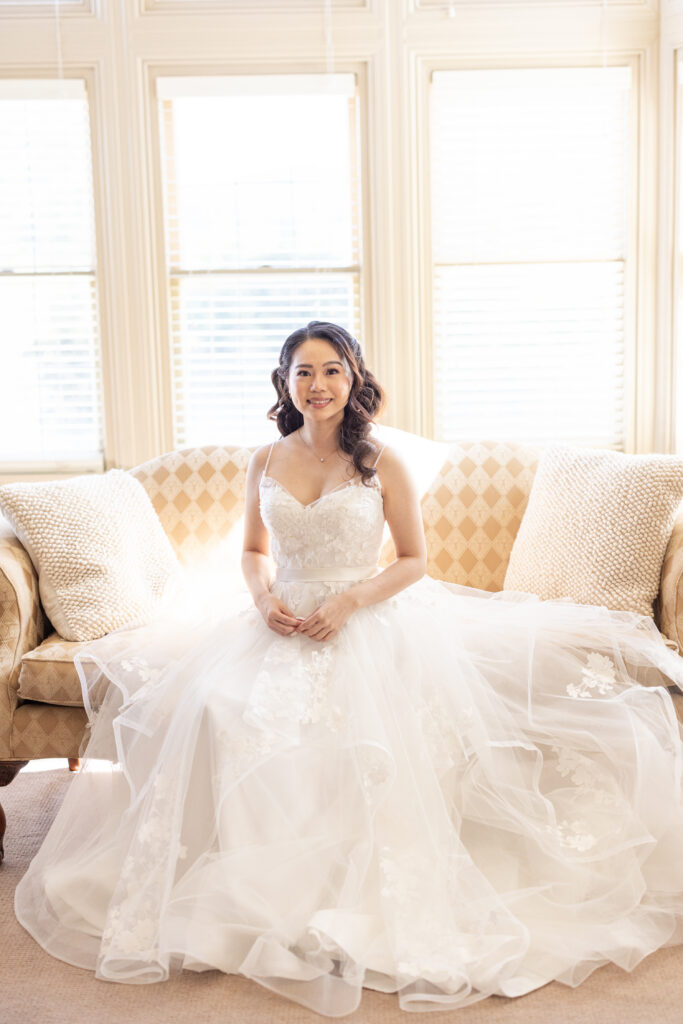
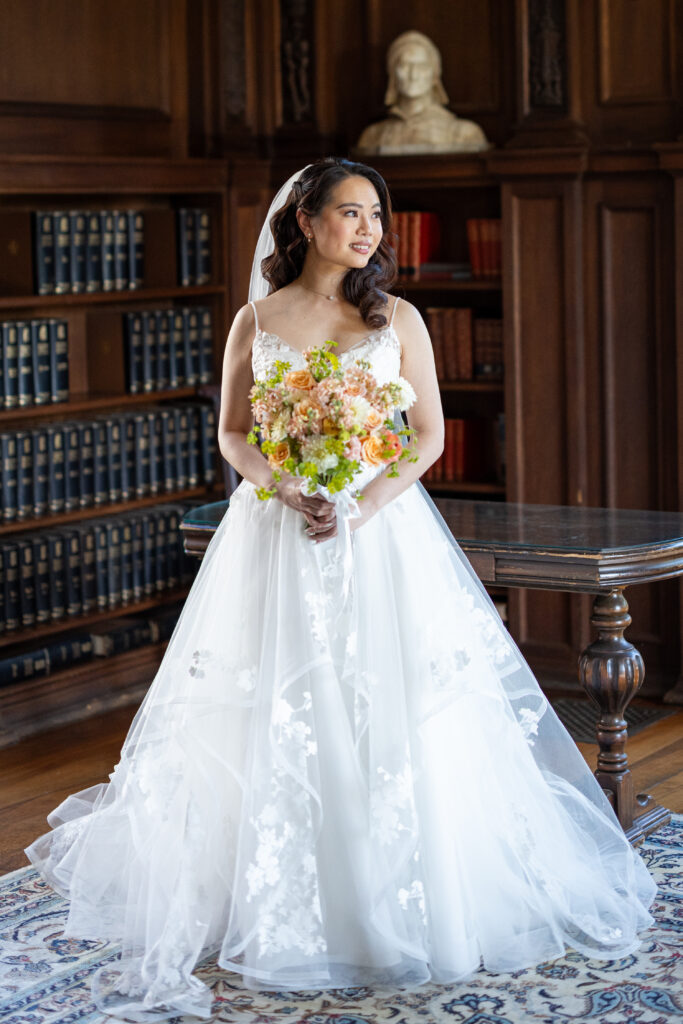
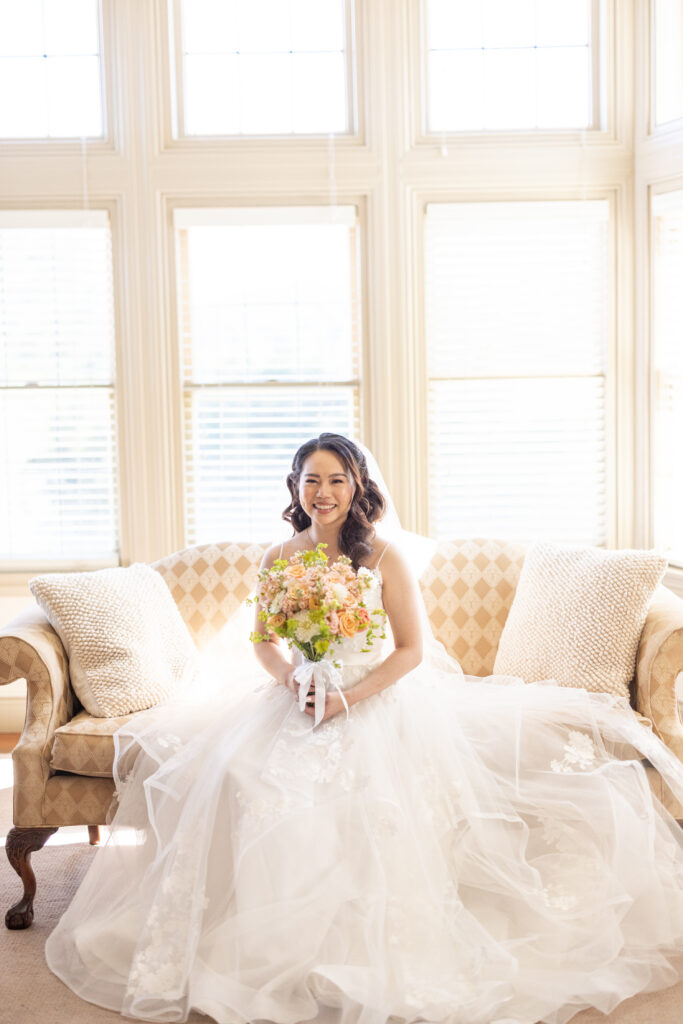
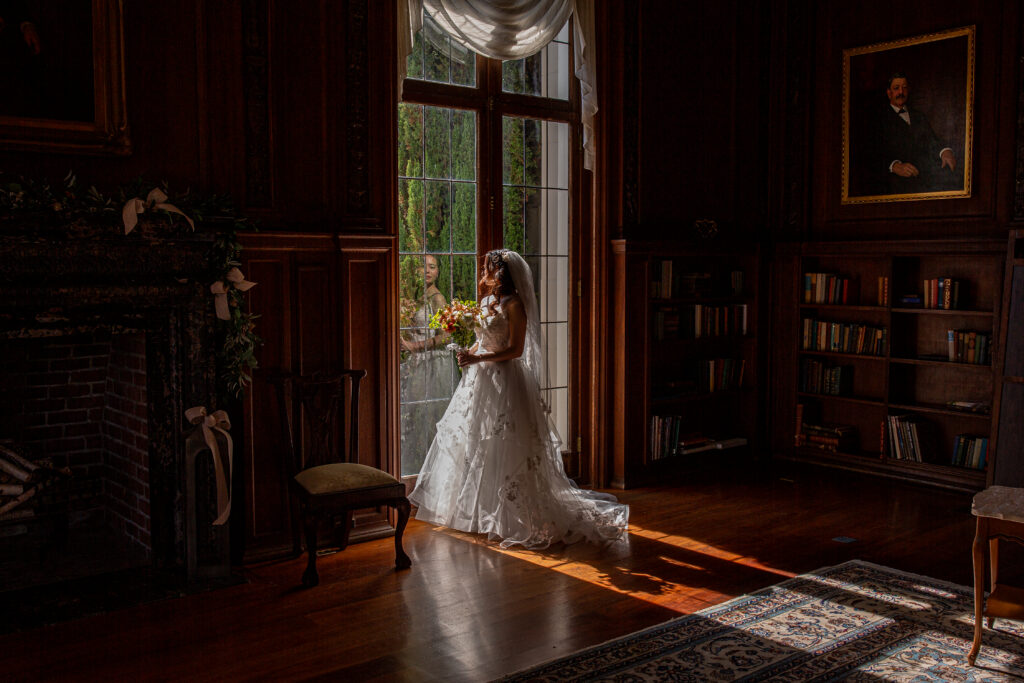
On the big day, Mina’s schedule started with hairstyling (Beauty by Thao) and makeup services (Looks by Hannah) together with her Maid of Honor and mothers. Then – get into her wedding dress, a study in understated elegance with a luxurious veil, supported by her bridal party….
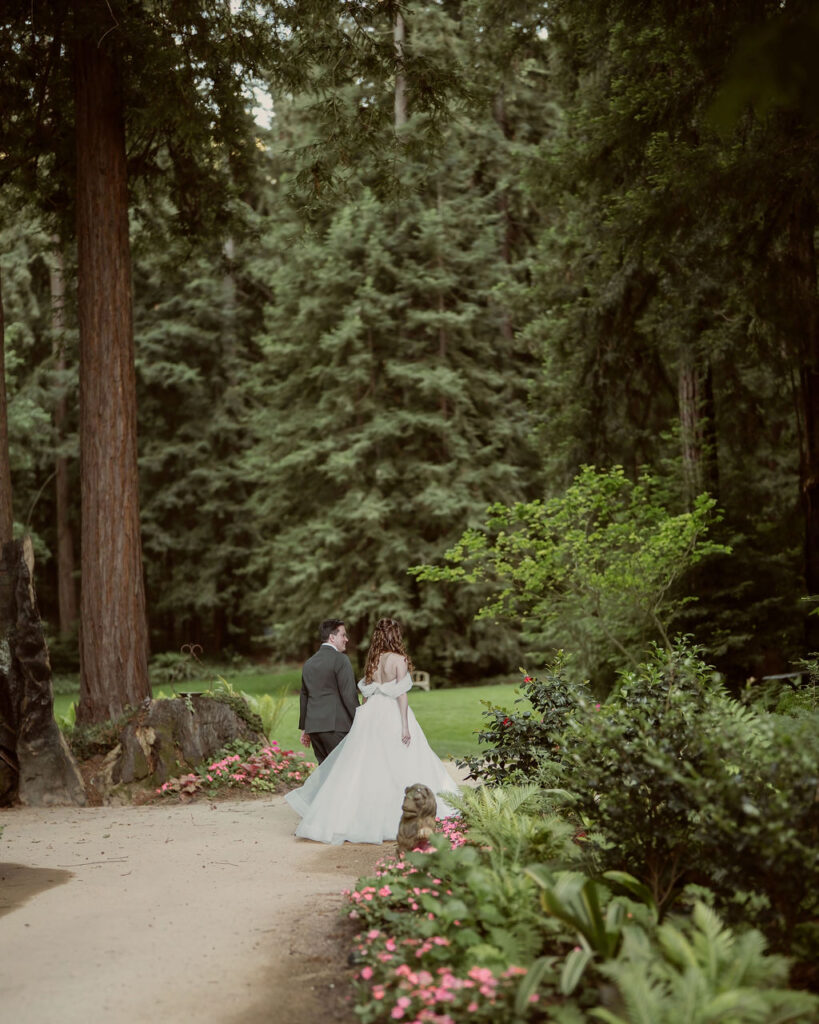
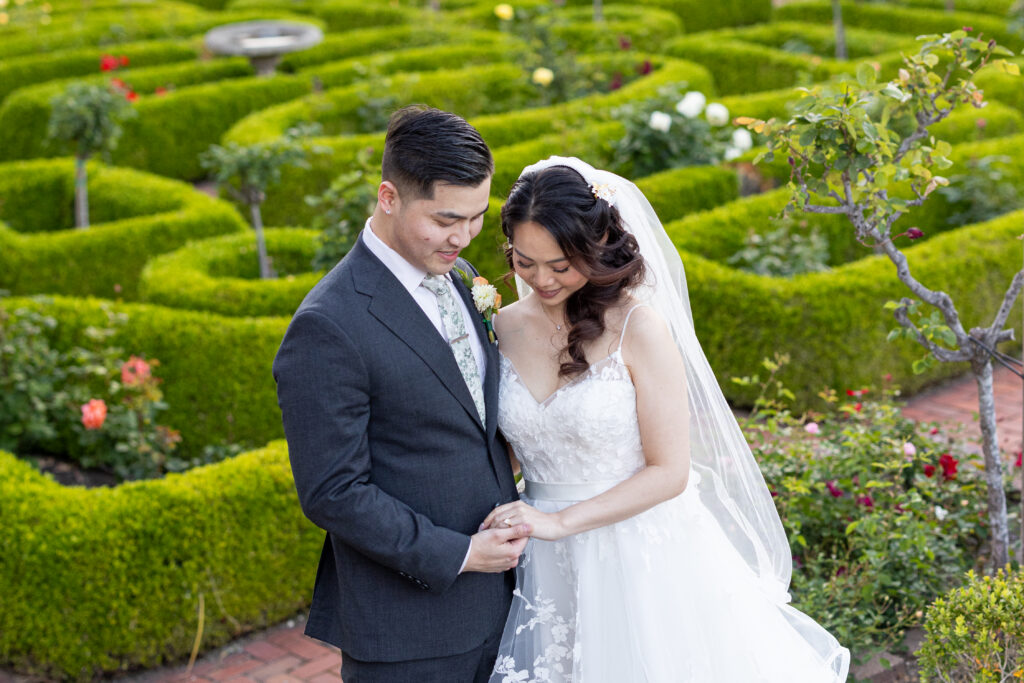
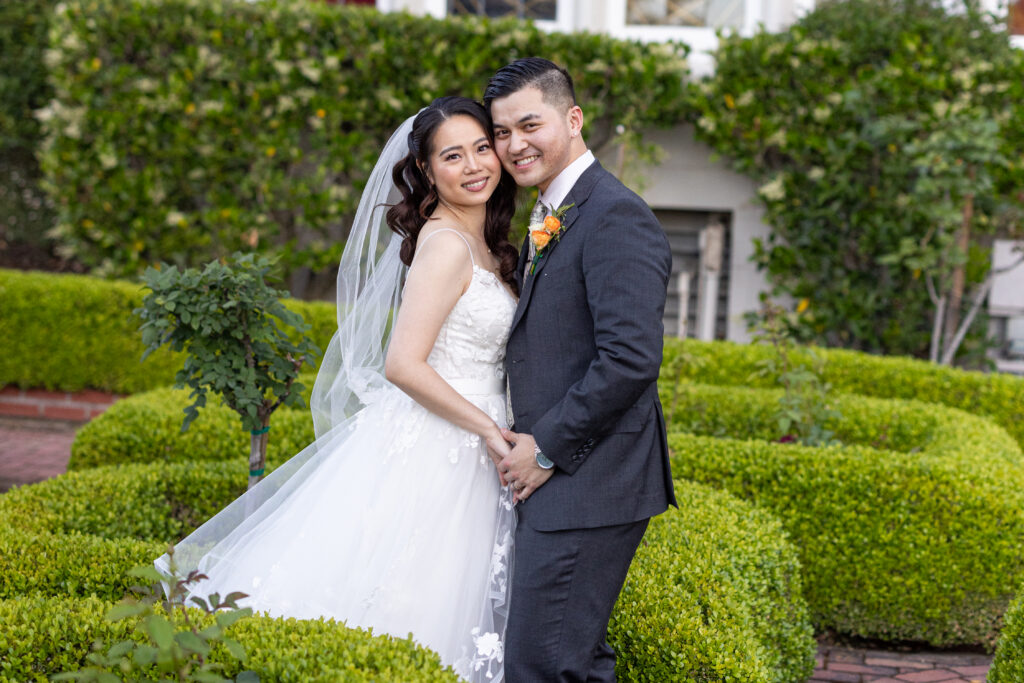
… at their elegant wedding venue, the historic Kohl Mansion in Burlingame – a Tudor-style mansion surrounded by formal gardens in full bloom.
Behind the scenes, the Kohl Mansion house manager team had set up all the furniture and prepared the venue for the big event.
The ceremony, with music by Bay Fine Strings, took place in the protected Courtyard, officiated by Alex’ father. There is no better proof of the support of both families for this union – and as you can see, ring bearer Merlin performed his duties with verve and grace. Truth be told, he was the true star of the whole affair!
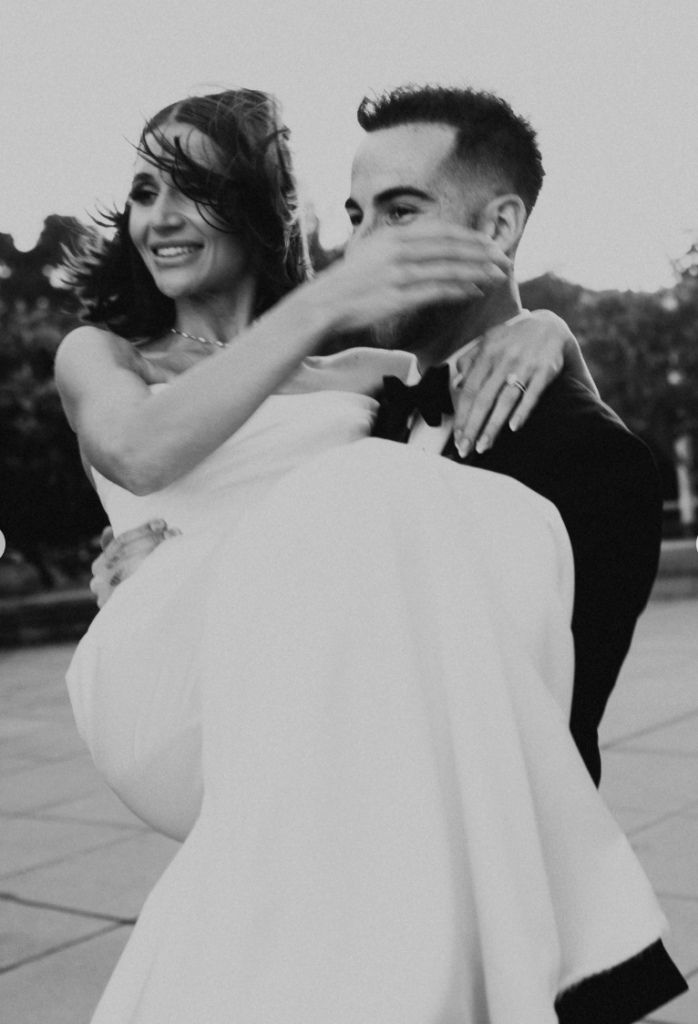
Just married!!
Now: photo time with Merlin ….
… and also… without Merlin who had to go home before dinner was served.
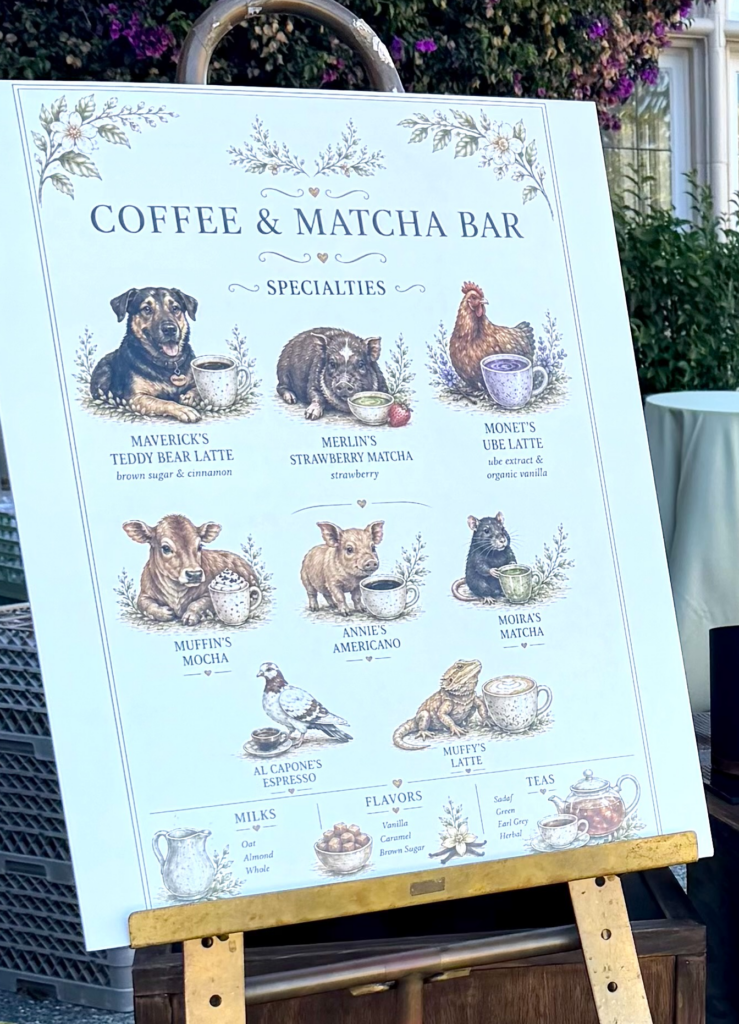
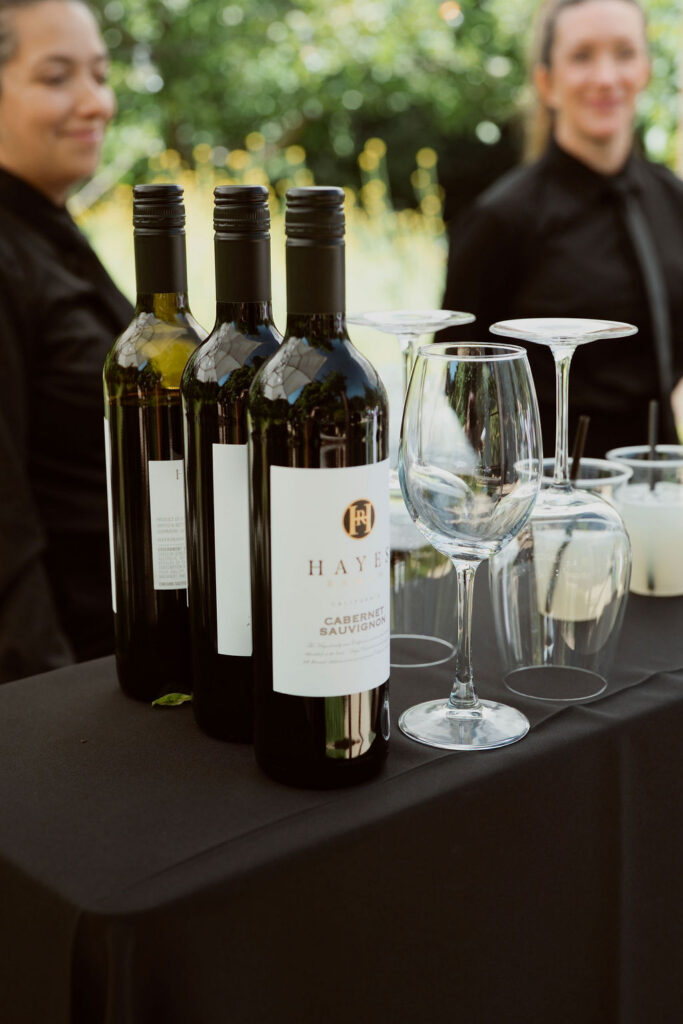
All the while, guests were treated to cocktails (by Mexcalito Bar Services) and coffee by Revival Espresso, with Mina’s and Alex’s menagerie presenting the bar menu!
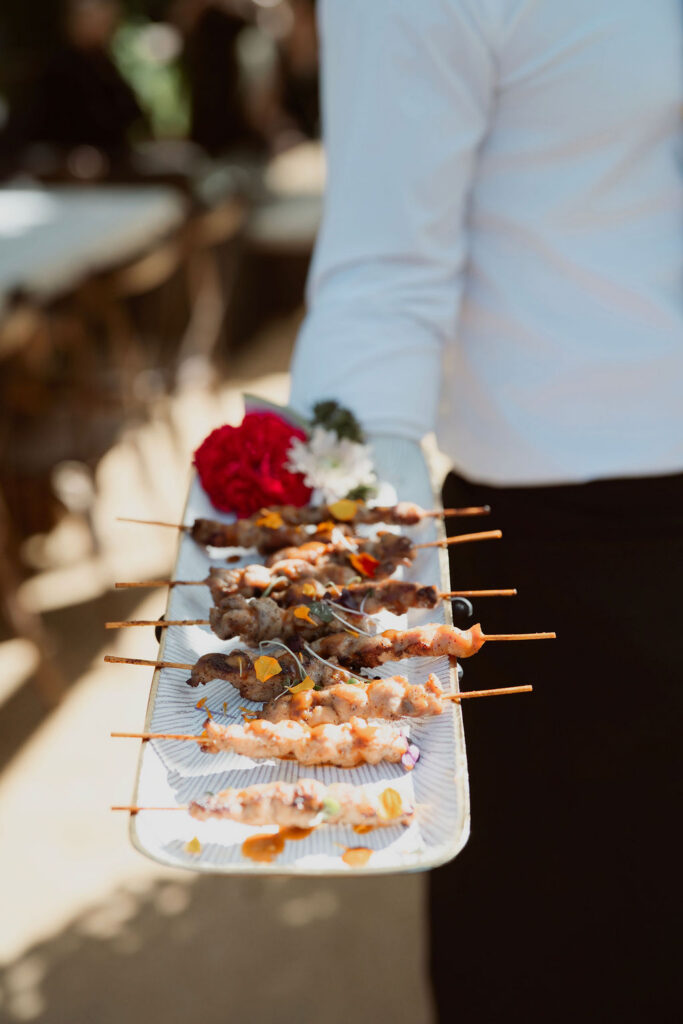
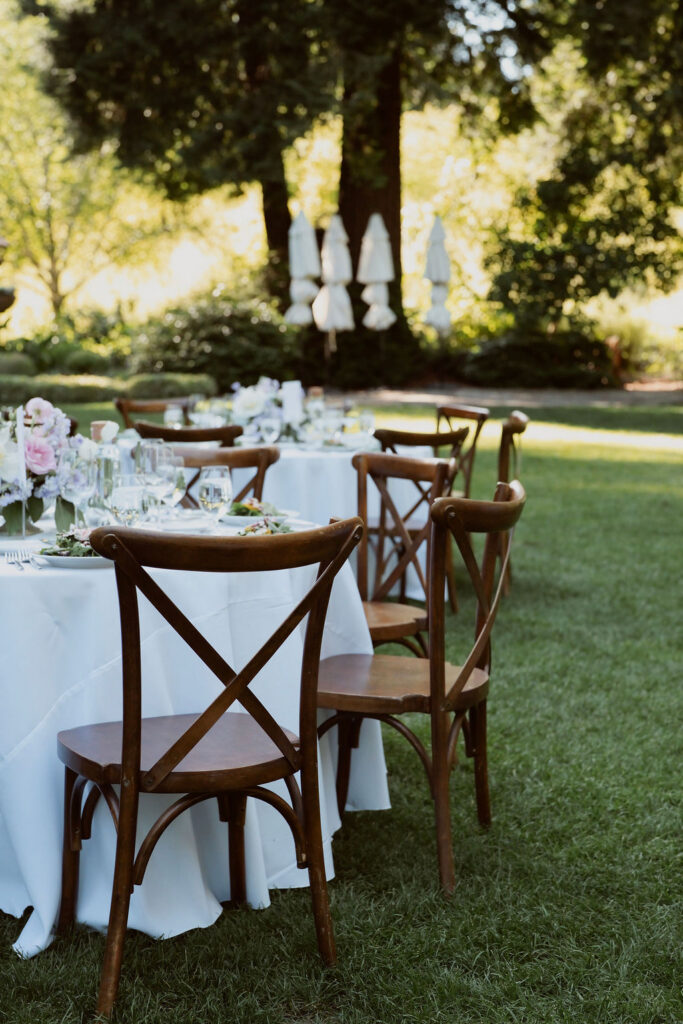
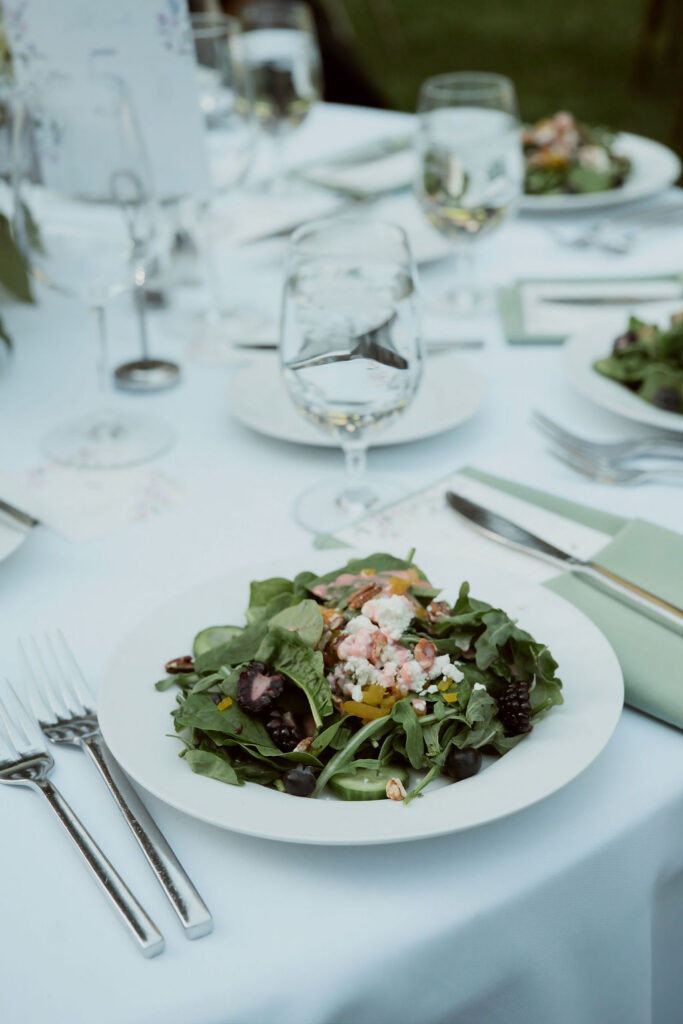
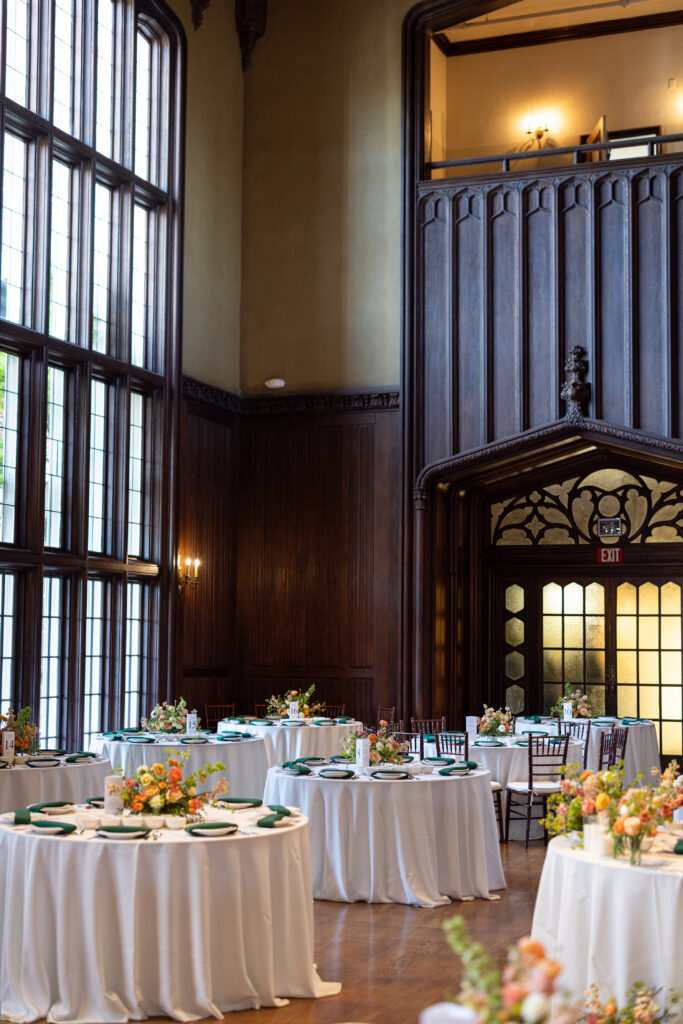
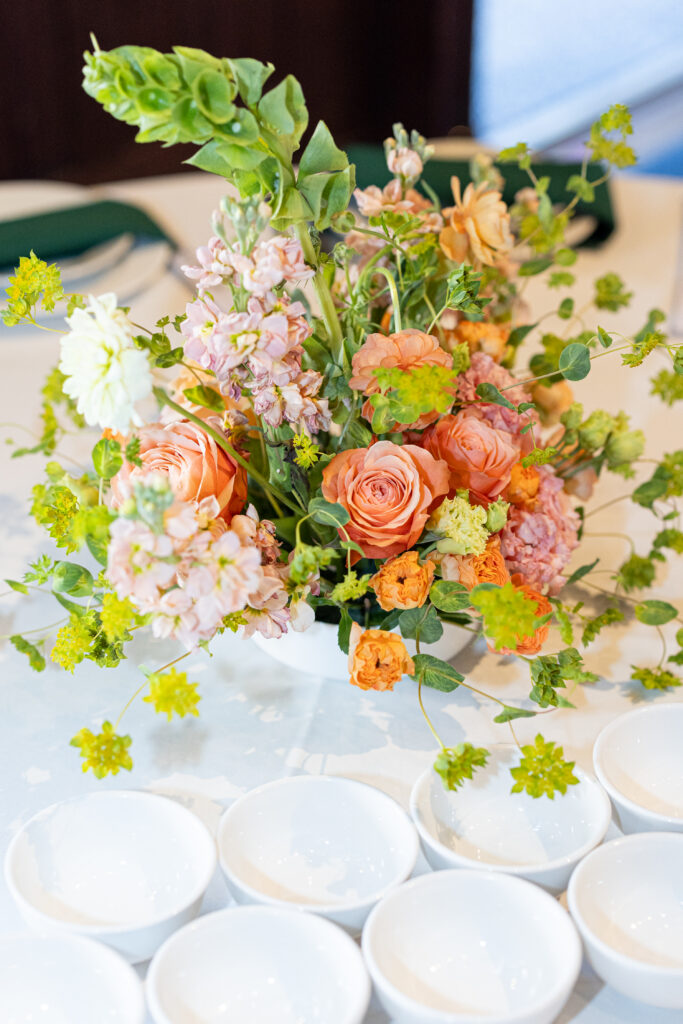
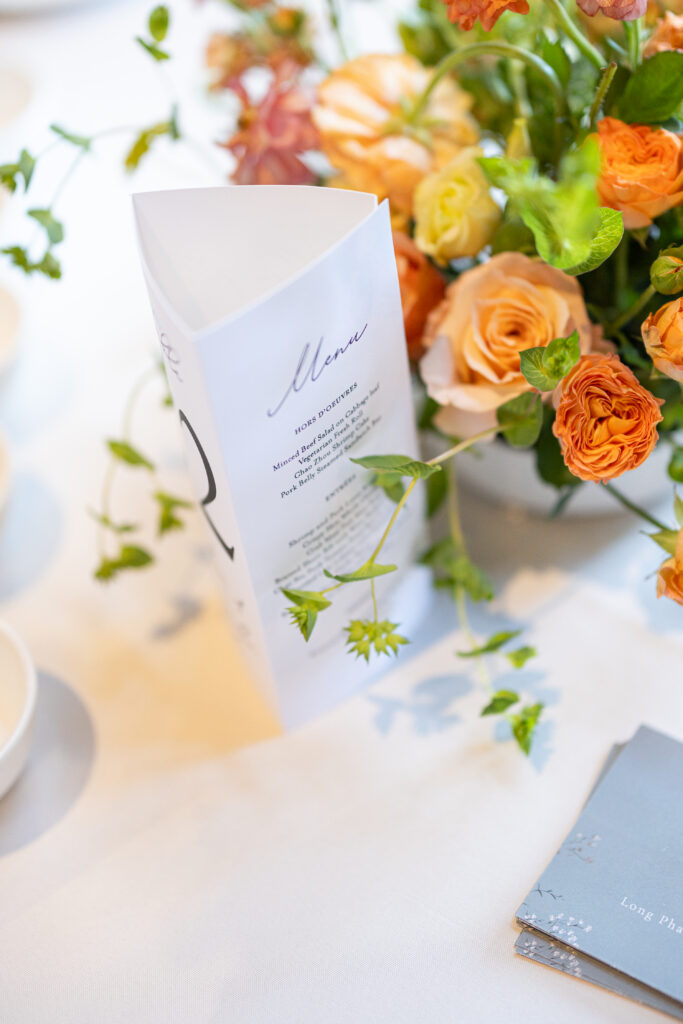
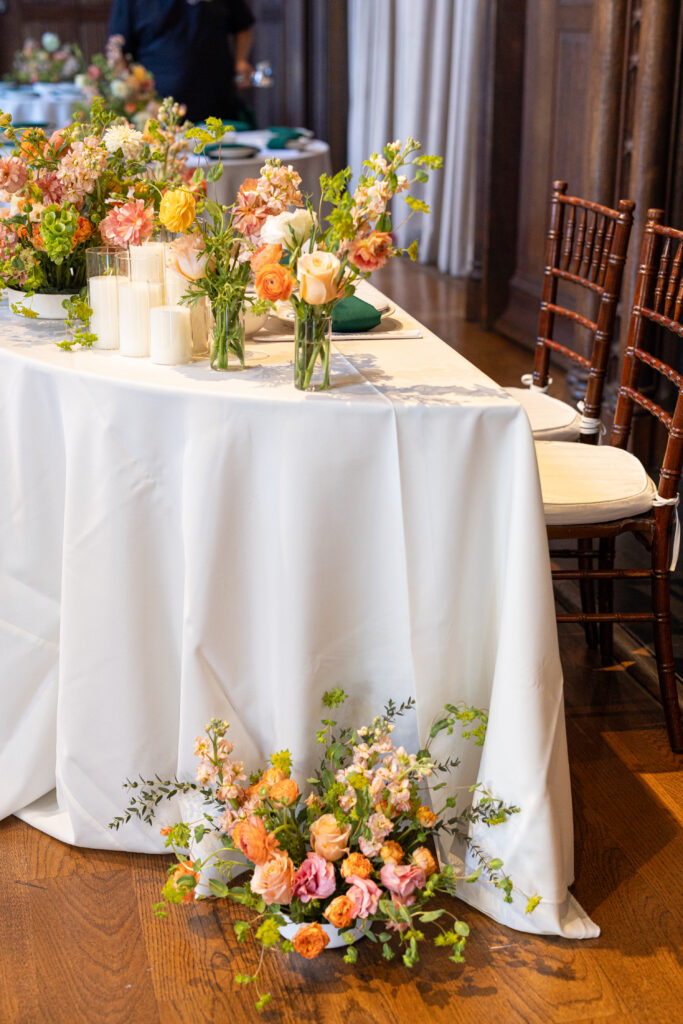
Of course, there were also small bites (by Espostos Catering), and the guests were still serenaded by the string trio; while Espostos catering set our dining tables with beautiful rental items (by YPR and Hensley Event Resources) – with stunning floral centerpieces as the focal point.
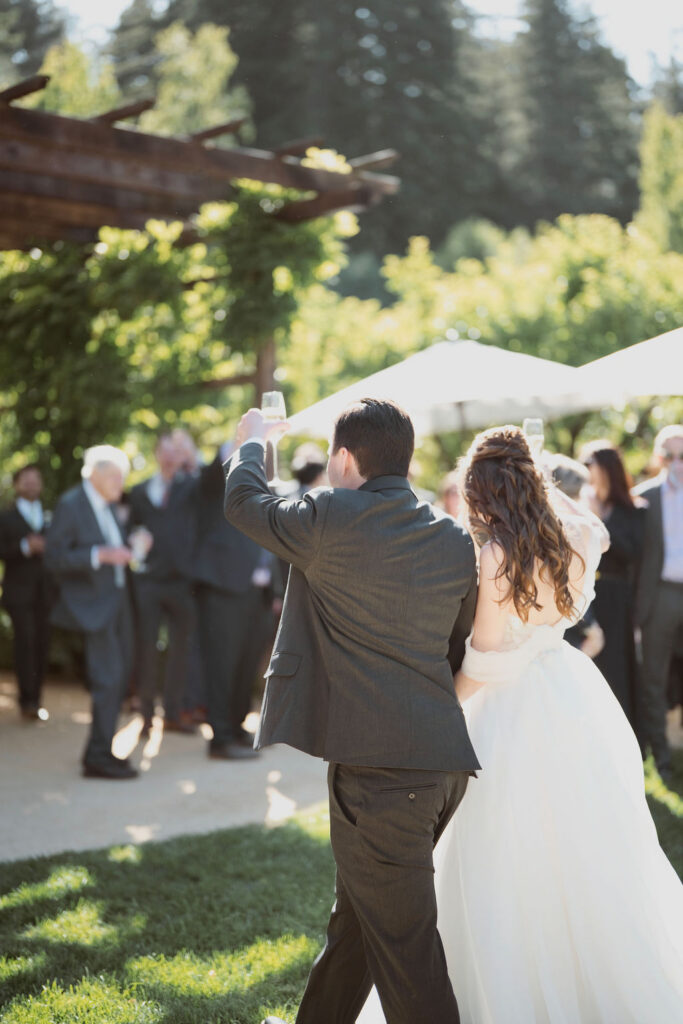
After their Grand Entrance…
… and once guests were well into the (vegetarian!) dinner for this animal-loving wedding party, it was time for Mina’s and Alex’ big reveal: they showed a video about their REAL wedding!
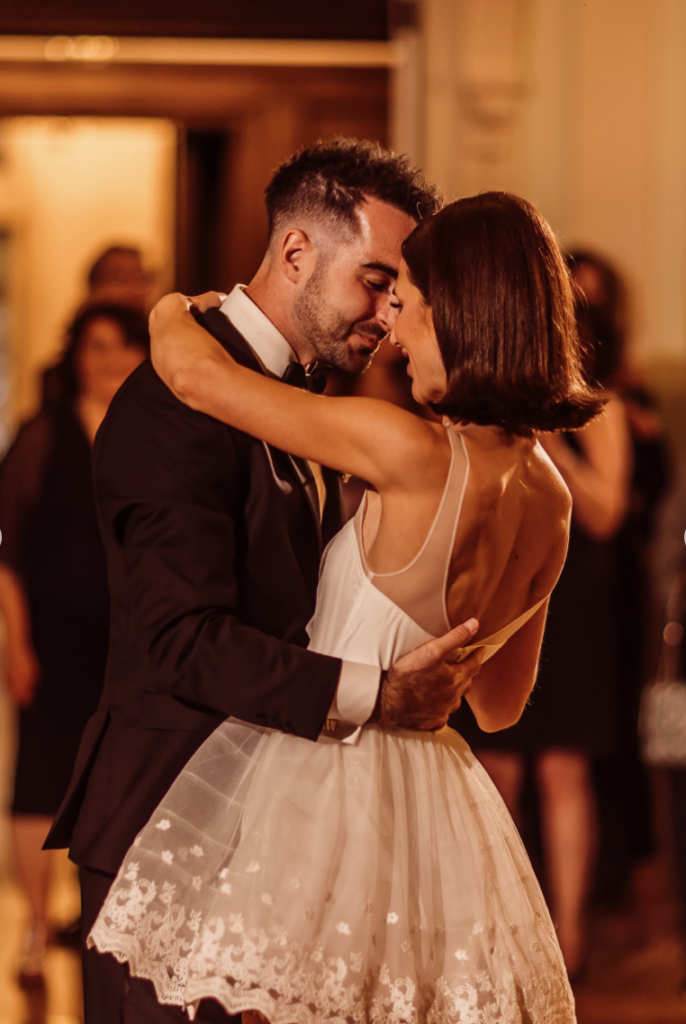
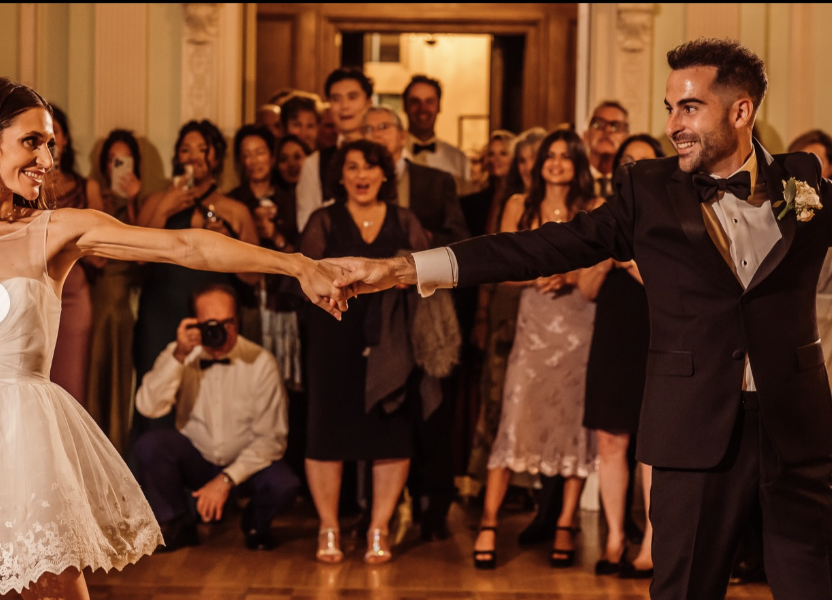
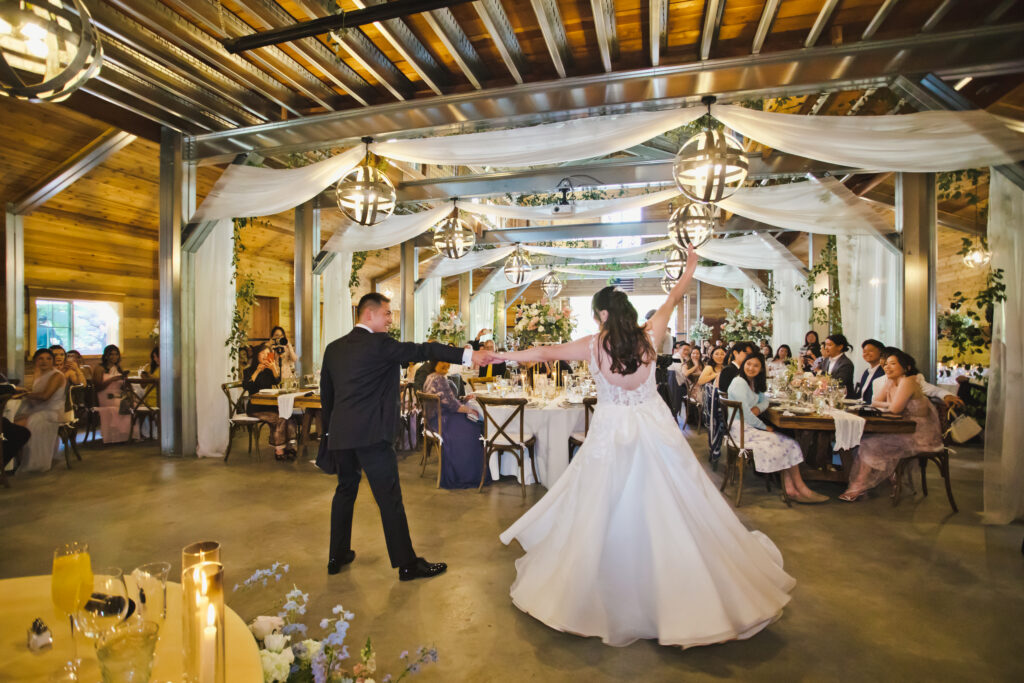
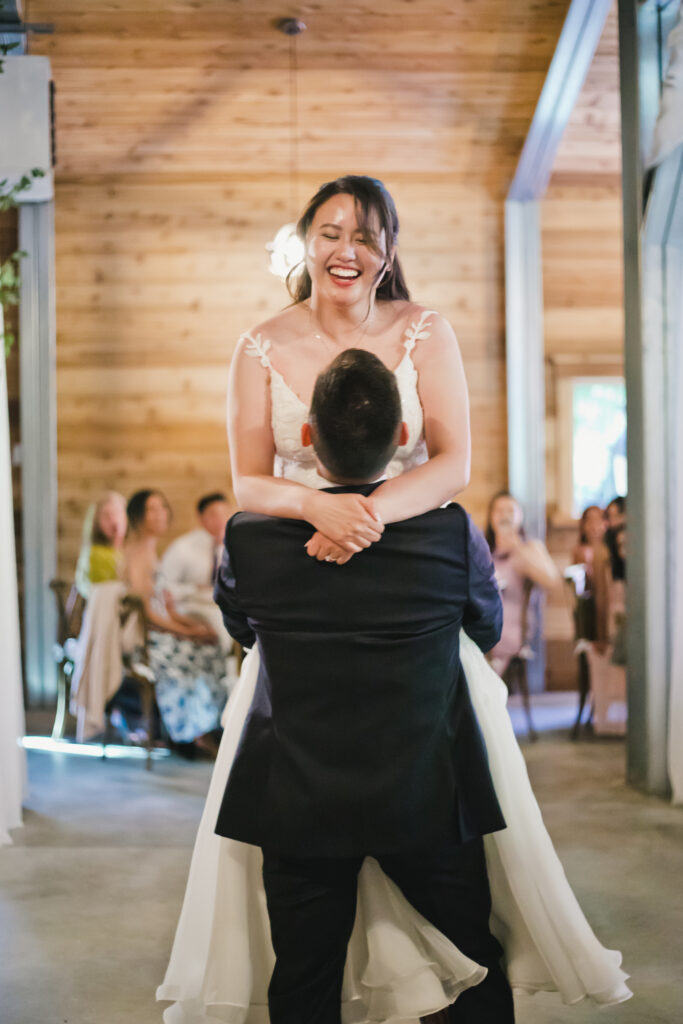
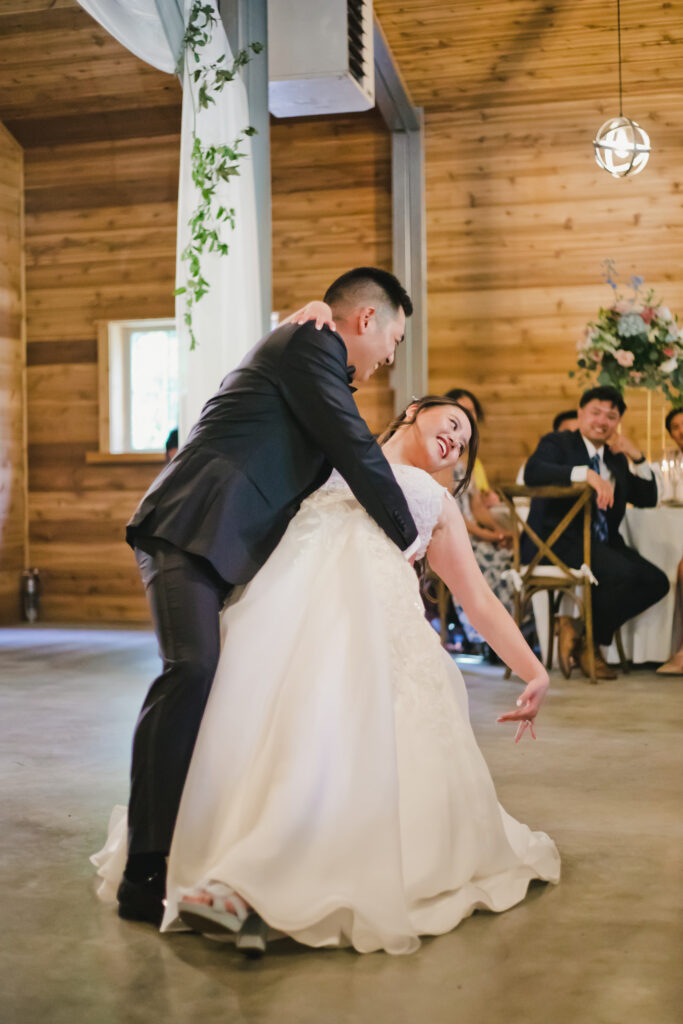
What came next? Their First Dance as “official” newlyweds!
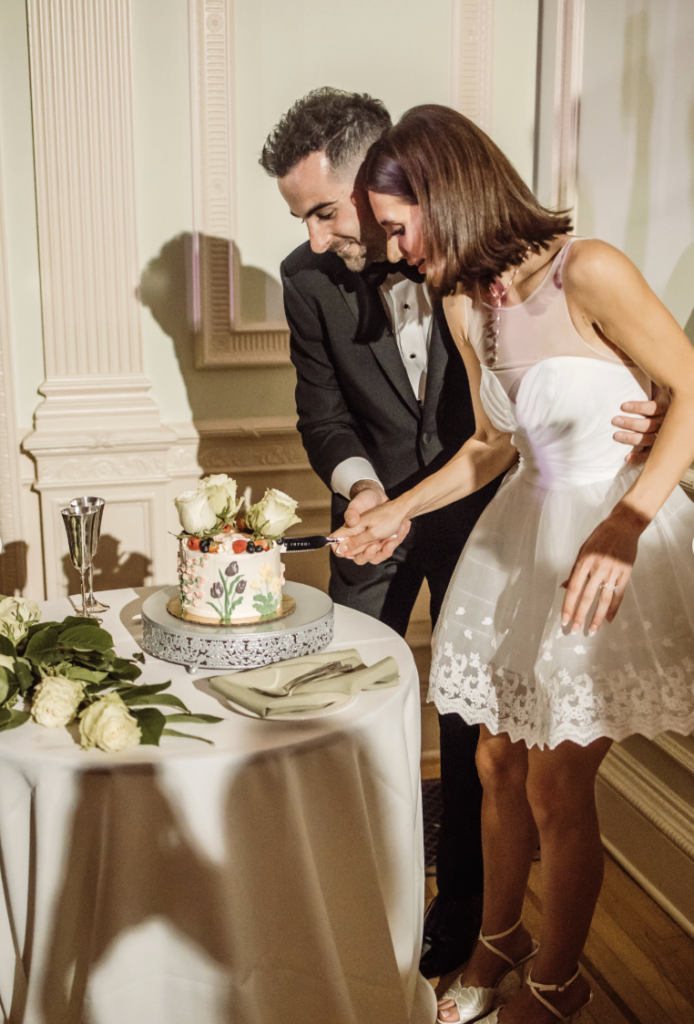
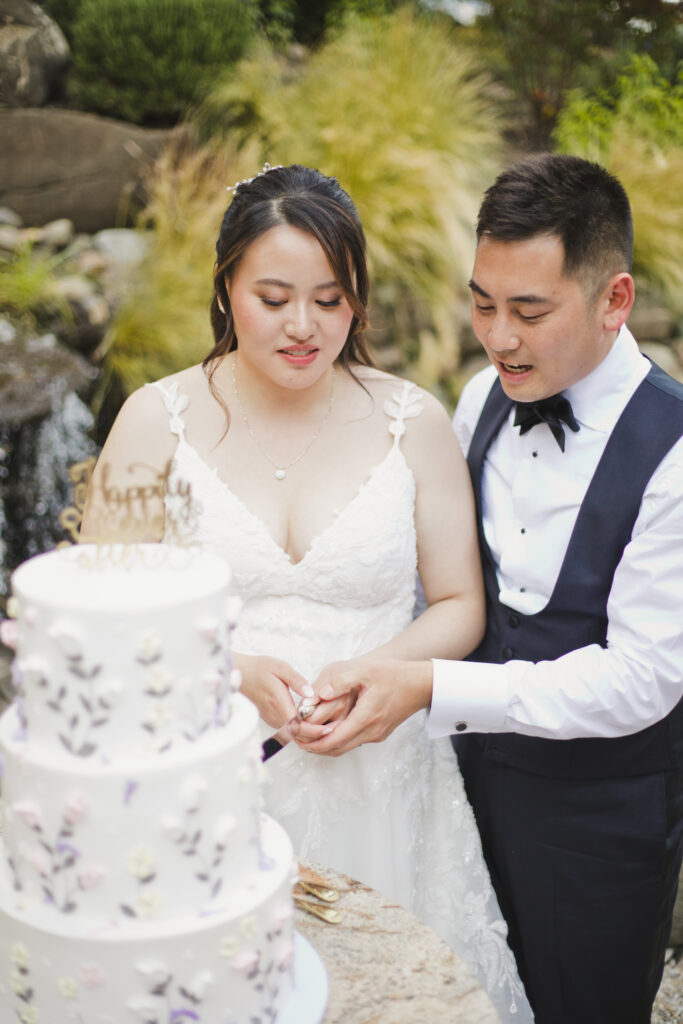
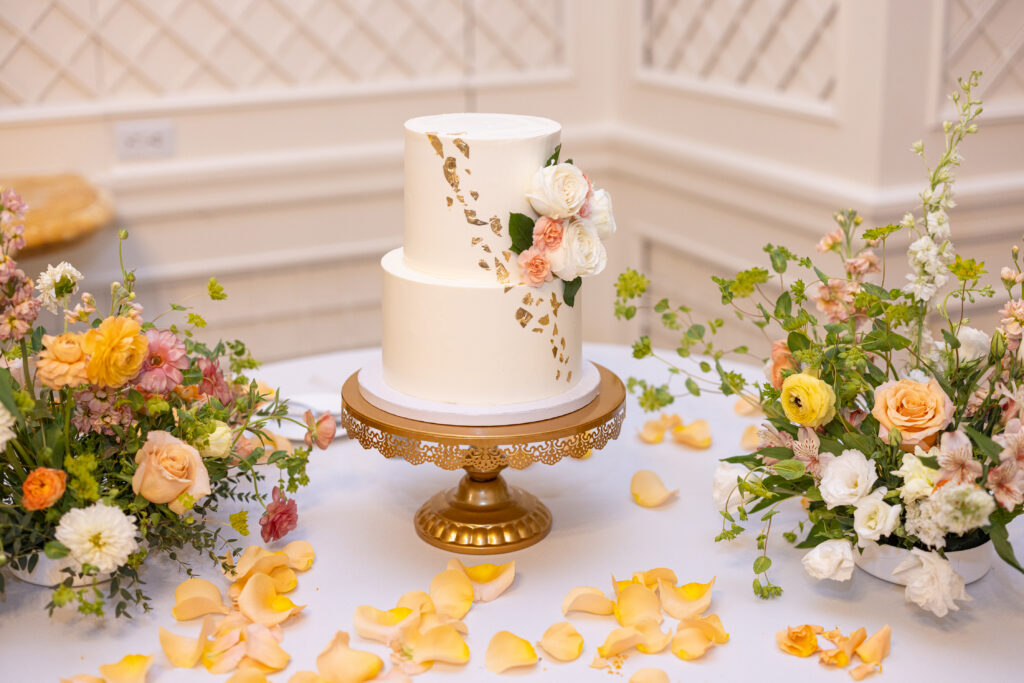
… AND cut her (vegan) cake!
So… would you agree that this was a totally, absolutely one-of-a- kind wedding?! Mina and Alex are happy!
We wish you that your happiness will only grow over time, surrounded by all the animals you are going to rescue!
As you can tell, “K” and “E” are VERY private people. They chose a gorgeous venue in the Redwoods – Nestldown Estate – not only for its natural beauty, but also for its absolute privacy. They wish to be referred to only by their first initials. They don’t want to be shown “front and center” – but they have graciously shared a lot of images from their Big Day. Get inspired!
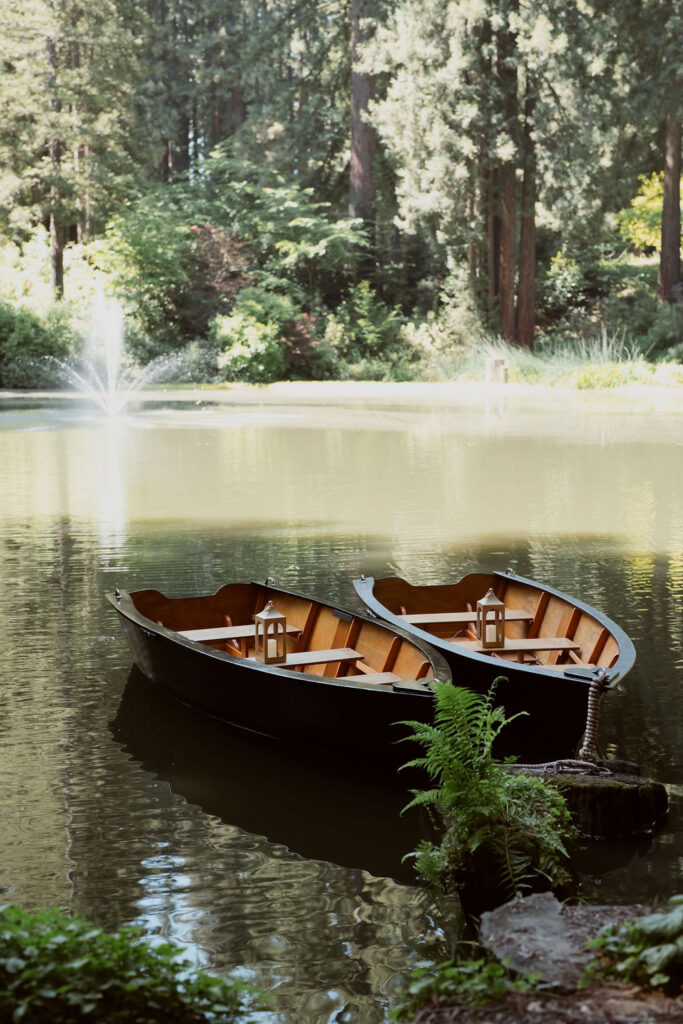
A romantic pond with a fountain… Nestldown is really a totally secluded fairytale setting.
While bride and bridesmaids were receiving beauty services by Tiffany of Design Her Image…
… and the groom and his groomsmen were dressing up …
… photographer Karly captured every precious moment AND every pretty detail!
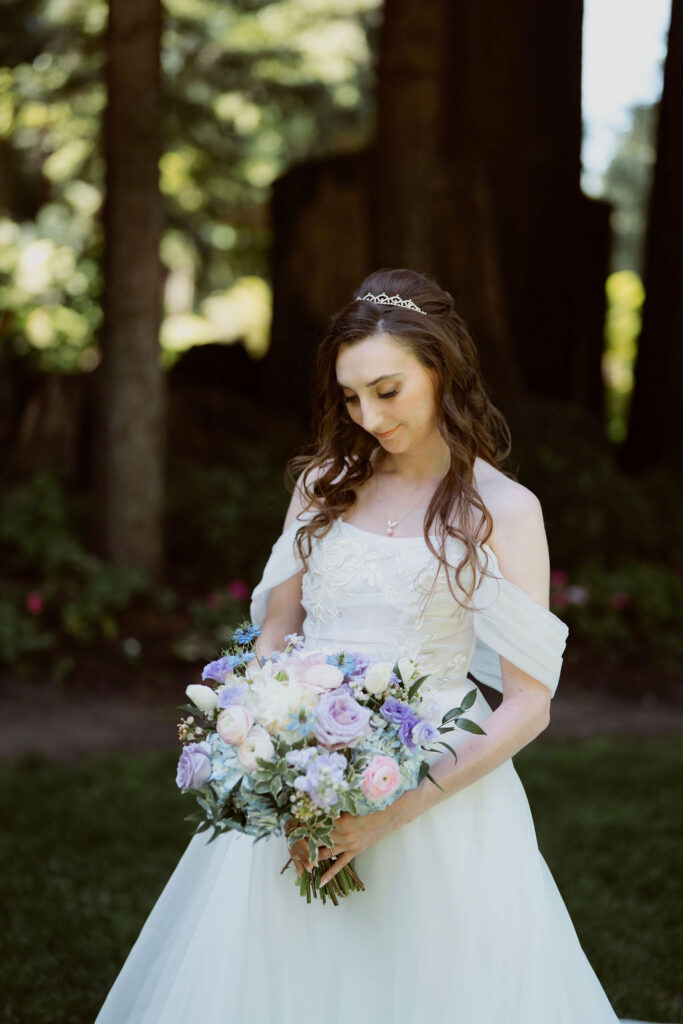
The bride absolutely LOVED her bouquet!
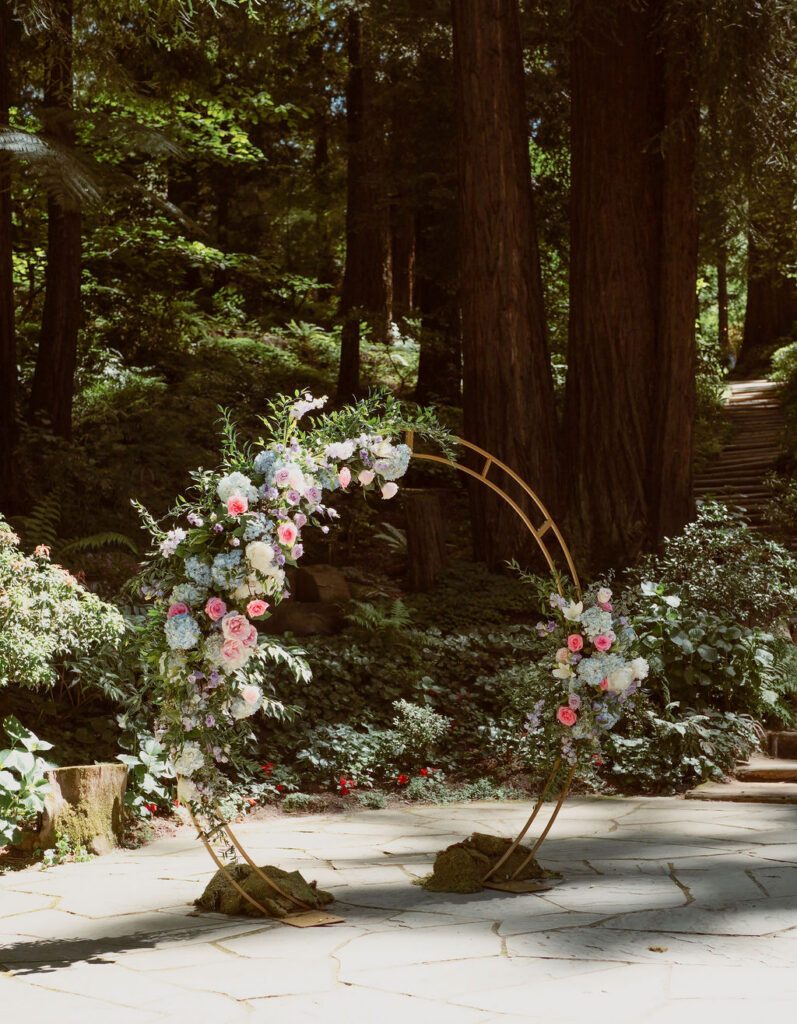
All vendor teams were already busy to get ready for the big celebration: the Nestldown team set everything up for ceremony, cocktails, dinner and dancing; florist Marie of Laurel & Vine brought in and installed the most beautiful floral arrangements and a circular gilded arch; the Continental Caterer team took over the kitchen and cooked up a storm; DJ Paul of Big Fun Disc Jockeys got the sound systems for all event spaces going; our cake baker Christian of Krumbs Cakes was ready to deliver his confection, and officiant Minister Maggie got situated as well. All the while, my A Day Like No Other production team, Lisa and Narod, orchestrated and organized it all from “behind the scenes.”
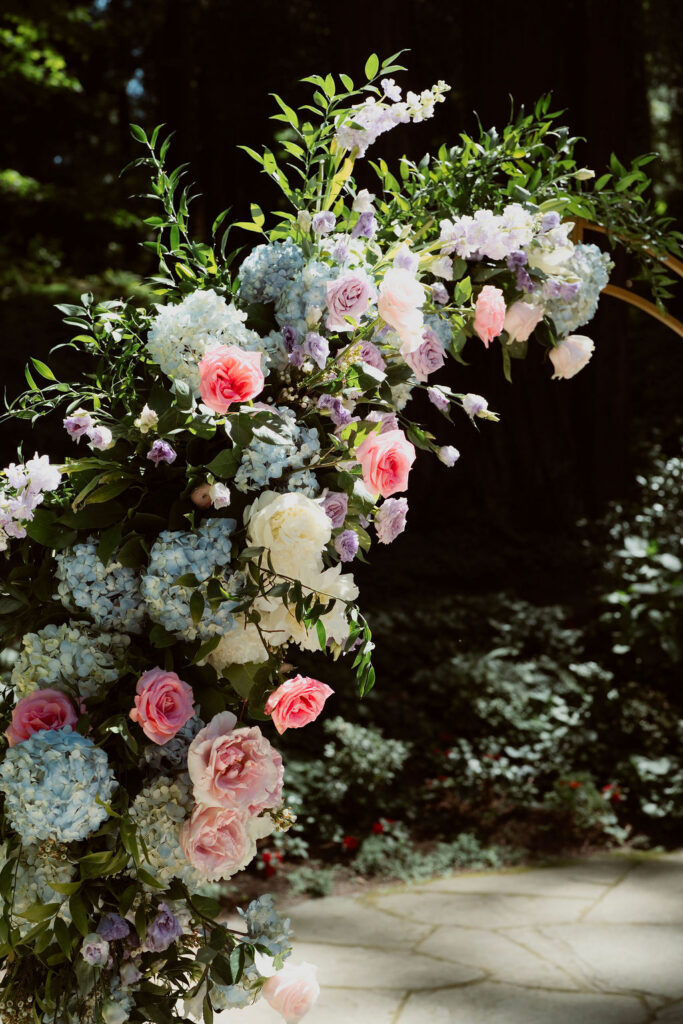
The pastel flowers on the arch looked like right out of a painting – nearly unreal!
Once bride and groom had arrived at Nestldown, it was time for their First Look, followed my many couple’s portraits.
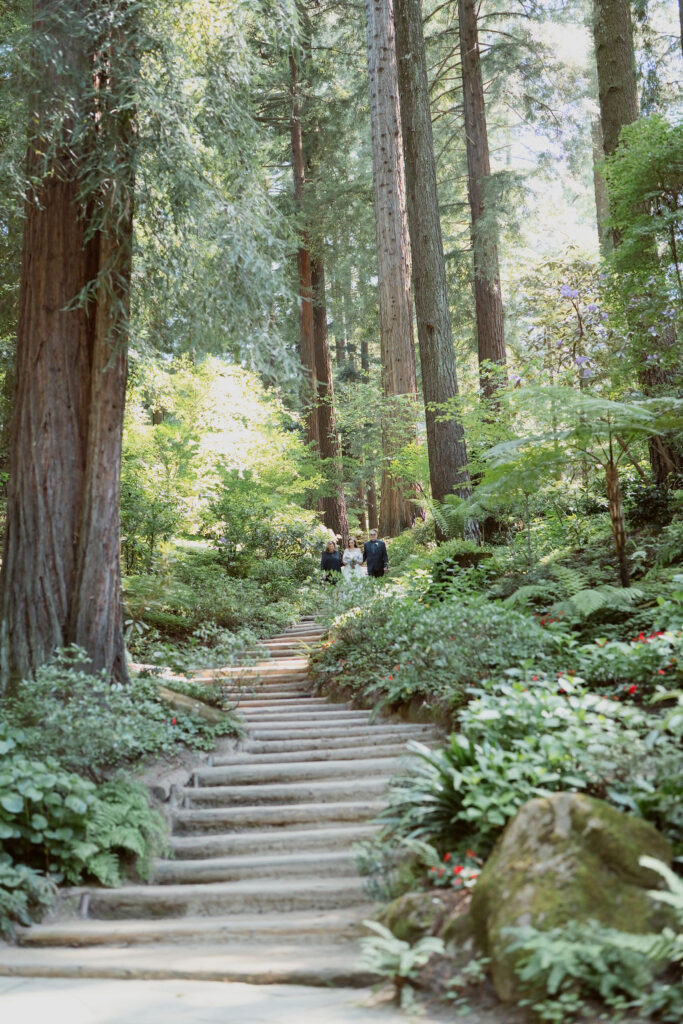
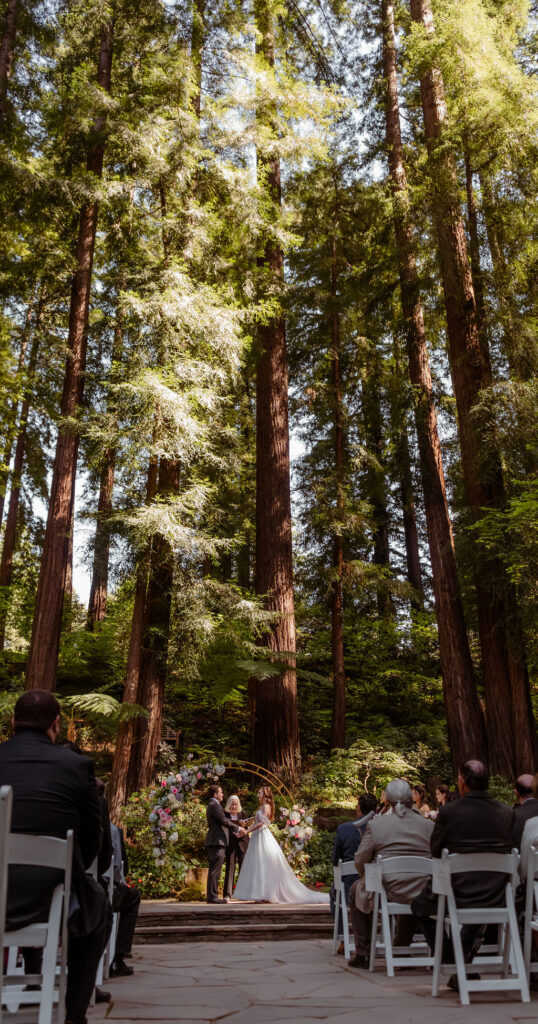
Time was literally flying, and guests were arriving for the wedding ceremony in the Redwood “Chapel.” The bride entered on the longest aisle EVER, coming down the hill, accompanied by both her parents.
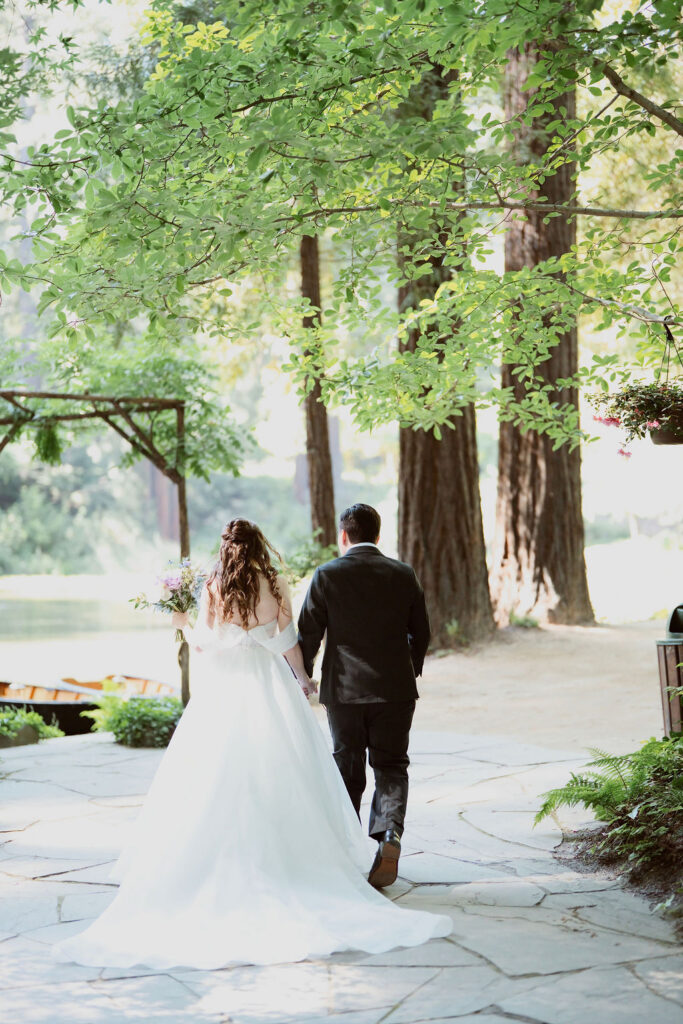
Here comes the bride!
There is no more dramatic setting to say one’s vows…
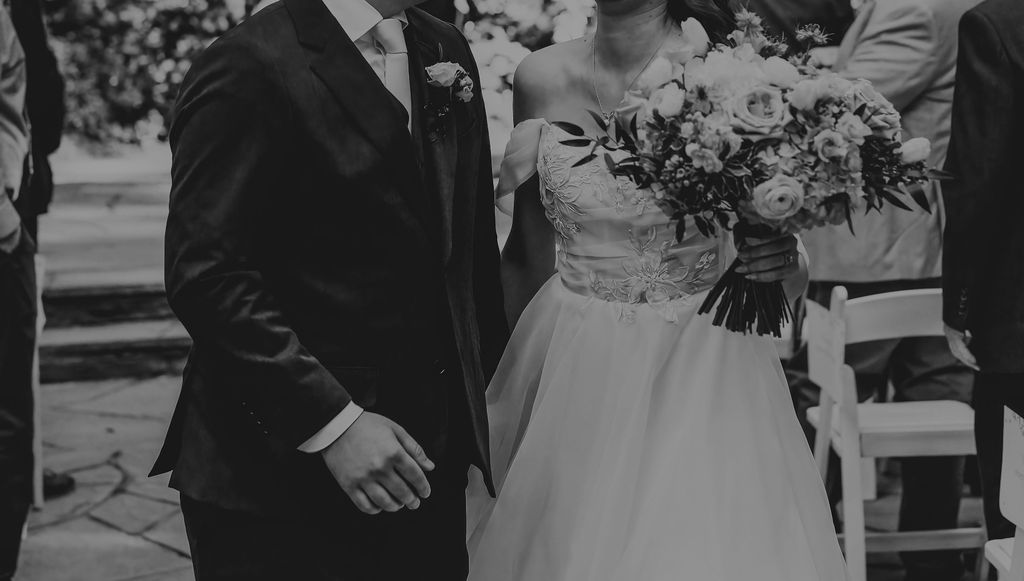
Just married – timeless in b&w…
After the ceremony and following the obligatory family photos, it was party time for everyone!
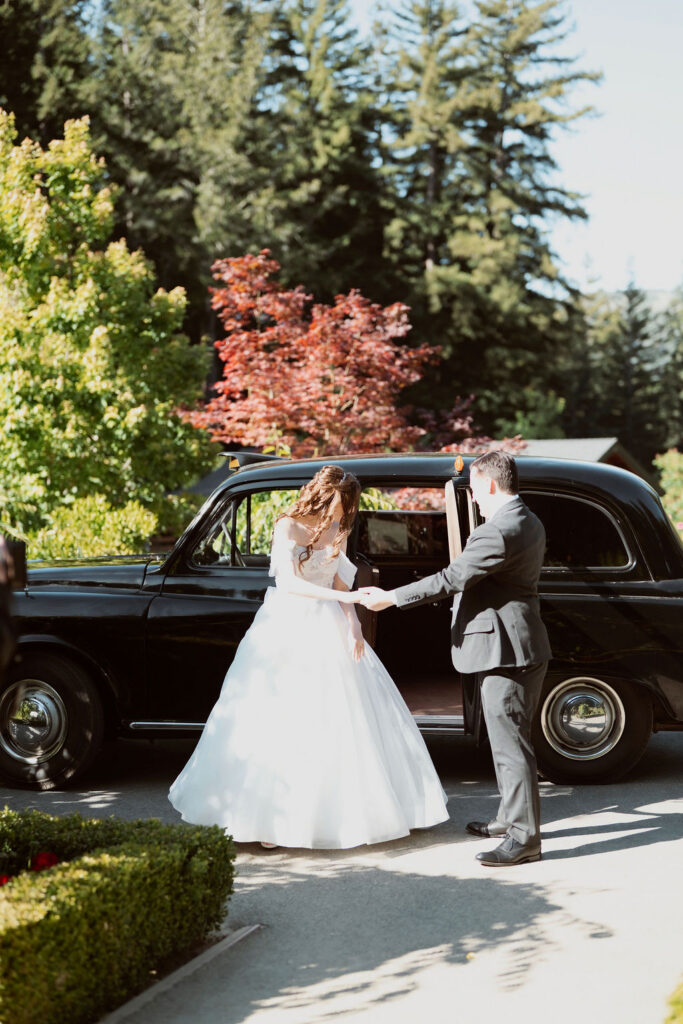
The famous London Taxi was waiting to take the newlyweds to Cocktail Hour…
… and here they are!!
In addition to bar and hors d’oeuvres….
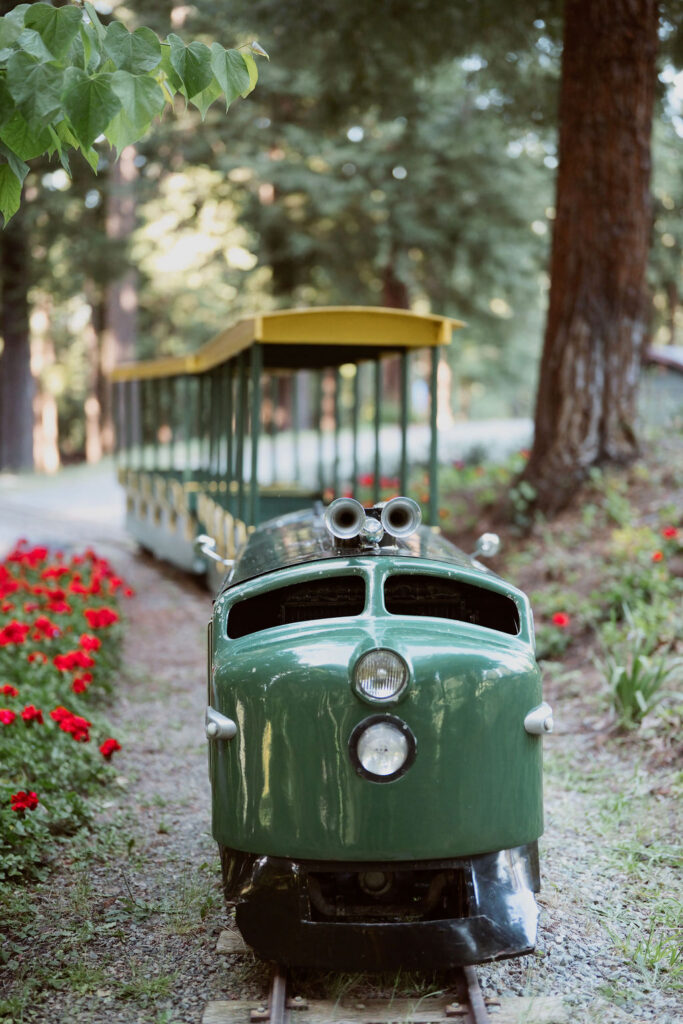
… guests were free to explore all the whimsical features of Nestldown – the lifesize train for joyrides…
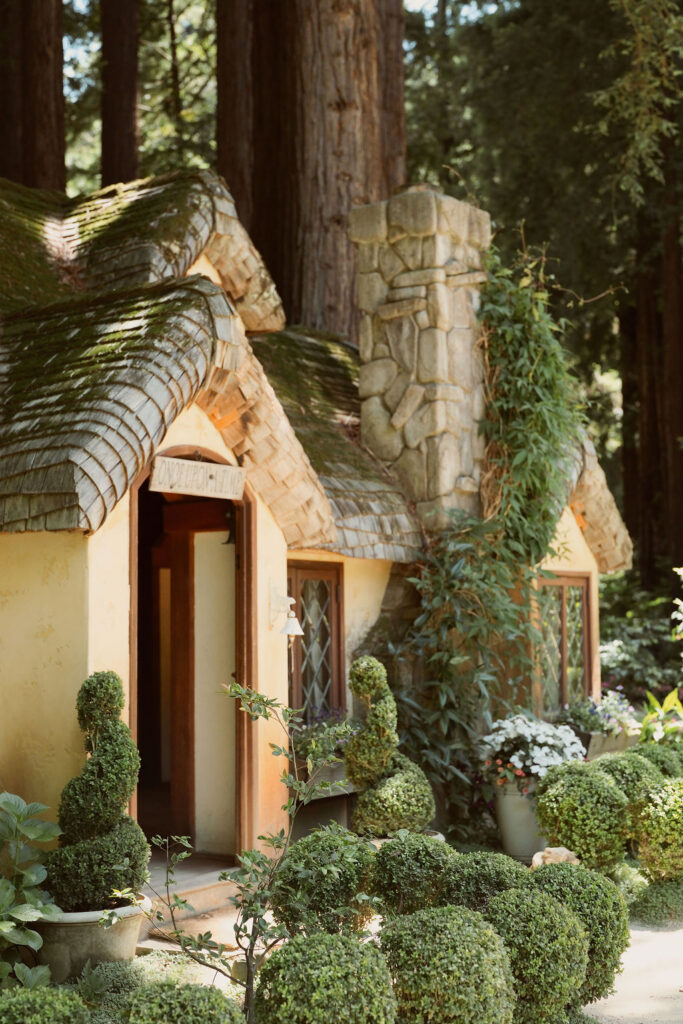
… the Fairytale Cottage…
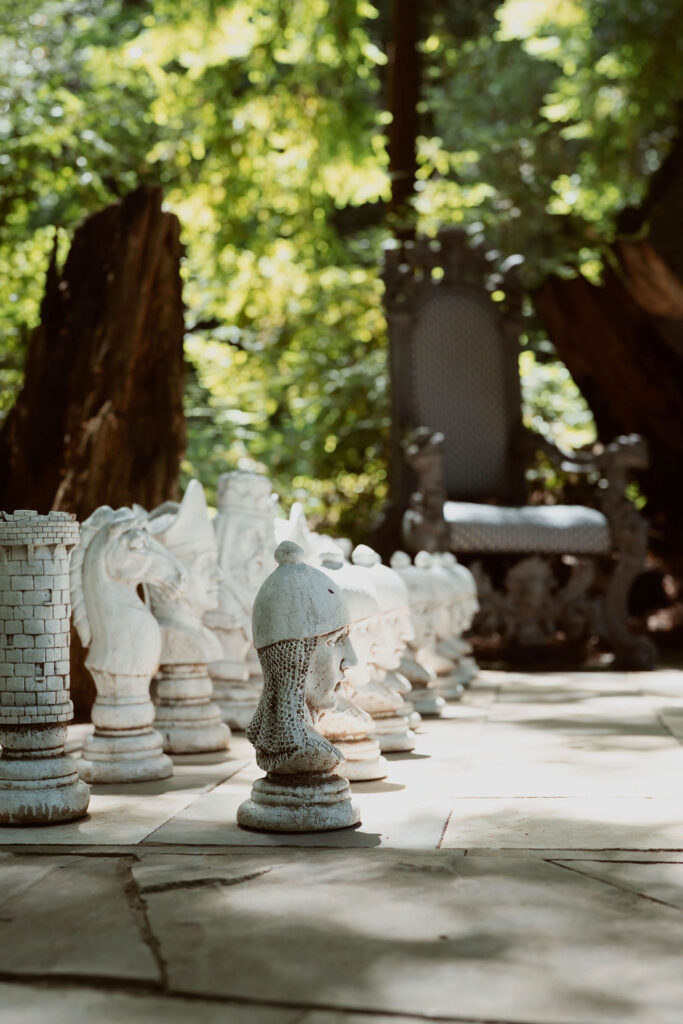
… the life-size chess set…
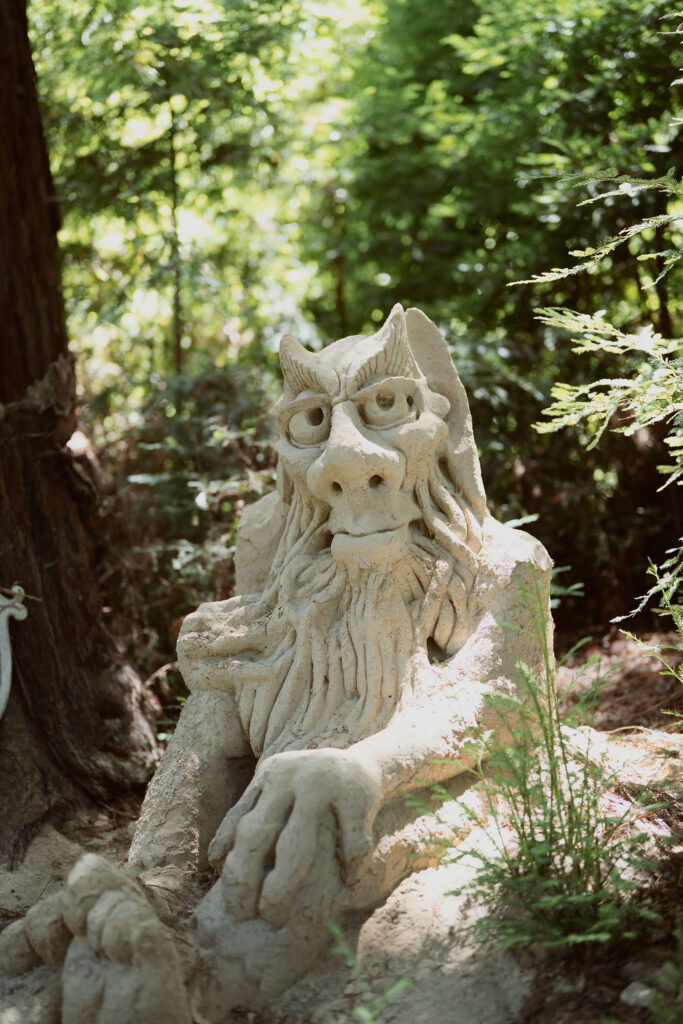
… and countless statues of mythical monsters and gargoyles!
Next: dinner time on the Main Lawn, surrounded by towering Redwood trees…
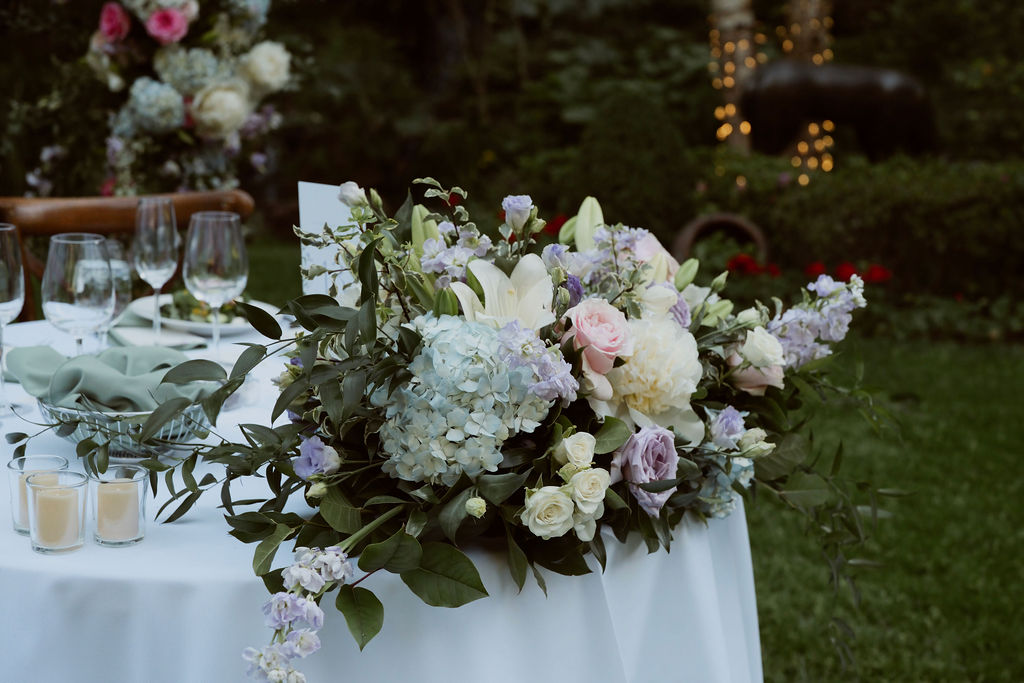
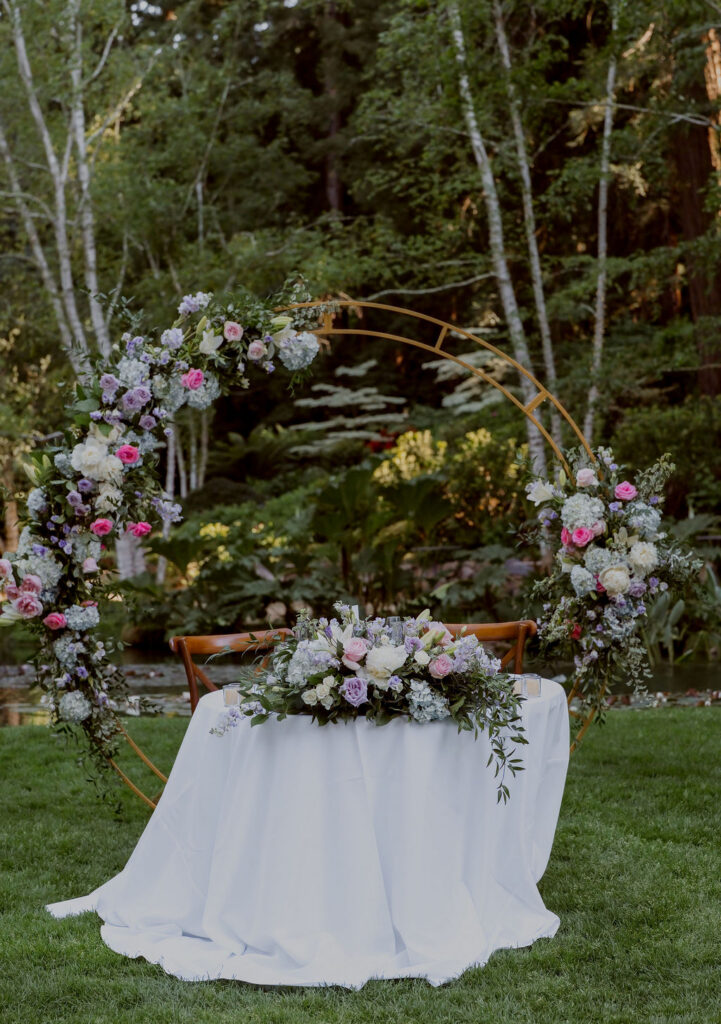
… and with a VERY festive Sweetheart Table in front of the Koi Pond.
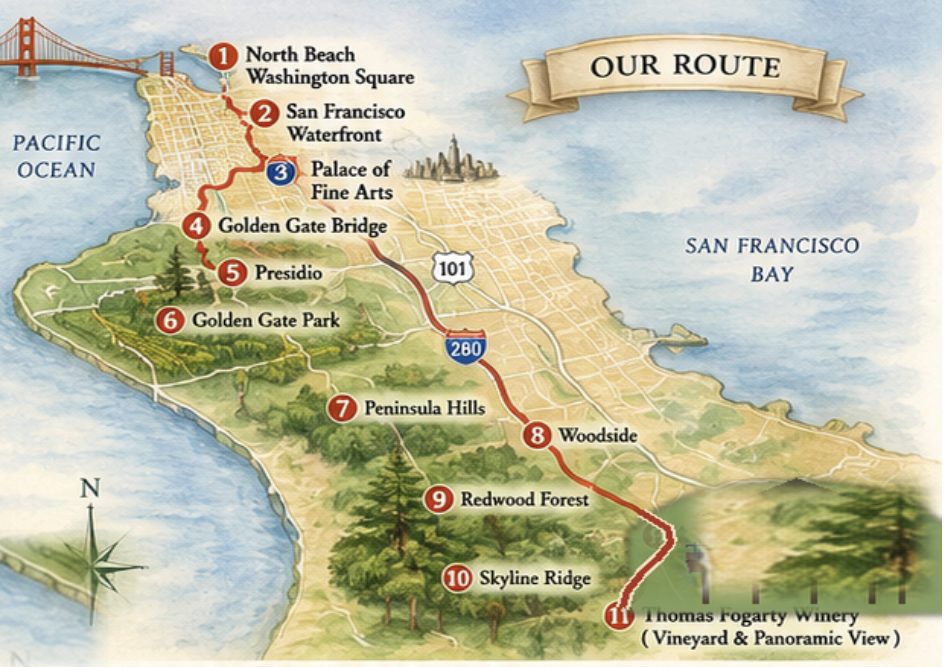
Wedding Reception Shuttle • Saturday, September 12, 2026 Depart Saints Peter and Paul Church 2:30 PM • Arrive Thomas Fogarty Winery 4:00 PM
Painterly route map created especially for this tour. Landmarks are shown schematically rather than to navigational scale.
“The ceremony may be behind us. But the celebration most certainly is not.”
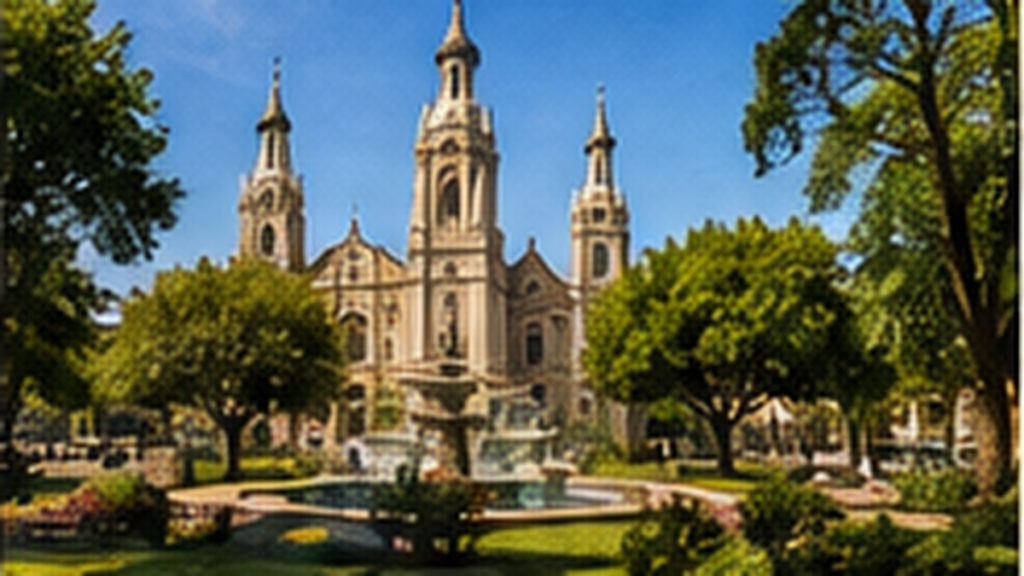
NORTH BEACH & WASHINGTON SQUARE
Original painterly illustration created for this guide.
Welcome aboard — and welcome to San Francisco.
As we leave Saints Peter and Paul Church, we are in the heart of North Beach, one of San Francisco’s oldest and most distinctive neighborhoods.
The open space beside the church is Washington Square, established in the 1840s and for generations the neighborhood gathering place of San Francisco’s Italian-American community.
North Beach became known as San Francisco’s Little Italy as Italian immigrants — many of them from the fishing villages of Liguria and northern Italy — settled here in the late nineteenth and early twentieth centuries. Italian restaurants, bakeries and cafés still line the neighborhood’s streets.
The church behind us, Saints Peter and Paul, has been a North Beach landmark for more than a century. Its twin towers are visible from across the neighborhood, and the church has long been closely associated with San Francisco’s Italian-American community.
Look around as we make our way toward the waterfront. This is quintessential San Francisco: steep hills, narrow streets, colorful buildings and, every so often, a completely unexpected view of the Bay.
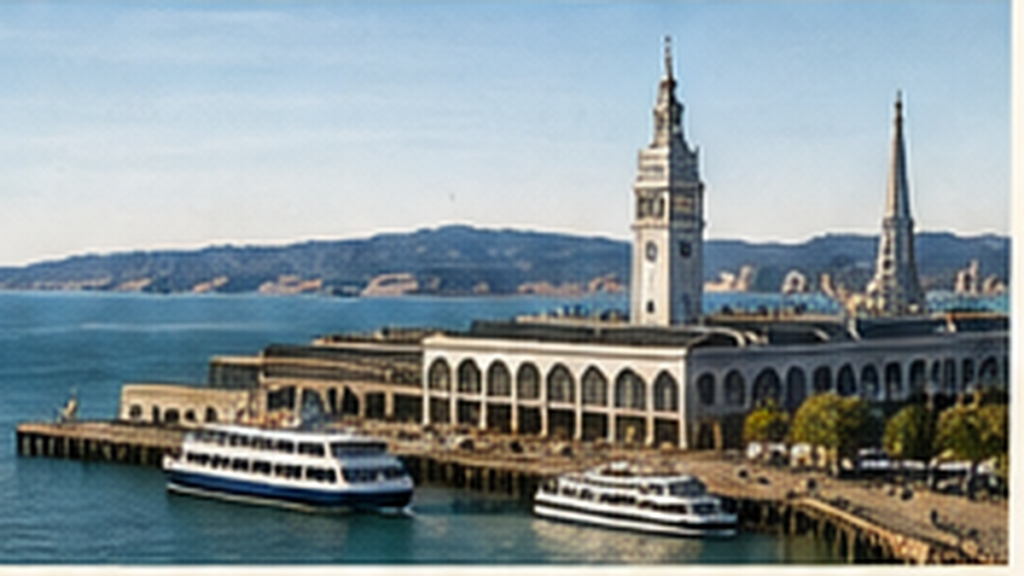
THE SAN FRANCISCO WATERFRONT
Original painterly illustration created for this guide.
We are now approaching the northern edge of the city and San Francisco Bay.
For much of San Francisco’s history, this waterfront was a working landscape — docks, warehouses, rail yards and military installations connecting the city with the rest of the Pacific world.
As we travel west along the waterfront, look out across the Bay. Depending on visibility and your position in the shuttle, you may catch sight of Alcatraz Island offshore.
Ahead of us is the Marina District, much of which was transformed for the Panama-Pacific International Exposition of 1915, a spectacular world’s fair celebrating both the completion of the Panama Canal and San Francisco’s recovery from the devastating earthquake and fire of 1906.
The exposition covered more than 600 acres along the city’s northern waterfront. It was filled with monumental exhibition halls, gardens, fountains and towers — an entire temporary city created for the fair. Almost all of it disappeared. But we’re about to pass one magnificent survivor.
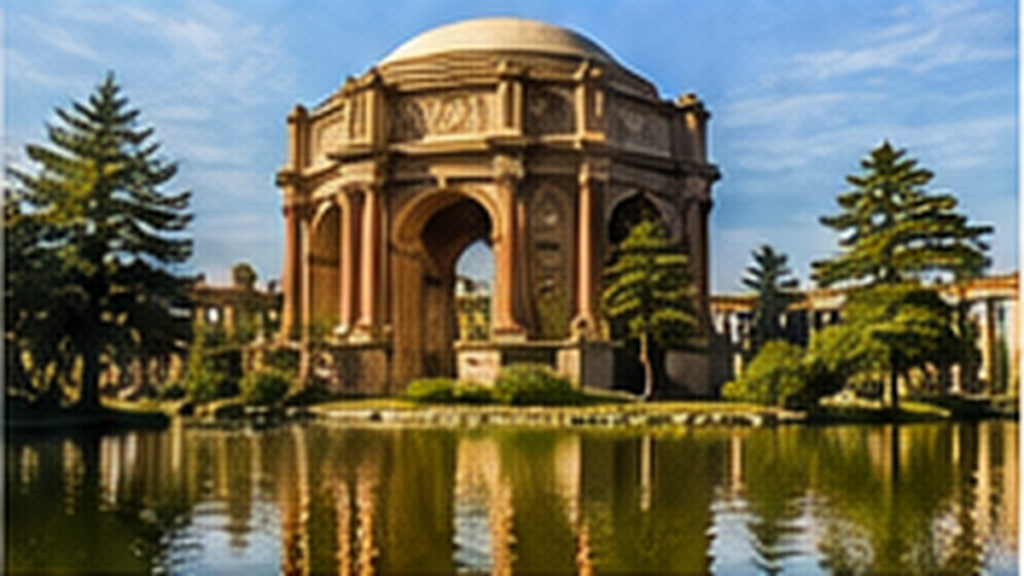
THE PALACE OF FINE ARTS
Original painterly illustration created for this guide.
Coming into view is the Palace of Fine Arts.
With its monumental rotunda, sweeping colonnades and lagoon, it can look as though a fragment of ancient Rome somehow landed in San Francisco. But the Palace isn’t ancient at all.
It was created for the 1915 Panama-Pacific International Exposition and designed by California architect Bernard Maybeck.
The exposition included elaborate palaces devoted to agriculture, transportation, manufacturing, education and the arts. Like most world’s fairs of the period, almost all of those buildings were intended to be temporary.
The Palace of Fine Arts was different. Maybeck designed it not simply as an exhibition hall but as a romantic ruin — a place intended to evoke beauty, melancholy and the passage of time.
San Franciscans loved it so much that they refused to let it disappear with the rest of the fair. The structure we see today was substantially reconstructed in permanent materials during the twentieth century, but Maybeck’s extraordinary vision survives: the great classical rotunda reflected in the lagoon, surrounded by trees and landscaped grounds.
It remains one of San Francisco’s most unusual landmarks — a building created to look like the beautiful remnant of a civilization that never actually existed.
And from this imaginary ruin of the past, we are about to see one of the great engineering achievements of the twentieth century.
THE GOLDEN GATE BRIDGE — THE BRIDGE THAT COULDN’T BE BUILT
Original painterly illustration created for this guide.
As we continue toward the Presidio, the Golden Gate Bridge should come increasingly into view.
Today it is difficult to imagine San Francisco without it. But for decades, many people believed that a bridge across the Golden Gate simply couldn’t be built. And they had some very good reasons.
The Golden Gate is the narrow opening through which San Francisco Bay meets the Pacific Ocean. The strait is roughly a mile wide, with powerful tidal currents. Add deep water, strong winds, dense fog and corrosive salt air — and then place the San Andreas Fault only about seven miles offshore.
At the beginning of the twentieth century, spanning it seemed beyond the practical limits of bridge engineering. One engineer who became the project’s great champion disagreed. His name was Joseph Strauss.
Strauss argued that the Golden Gate could indeed be bridged. His first design looked nothing like the bridge we know today: a massive combination of cantilever and suspension bridge. Over the following years, the concept evolved into the elegant suspension bridge before us today, with crucial engineering work by Charles Alton Ellis and Leon Moisseiff and architectural contributions by Irving Morrow.
And all of this engineering was done without computers. Calculations for what would become the world’s longest suspension span were performed with pencils, paper, mathematical tables and slide rules.
Then came another problem: money. The bridge was ready to move forward just as America entered the Great Depression. Voters in six Northern California counties approved a $35 million bond issue, effectively betting on the future of the bridge in the middle of one of the worst economic crises in American history.
Construction finally began in January 1933. The engineering challenges were extraordinary. The south tower had to be constructed more than a thousand feet offshore in the turbulent waters of the Golden Gate. Above it, ironworkers assembled towers that rise 746 feet above the water.
Between those towers, workers spun the enormous main cables wire by wire. Each main cable contains more than 27,000 individual steel wires.
Chief Engineer Strauss was also unusually concerned with keeping his workers alive. A large safety net was suspended beneath the bridge deck. Men whose falls were stopped by that net jokingly called themselves members of the “Halfway to Hell Club.”
When the bridge opened in May 1937, its 4,200-foot center span was the longest suspension-bridge span in the world, and its towers were the tallest bridge towers ever constructed. The impossible bridge had been built.
Its famous color is called International Orange. Consulting architect Irving Morrow championed it because it complemented the surrounding landscape while making the bridge visible against ocean, sky and San Francisco’s famous fog.
Despite the name, the bridge is not named for its color. The Golden Gate is the strait beneath it — the entrance from the Pacific Ocean into San Francisco Bay. The bridge stretches 1.7 miles from end to end.
And if the bridge happens to be partly disappearing into fog today, don’t feel cheated. That is, arguably, the most authentic San Francisco view of all.
THE PRESIDIO
Original painterly illustration created for this guide.
We are now passing through the Presidio of San Francisco.
It may feel like an unusually beautiful city park, but this landscape has an extraordinary history.
For thousands of years, the lands around the Golden Gate were home to the Yelamu, a local tribe of the Ramaytush Ohlone peoples.
Spain established a military post here in 1776. After Mexican independence, it became a Mexican military outpost, and in 1846 the United States Army took control.
The Presidio remained an active U.S. Army post until 1994 — more than two centuries of military history layered onto the same landscape. Today it forms part of the Golden Gate National Recreation Area and is a National Historic Landmark District.
As we leave the Presidio and cross San Francisco toward the south, we’re about to encounter another landscape that seems completely natural. It isn’t. In fact, what we’re approaching is another of San Francisco’s great acts of imagination.
GOLDEN GATE PARK — A PARK BUILT FROM SAND
Original painterly illustration created for this guide.
This enormous green landscape is Golden Gate Park. And there’s something rather extraordinary about it.
Much of what you see here was once windswept sand dunes.
When Golden Gate Park was created in 1870, this western part of San Francisco was largely a bleak expanse of shifting sand extending toward the Pacific Ocean. The idea that anyone could turn it into a great city park seemed almost absurd.
Landscape engineer William Hammond Hall, the park’s first superintendent, began figuring out how to stabilize the dunes and create soil where virtually none existed. Beginning in the 1880s, horticulturist John McLaren devoted much of his life to transforming the landscape.
Trees and hardy plants were used as windbreaks. Sand was stabilized. Soil was developed. Roads, lakes, meadows and gardens gradually appeared. Over decades, San Franciscans effectively created a forest and parkland where nature had provided sand dunes.
Today Golden Gate Park covers roughly 1,017 acres — more than three miles from east to west and roughly half a mile wide. It is larger than New York’s Central Park.
Among its landmarks is the Conservatory of Flowers, opened in 1879, a beautiful Victorian glasshouse containing rare and tropical plants.
Farther into the park is the California Academy of Sciences, combining an aquarium, planetarium, natural-history museum and scientific research institution beneath one remarkable living roof.
Directly across the Music Concourse stands the de Young Museum, devoted primarily to American art, international textiles and art from Africa, Oceania and the Americas.
And tucked beside them is one of the park’s most enchanting places: the Japanese Tea Garden. It began as part of the California Midwinter International Exposition of 1894 and evolved into a permanent garden of Japanese maples, pines, azaleas, ponds, bridges, stone lanterns and traditional architectural elements.
Golden Gate Park also contains the San Francisco Botanical Garden, with 55 acres and thousands of kinds of plants from around the world. There are lakes, meadows, sports fields, windmills, miles of walking and cycling paths — and, perhaps most unexpectedly, a herd of American bison.
What makes all of this especially remarkable is worth remembering as we leave it behind: almost none of this landscape existed here naturally.
In its own way, Golden Gate Park and the Golden Gate Bridge tell rather similar San Francisco stories. One transformed an apparently unbridgeable strait. The other transformed seemingly useless sand dunes. Both began with ideas that many people considered unrealistic. And both became inseparable from the city itself.
THE PENINSULA HILLS
Original painterly illustration created for this guide.
As we continue south, we’re beginning a much larger geographical transition.
We are leaving the dense city behind and heading down the San Francisco Peninsula, the narrow strip of land separating San Francisco Bay from the Pacific Ocean.
The landscape begins to open. Urban San Francisco gives way to rolling hills, wooded ridges and the protected lands surrounding the Crystal Springs watershed.
This is one of the delightful surprises of the Bay Area. Although millions of people live only a short distance away, much of the spine of the Peninsula remains remarkably green and undeveloped.
As we travel south on Interstate 280, the reservoirs and protected watershed lands beside us form part of the system that supplies water to San Francisco and communities throughout the Peninsula.
The ridge rising to the west is part of the Santa Cruz Mountains. That’s where we’re going. Our destination is not down in Silicon Valley. It’s high above it.
WOODSIDE
Original painterly illustration created for this guide.
We now leave the freeway and turn west toward Woodside.
The change can feel almost instantaneous. The Peninsula’s cities recede, the road narrows, and the landscape becomes increasingly rural and wooded.
And we’re crossing a particularly fascinating boundary.
Immediately to the south lie Palo Alto and Sand Hill Road — the heart of Silicon Valley and, for decades, one of the world’s most important centers of venture capital and technology investment.
Yet we’re heading in precisely the opposite direction. Within just a few minutes, the office campuses and suburban communities of the Peninsula give way to horses, wooded estates and narrow country roads.
Woodside itself grew from a nineteenth-century logging community. The surrounding forests supplied redwood lumber to the rapidly expanding settlement of San Francisco following the California Gold Rush.
Today it is one of the Peninsula’s most secluded communities, known for wooded estates, equestrian trails and a deliberate preservation of its rural character.
The contrast is remarkable. Behind and just south of us is one of the world’s great centers of technology, entrepreneurship and innovation. Ahead of us are the forests of the Santa Cruz Mountains.
And from here, we begin to climb.
INTO THE REDWOODS
Original painterly illustration created for this guide.
As Highway 84 winds upward, we enter the forests of the Santa Cruz Mountains.
Watch how quickly the landscape changes. The bright, open Peninsula gives way to shade. The temperature often drops. The road begins to twist beneath a canopy of trees.
Among them are coast redwoods — Sequoia sempervirens — the tallest tree species on Earth.
Under ideal conditions, coast redwoods can grow well over 300 feet tall, and individual trees can live for more than a thousand years.
These forests once covered much larger areas of the Santa Cruz Mountains. Extensive logging during the nineteenth century removed most of the original old-growth trees, but redwoods have an extraordinary ability to regenerate.
New trunks can sprout directly from the roots and stumps of older trees, sometimes creating the circles of redwoods you may notice growing together in the forest.
The moisture here is important, too. Coast redwoods thrive in the narrow climatic belt along Northern California’s coast, where summer fog provides moisture during the long dry season.
So even San Francisco’s famous fog — occasionally inconvenient to humans — is part of what makes these forests possible.
This is one of the remarkable things about the Bay Area. Less than an hour ago we were surrounded by steep city streets, apartment buildings and the waterfront of one of America’s great cities. Now we’re driving through a redwood forest.
SKYLINE RIDGE
Original painterly illustration created for this guide.
We are approaching the crest of the Santa Cruz Mountains.
At the top, Highway 84 meets Skyline Boulevard — California Highway 35. We’ll turn south and follow the ridge.
Skyline is an appropriate name. The road roughly traces the mountainous spine separating San Francisco Bay to the east from the Pacific Ocean to the west.
We are now traveling at elevations approaching 2,000 feet.
On clear stretches, watch for openings through the trees. Far below and to the east and southeast lie Silicon Valley and the southern San Francisco Bay.
This juxtaposition is one of the defining characteristics of this region. Some of the world’s most densely concentrated technology, innovation and wealth lie immediately beside mountains, forests, vineyards and protected open space.
And somewhere along this ridge, our journey changes one final time. The forest begins to open. Vines appear. We have arrived in wine country.
THOMAS FOGARTY WINERY
Welcome to Thomas Fogarty Winery.
The estate sits high in the Santa Cruz Mountains overlooking Silicon Valley.
Its founder, Dr. Thomas Fogarty, was a cardiovascular surgeon and medical-device inventor, best known for developing the balloon catheter.
In 1976, he decided to preserve his approximately 350-acre mountain estate as open space while giving it an agricultural purpose. He initially considered kiwi fruit. Fellow Stanford physicians introduced him instead to Burgundy and to local Santa Cruz Mountains producers.
Fogarty and winemaker Michael Martella founded the winery in 1981. Today, almost thirty acres are under vine, while the broader estate remains preserved as heritage oak and fir forest.
The elevation, cool mountain climate and influence of the nearby Pacific help make the Santa Cruz Mountains particularly well suited to varieties such as Pinot Noir and Chardonnay.
And as we enter the property, look toward the east whenever the landscape opens. On a clear day, the view extends far across the Peninsula and Silicon Valley toward San Francisco Bay.
So, in the space of about an hour and a half, we’ve traveled from an Italian neighborhood in the heart of San Francisco… past the Bay and the Palace of Fine Arts… beneath the gaze of the Golden Gate Bridge… through a former military post… past a park created from sand dunes… along the hills of the Peninsula… through Woodside and the redwood forest… and finally onto the ridge of the Santa Cruz Mountains.
The ceremony may be behind us. But the celebration most certainly is not.
Welcome to Thomas Fogarty Winery.
It’s time for the wedding reception.
GUIDE NOTES & SOURCES
This narration is designed to be delivered in short location-triggered chapters with quiet intervals between them, so guests can enjoy the scenery. The painterly map and landmark illustrations in this document are original AI-created artwork produced specifically for this wedding shuttle guide; they are not reproductions of third-party photographs.
Key factual references used to verify the narration include the Golden Gate Bridge, Highway and Transportation District (bridge design and construction history); Gardens of Golden Gate Park (park history and institutions); and Thomas Fogarty Winery (estate and winery history).
Golden Gate Bridge — Design & Construction: https://www.goldengate.org/exhibits/the-history-of-the-design-and-construction-of-the-bridge/
Gardens of Golden Gate Park — History: https://gggp.org/about/
Thomas Fogarty Winery — Our Story: https://www.fogartywinery.com/pages/our-story
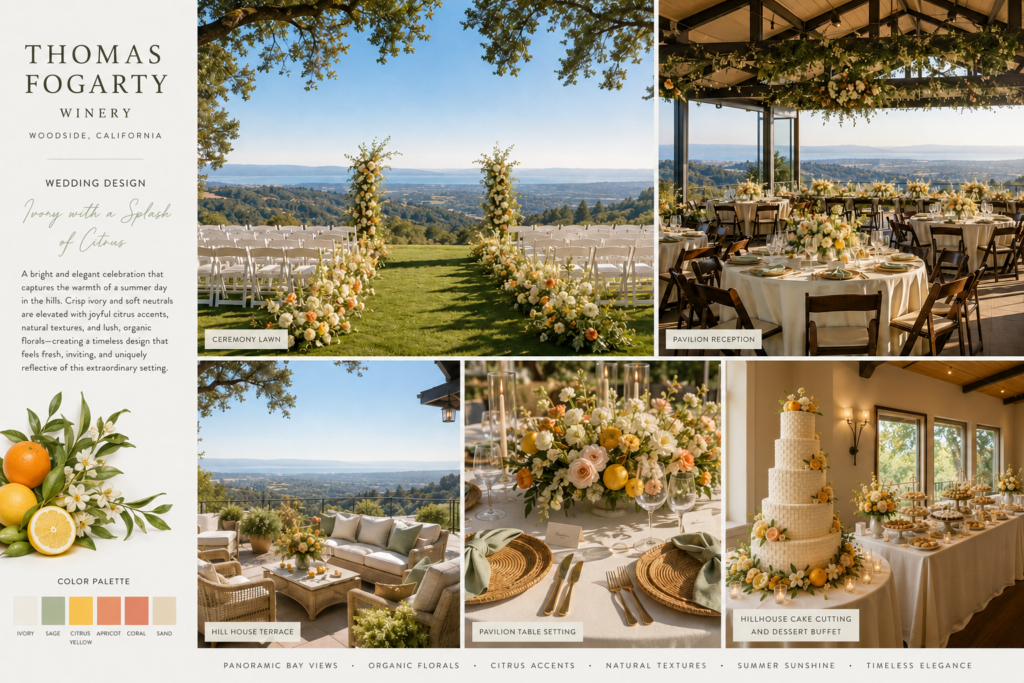
This spectacular venue is probably the one place where I have done the most of my weddings in the last decade – and for good reason! I keep recommending Fogarty for its endless views, from San Francisco to Silicon Valley; for its romantic setting amidst lush vineyards, and for its polished event spaces and accommodating staff. In short – the perfect combination for a garden-themed, summery, mostly outdoor wedding!
My Fogarty weddings have ranged from intimate gatherings to 200 people; were anywhere from rustic to elegant, and came in a rainbow of accent colors.
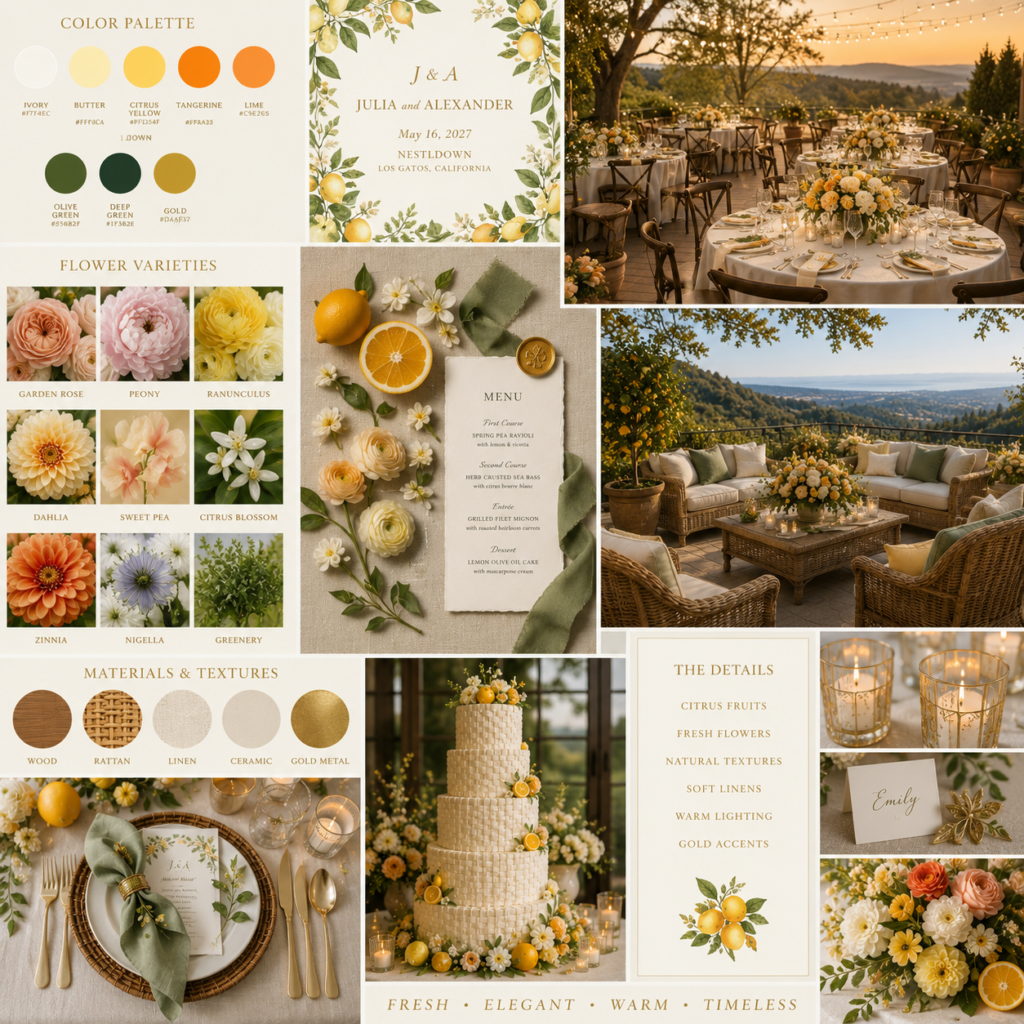
Here is my personal inspiration – how I want to see it! Fresh citrus colors …
… combined with natural materials like wood and rattan, candlelight and metallic gold accents.
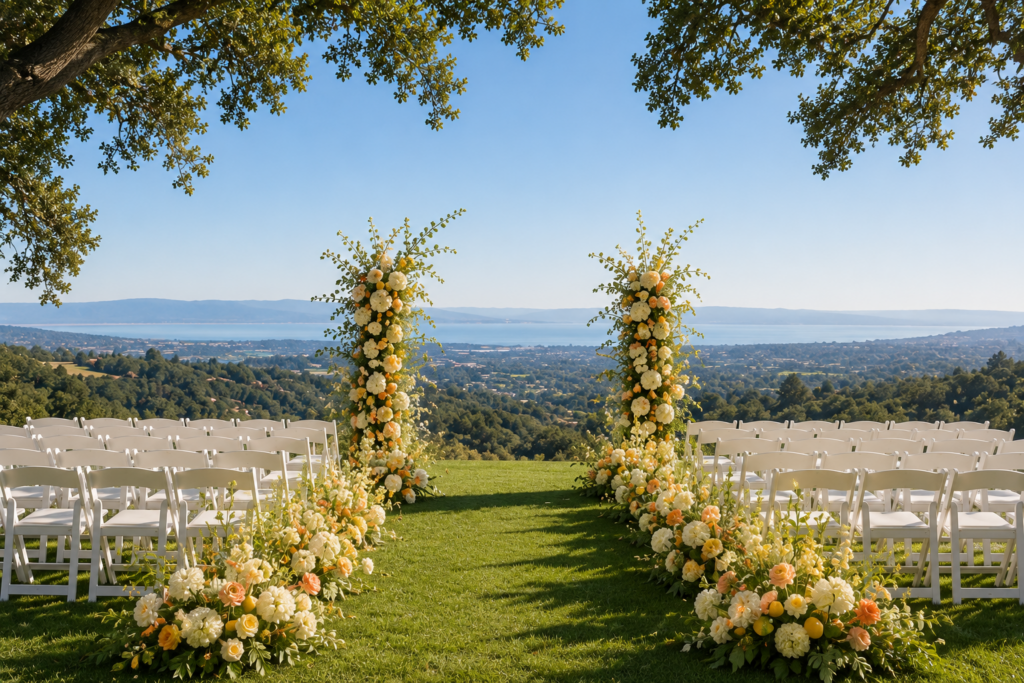
This would complement the spectacular views from the ceremony lawn (actually using the ceremony chairs from the venue inventory)…
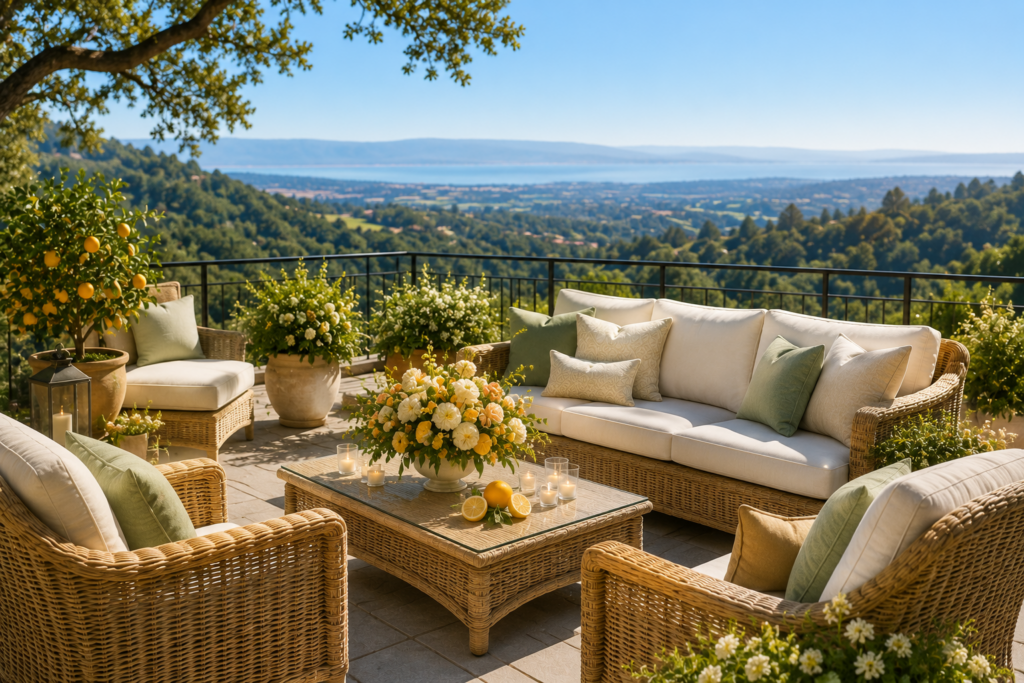
… and rattan lounge furniture, potted shrubs and fluffy pillows would be perfect for Cocktail Hour on the open deck.
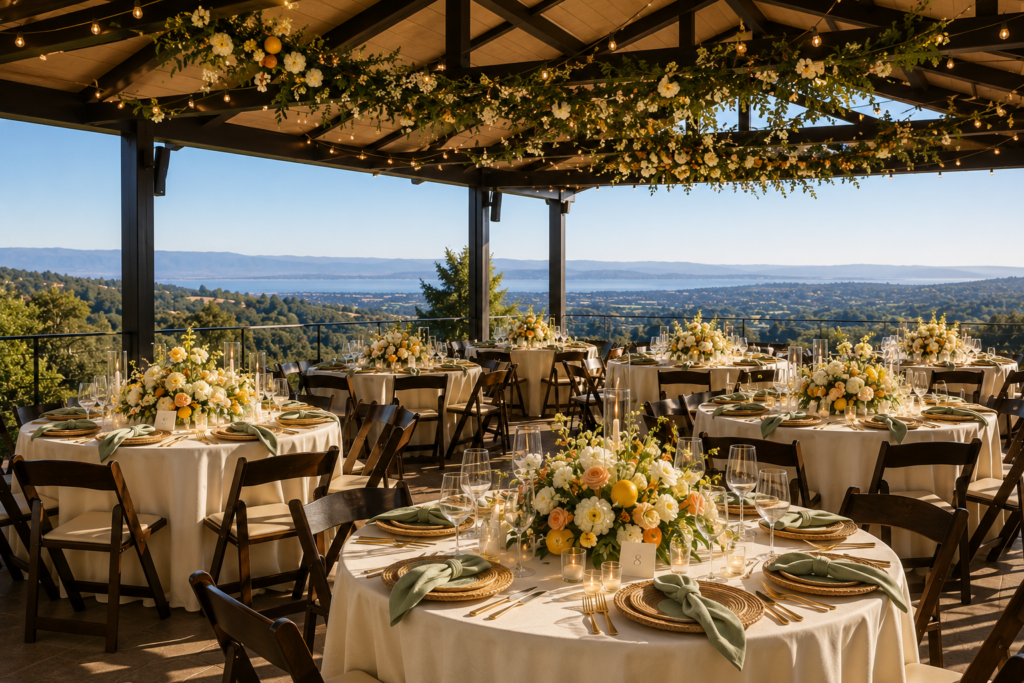
For dinner in the Pavilion, I am envisioning suspended florals (after all, the Pavilion was constructed with exactly such decor in mind – the struts can carry the load!)…
… and the new venue dining chairs would look great with this design.
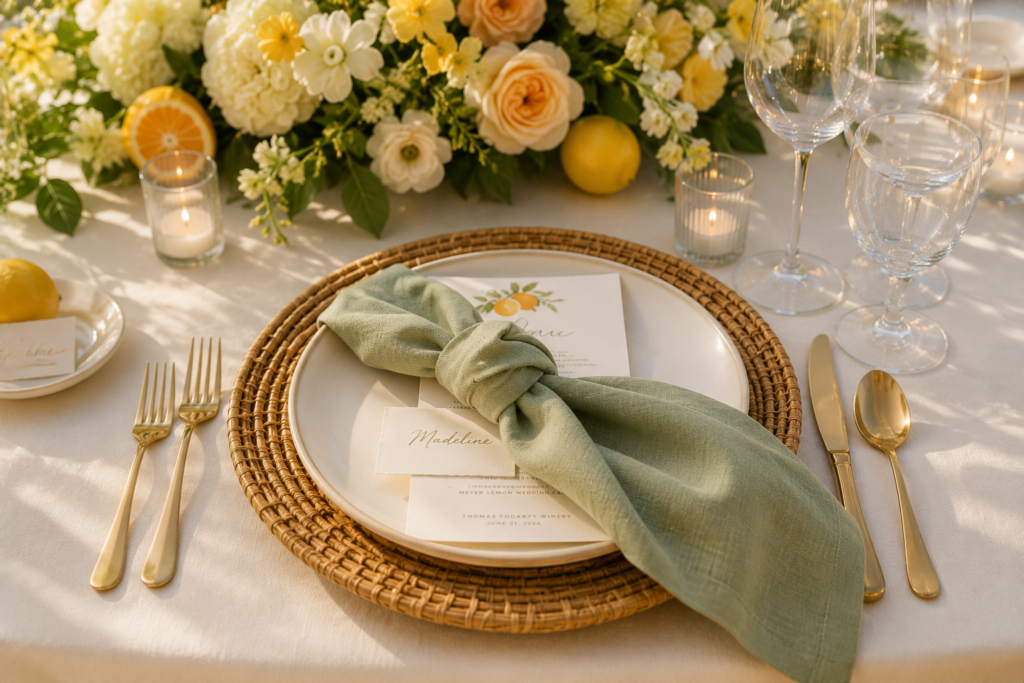
The place settings combine elegance, natural materials and – with pretty menu cards – a touch of formality.
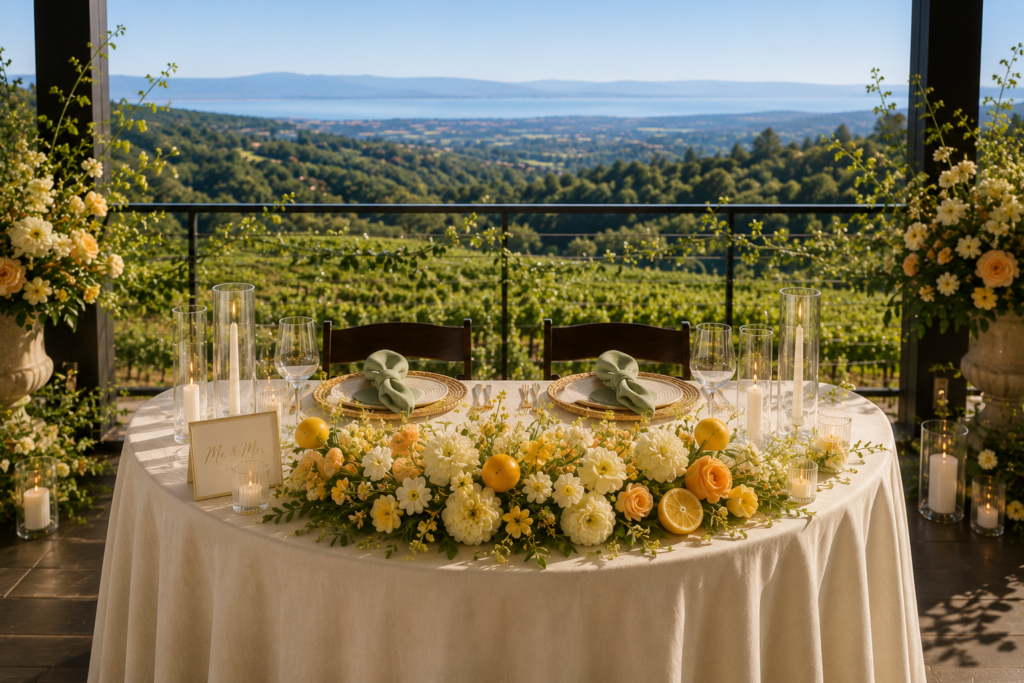
And, of course, the Sweetheart Table gets special treatment!
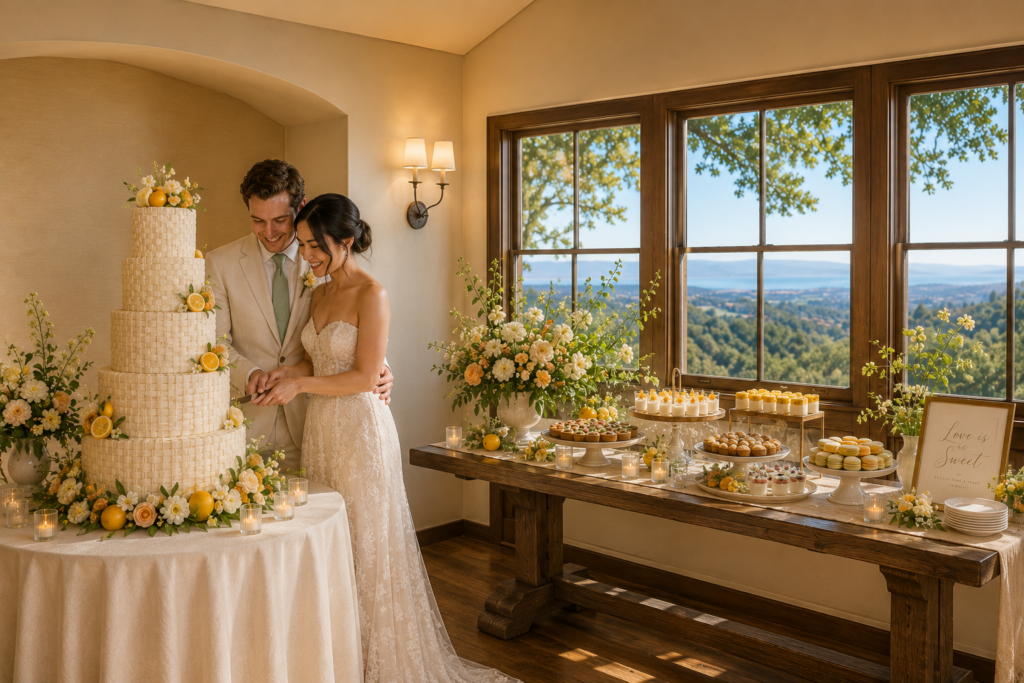
Cake cutting would happen in the Hill House…
… the basketweave design of the cake matching the “natural materials” theme of the decor, and the rustic bare wooden dessert table playing along with desserts in citrus colors.
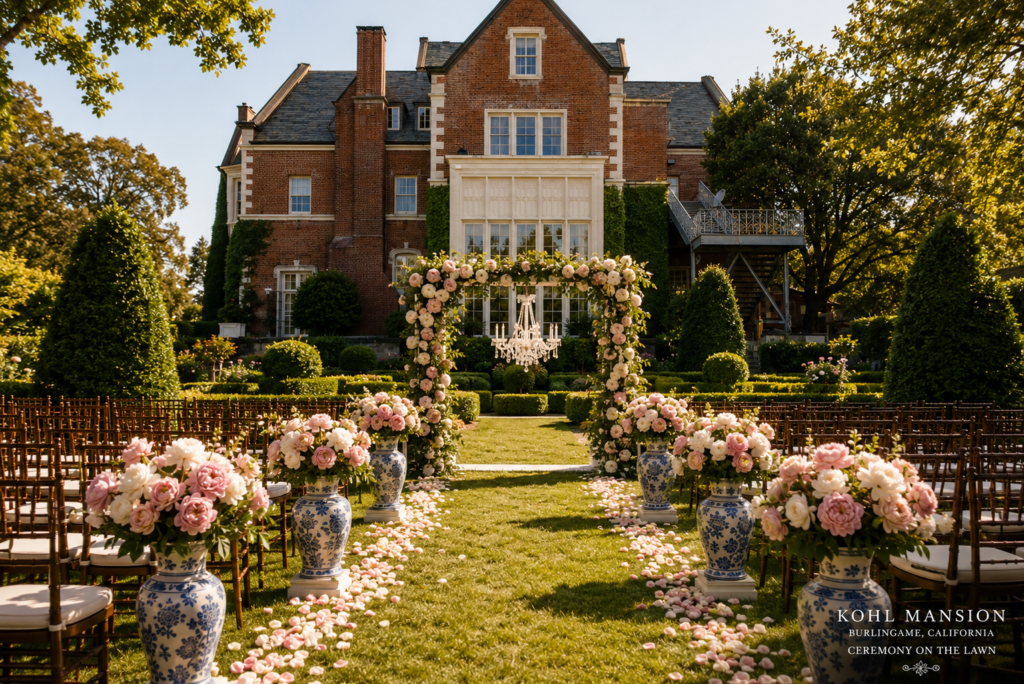
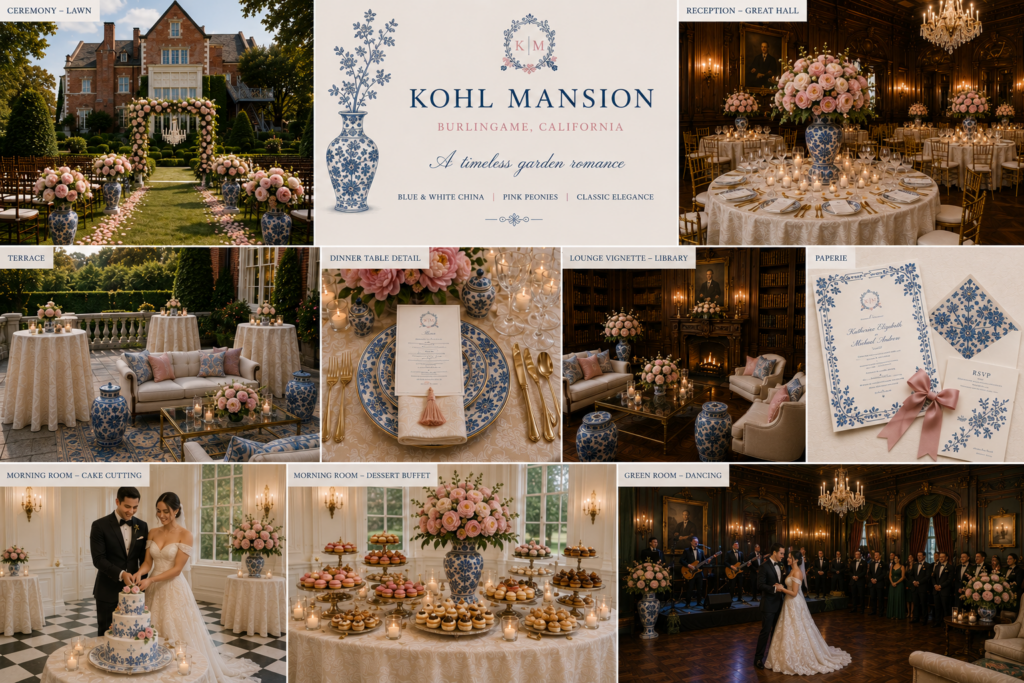
This is the first installment in what will hopefully become a real series – starting with one of my all-time favorite wedding venues in the Bay Area. Kohl Mansion is a historic landmark in classic Tudor architecture, set in beautiful, lush formal gardens, with a melange of dark wood paneling and double-height spaces (the Great Hall) and light-filled nearly playful rooms – e.g. the Morning Room with its black-and-white checkerboard floor and the Green Room, the original dining room of the mansion, painted a very light shade of pastel green. Then there is the elegant library with its Persian rugs, the formal entrance foyer, the photogenic grand staircase … I could go on and on. This mansion is high elegance personified – perfect for high-end weddings!
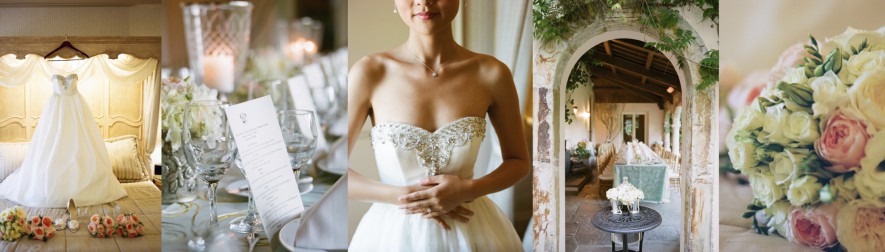
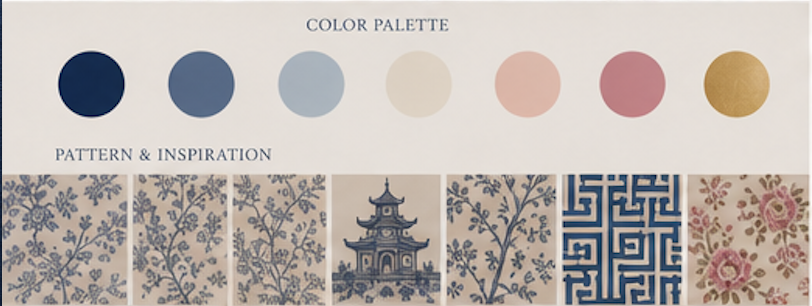
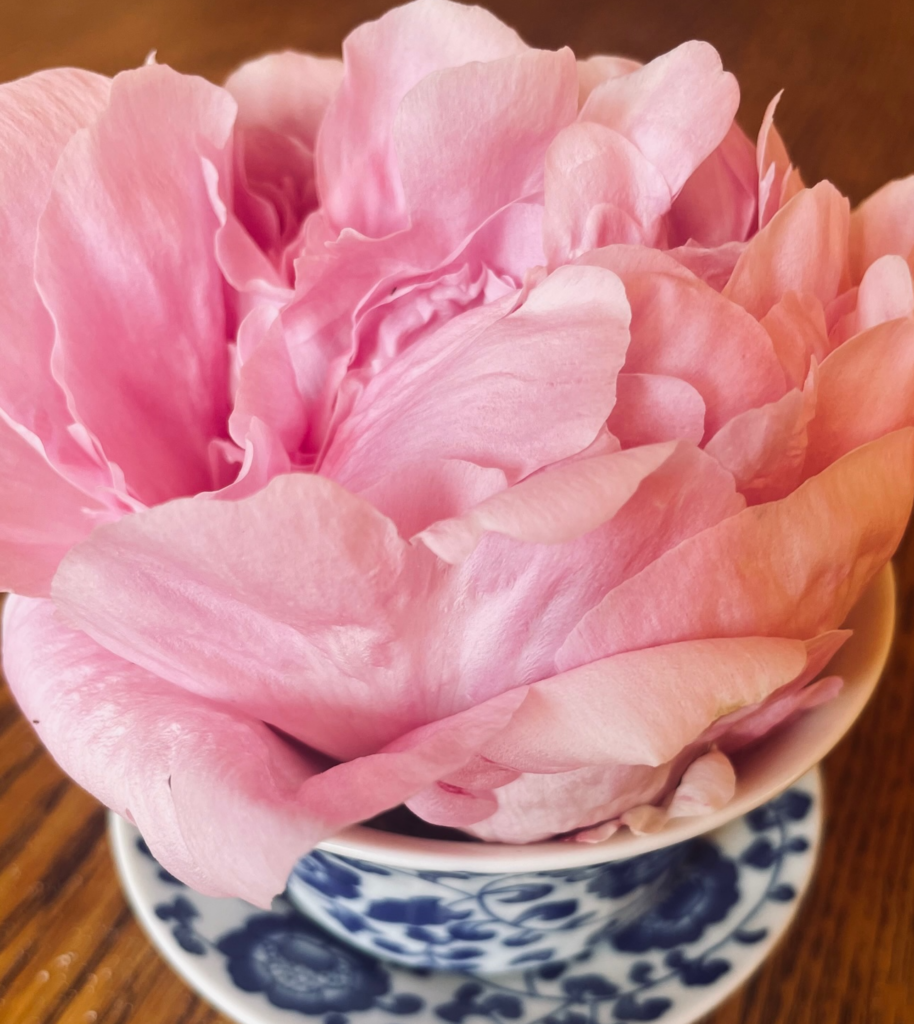
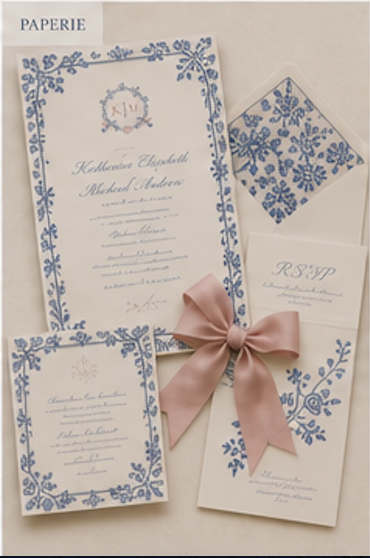
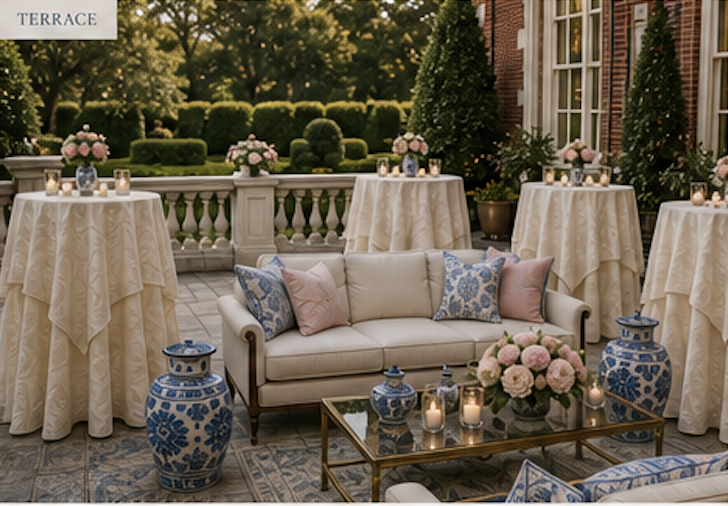
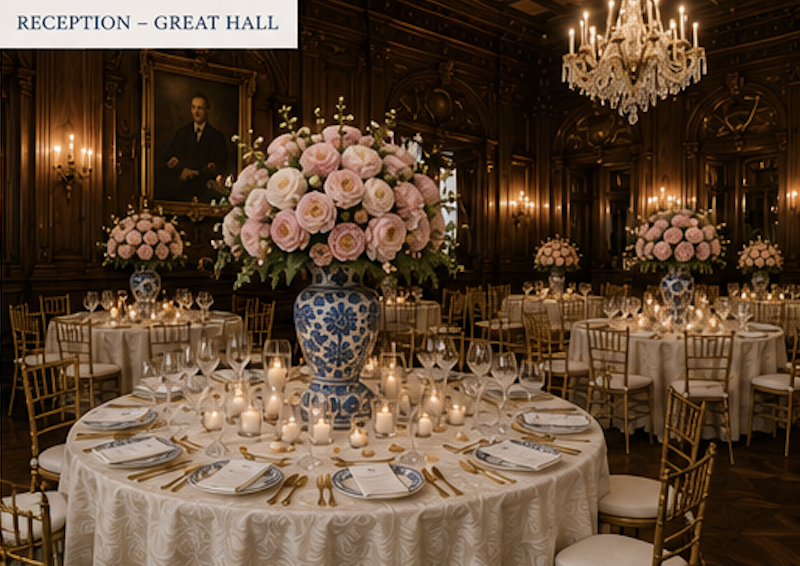
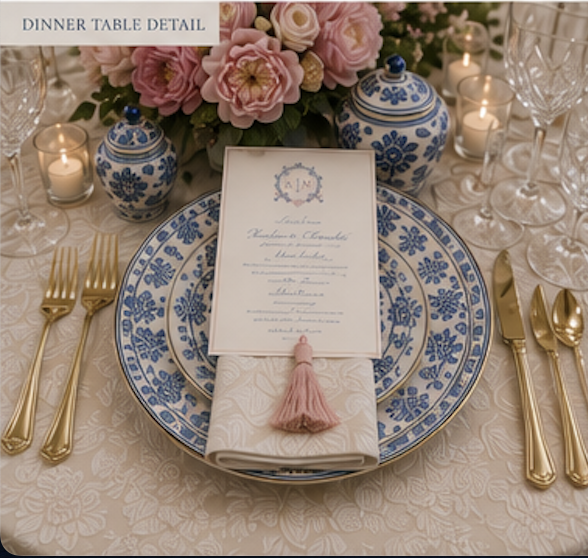
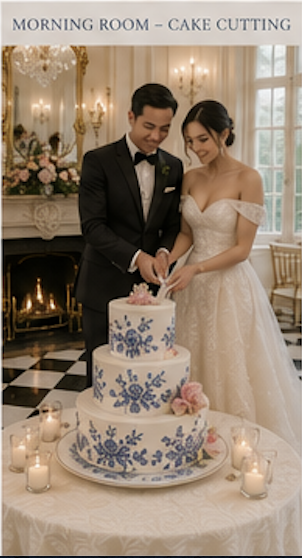
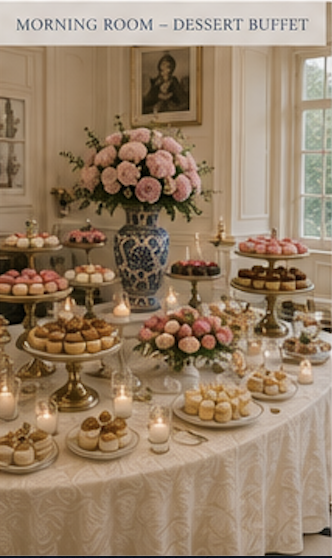
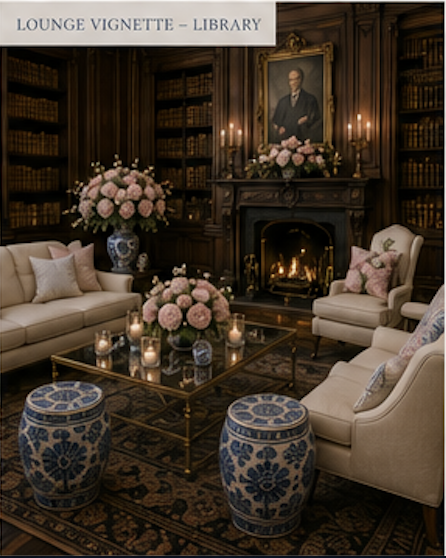
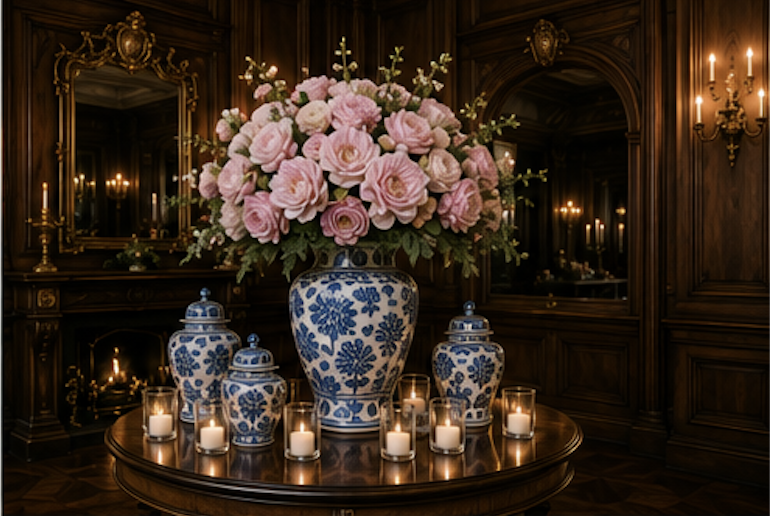
My idea to complement the architectural beauty with a nod to wedding events: Chinese-pattern blue-and-white china and pink roses and peonies…
… starting with invitations and wedding day stationery.
This is what the ceremony could look like:
… followed by cocktails in the Courtyard…
… and dinner in the Great Hall.
This is how I would envision the place settings:
… and Cake Cutting in the Morning Room.
We’d also have a dessert buffet right there…
… and a comfortable lounge area for quiet conversations…
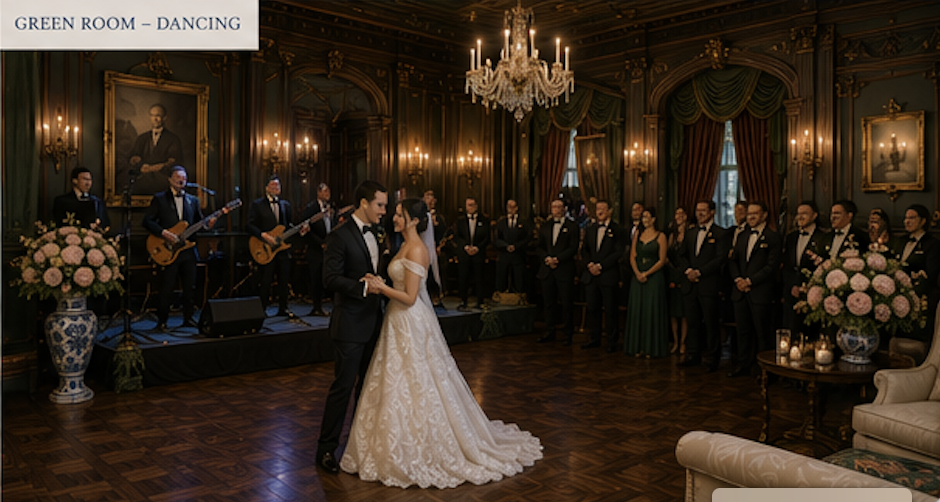
… while others are dancing in the Green Room.
And here is the whole design concept at a glance – I hope you like it!
Having trouble with your wedding Thank-You’s? When, Who, How?
It’s actually easy.
When: no later than 2 weeks after receiving the gift (before the wedding) or no later than 2 weeks after your wedding.
Whom do you need to send a Thank You note?
Everyone!
Guests that have attended your wedding, whether they gave you a gift or not
Guests that were invited, did not come, but sent a gift
People who were not even invited but gave you a gift
Your vendors
How should you write these notes?
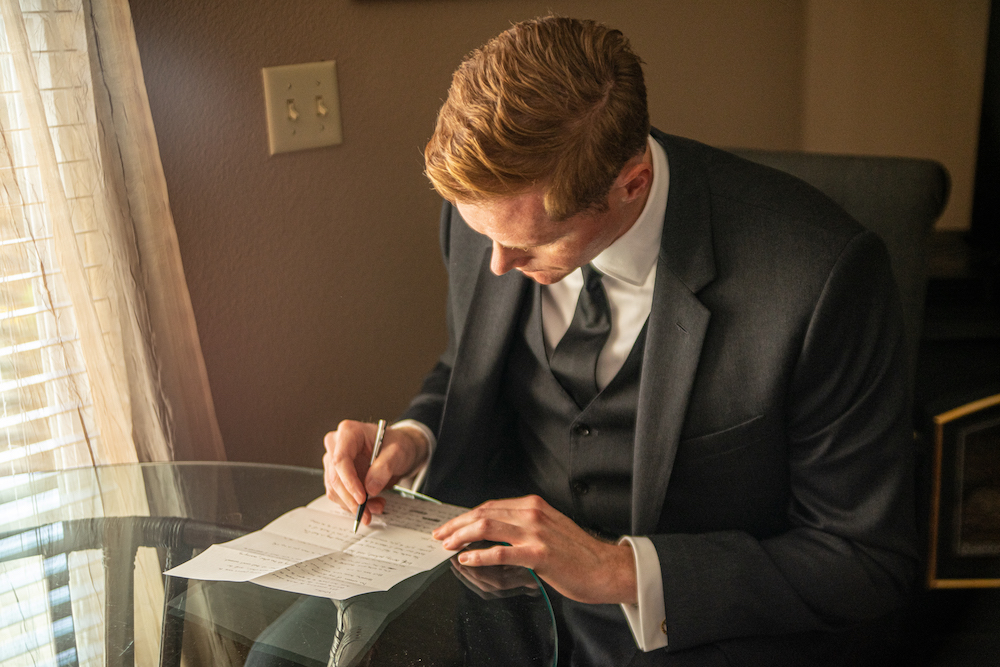
Hand-write. Absolutely hand-write. Preferably on stationery matching your invitations, but if you don’t have that, either use a card with a wedding photo or even a generic nice Thank You card. And use a good pen or, even better, fountain pen.
Here is the template:
“Dear” (recipient’s name or names)
“Thank you for” (the item they gave you as a gift, also cash gift)
How you intend to use the item or how you’ve used it so far
Then say how much you loved celebrating alongside them at your wedding (or how how much you are looking forward to celebrate with them, if you’re sending this note before the big day)
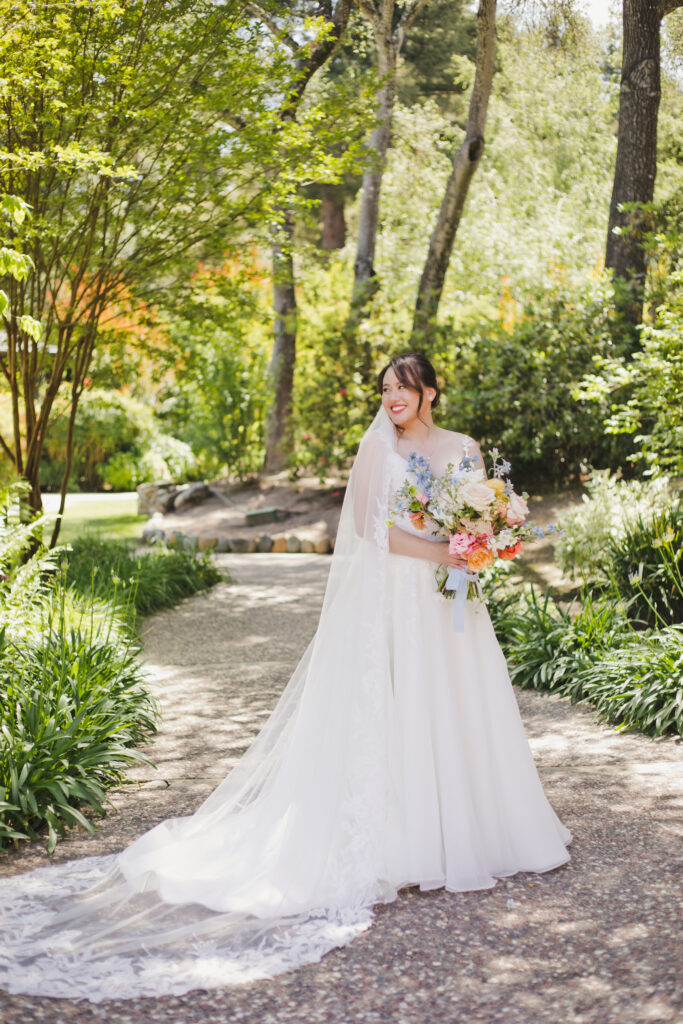
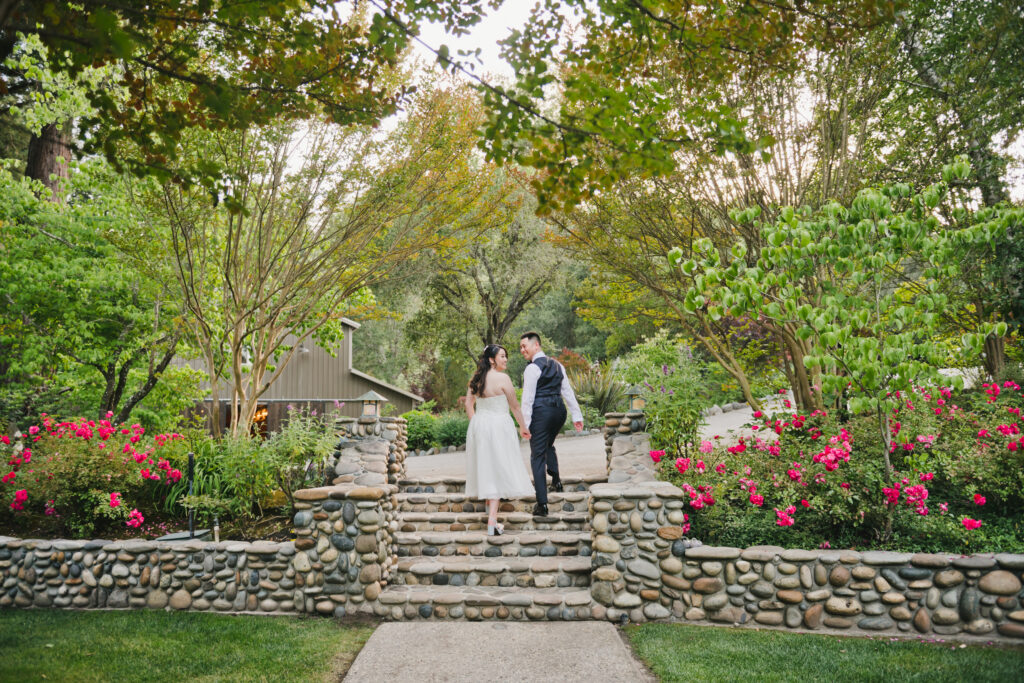
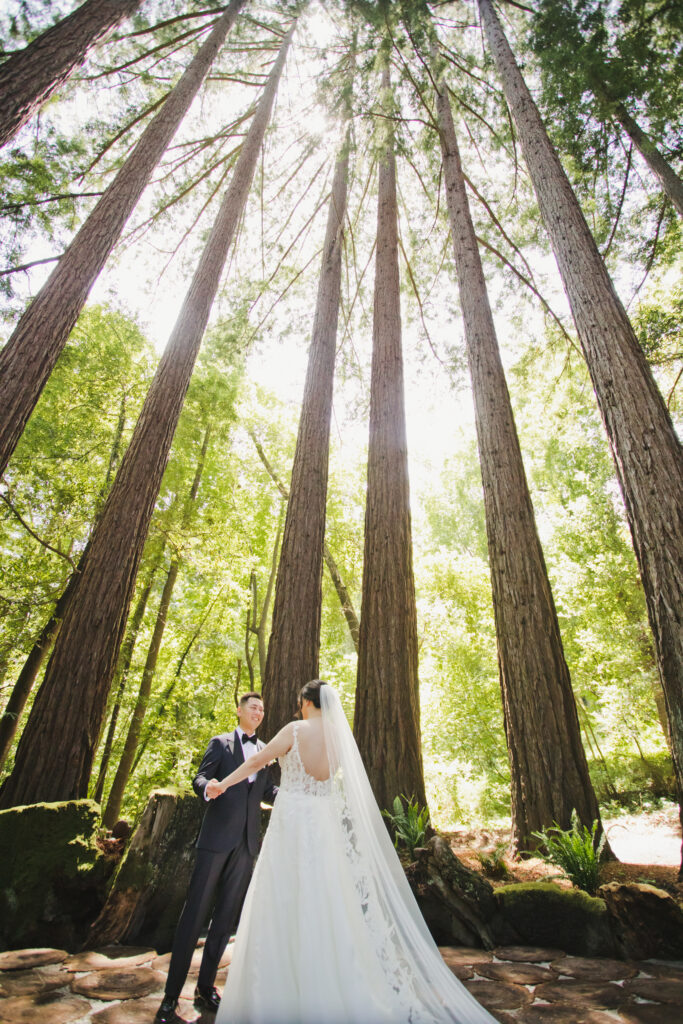
When this couple approached my company, A Day Like No Other, for help with planning their wedding, they had already done a lot of venue search and identified a number of constraints. No wedding in Fall, out in nature, preferably under towering Redwood trees, with sufficient shade against the California sun, a polished event venue, close-by accommodations for their numerous out-of-town guests, not too far away from Silicon valley… and if that wasn’t tricky enough, their respective parents had overlapping date conflicts. In short, this was not easy! Until… enter River House, a fairly new event venue in the Santa Cruz Mountains. It checked most of the couple’s requirements, AND it had suitable event dates still available. BOOKED!
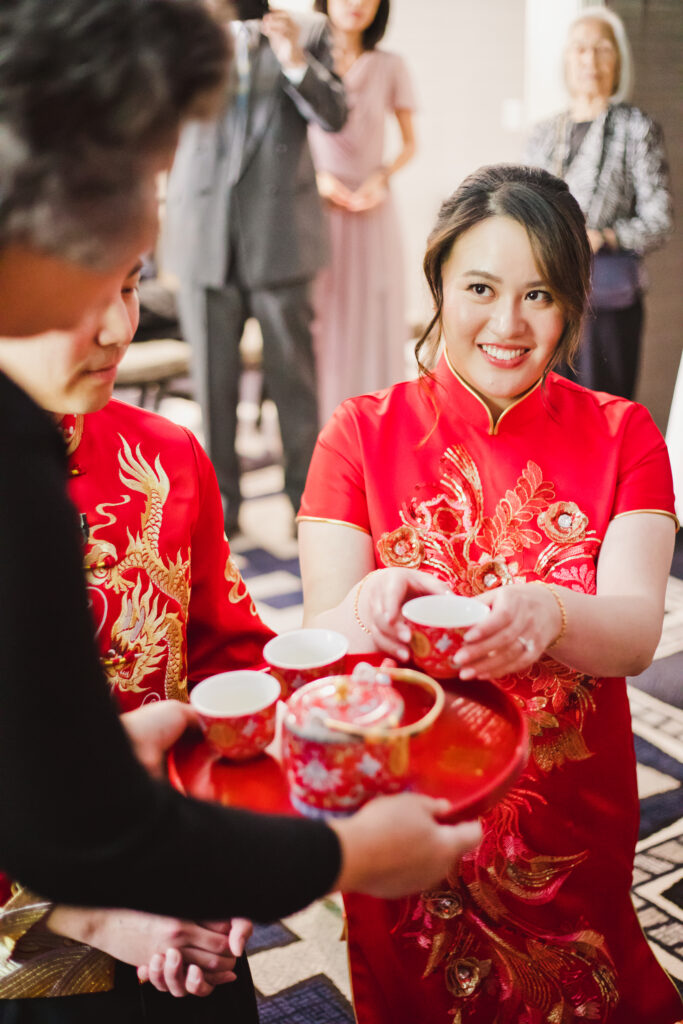
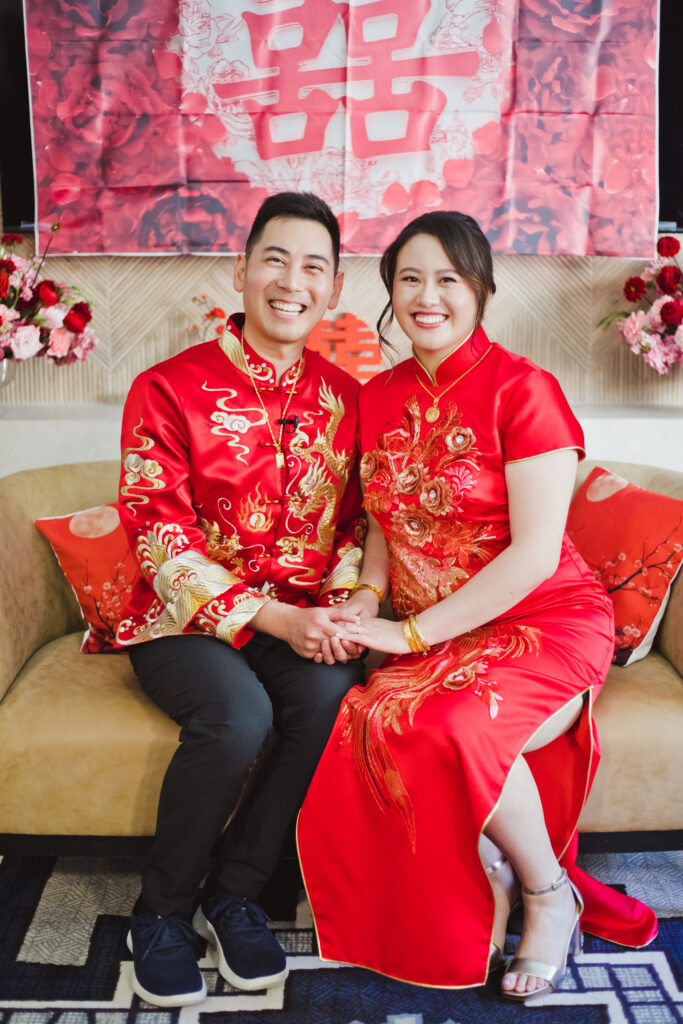
With just under nine months to go (and demanding work schedules for both bride and groom), we had our work cut out for us. The wedding planner provided by the venue helped with local connections and vendors. After a whirlwind of sourcing, comparing and booking vendors, food and cake tastings, showroom visits and lounge furniture selection, organizing a Tea Ceremony preceding the Western festivities and an afterparty close to the wedding venue…. the Big Day had finally arrived!
Given the mid-morning Tea Ceremony to start the day, the bride and her bridesmaids and the mothers had to get up VERY early to have their hair and makeup done (DesignHerImage).
The traditional Tea Ceremony was held at the Hilton Scotts Valley hotel which served as the “home base” for the couple, their family members and many of their guests.
After that, the Western part of their wedding day started… with transit to River House, the local wedding planner taking over and bride and groom getting into Western wedding attire.
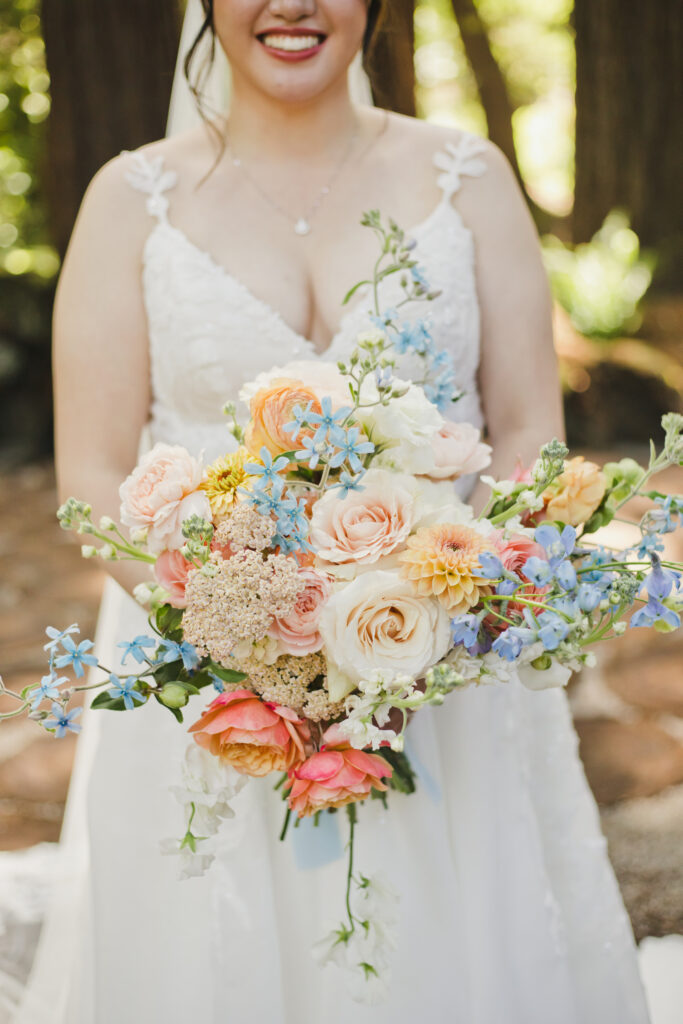
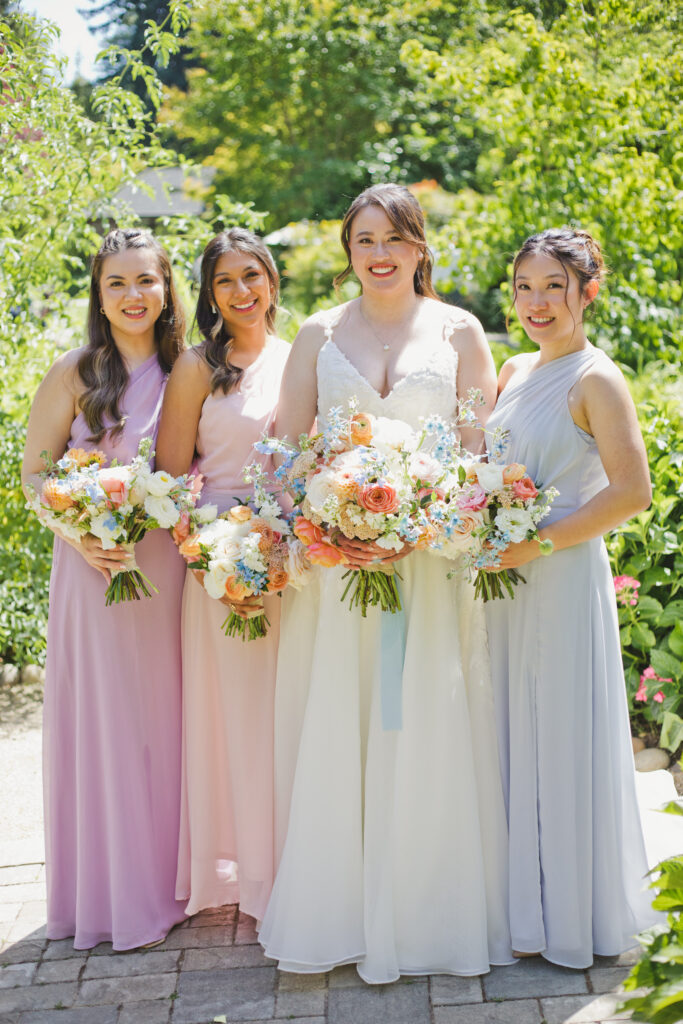
Beautiful romantic bouquets in pastel Spring colors (Laurel Canyon Farms) were waiting for the bride (and her bridesmaids…)
… who were themselves wearing assorted pastel Spring colors.
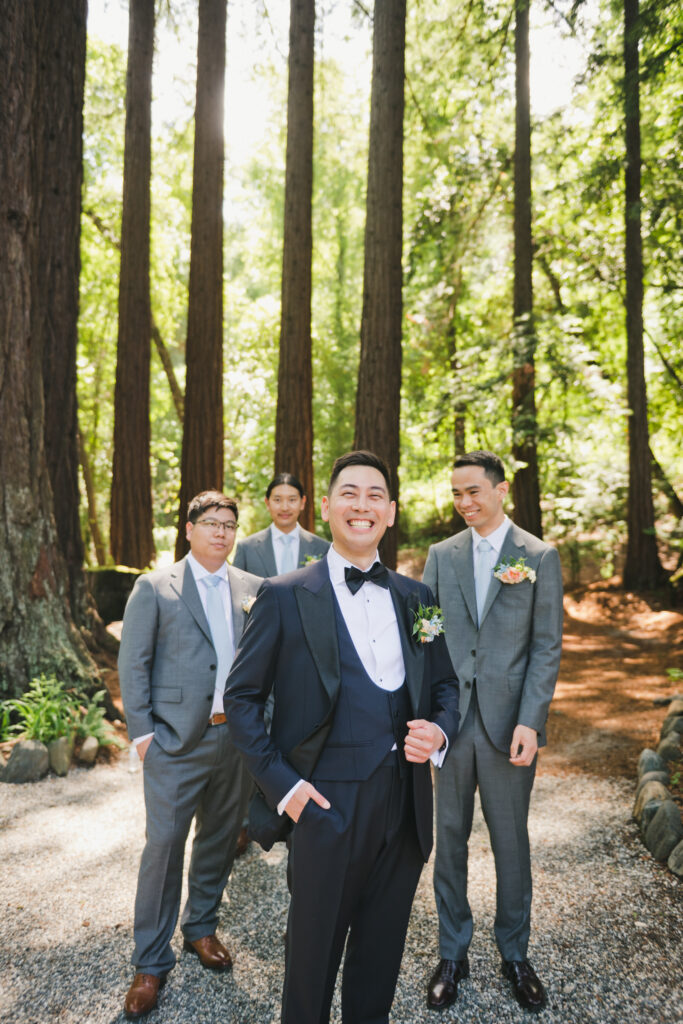
The groom and groomsmen were dressed up for the celebration as well:
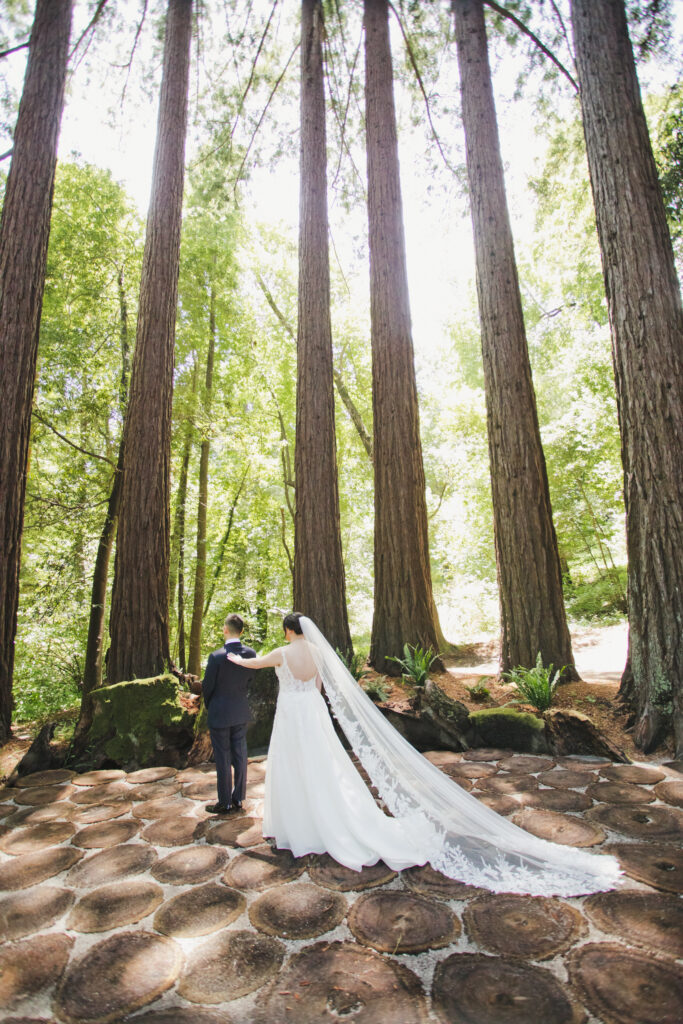
Ready for their First Look – all captured by the One Love photo team and Curio videographers.
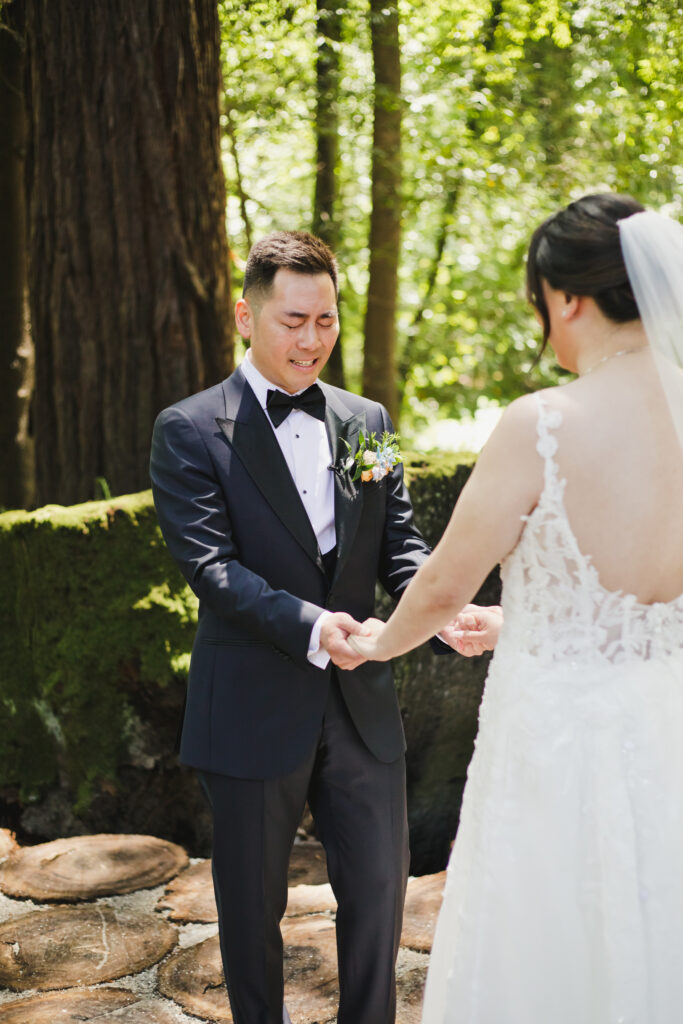
Always such an emotional moment…
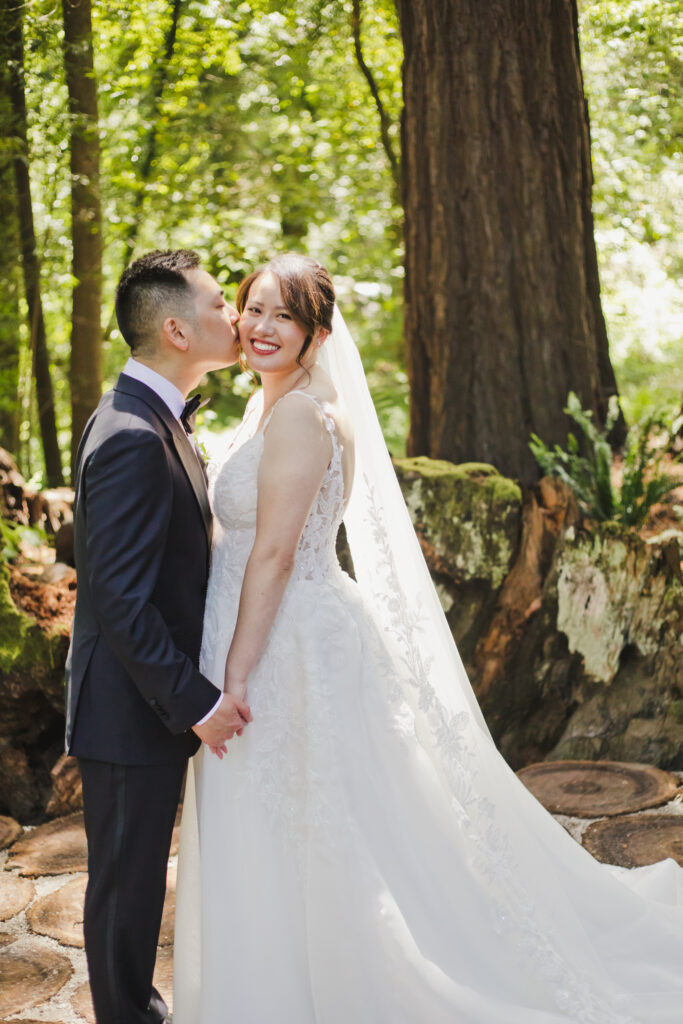
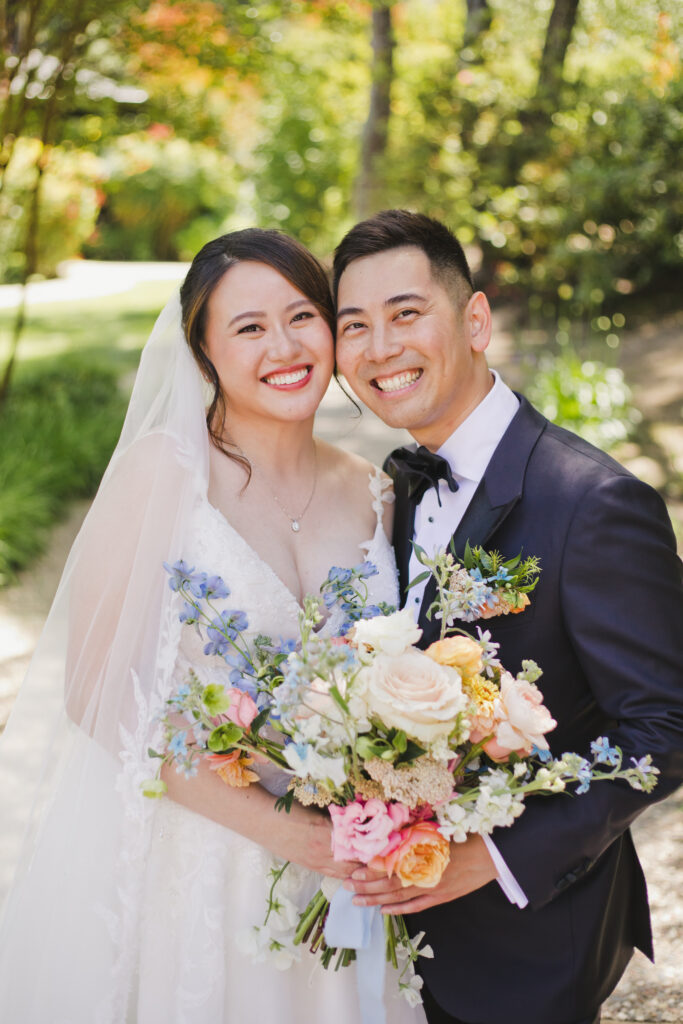
This should be their official wedding photo, don’t you think?!
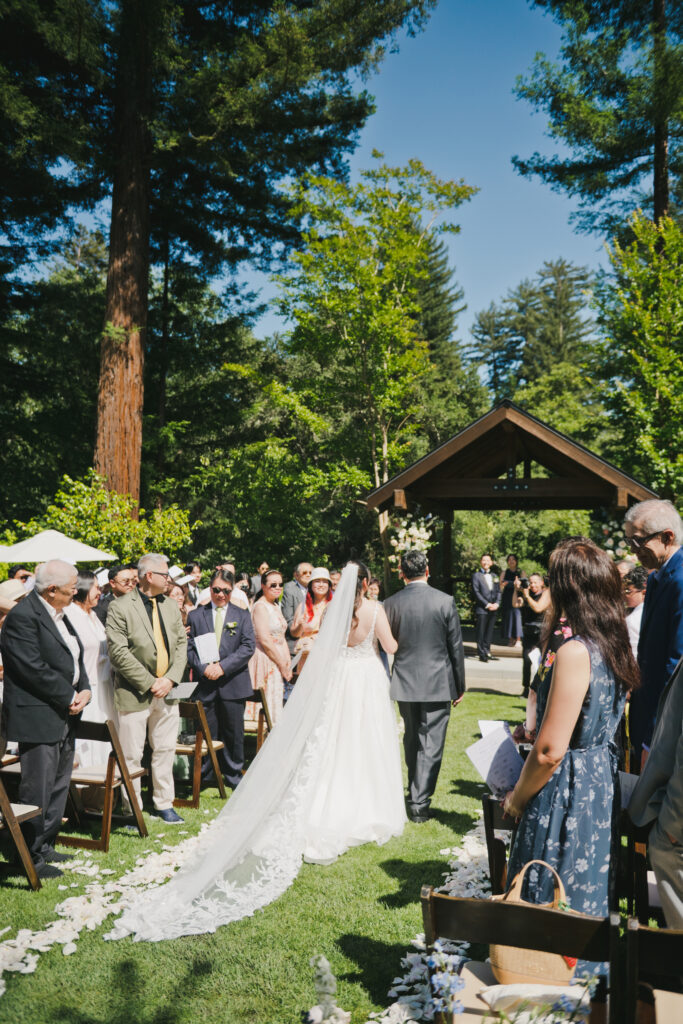
… for her romantic wedding ceremony in the outdoor pavilion, serenaded by Innocenti Strings.
Just married!
YESSSS!!
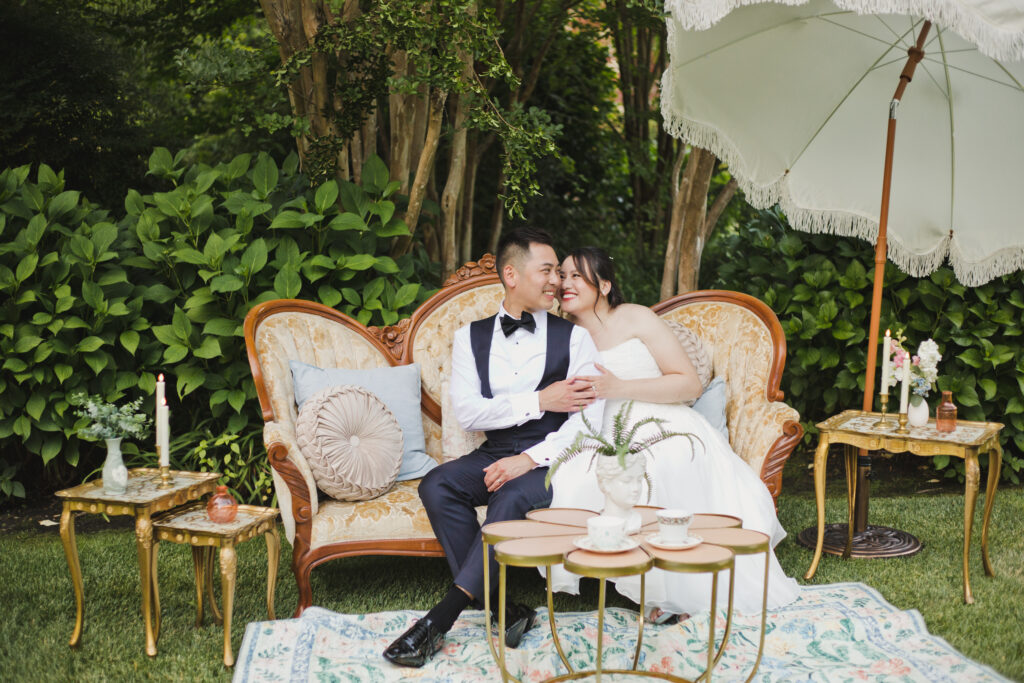
And while guests got to enjoy not only the usual cocktails and hors d’oeuvres (by Love Creek Catering), but also ice cream and a veritable British High Tea (!), lounging on vintage furniture pieces by White Rabbit Event Rentals, the newlyweds went off to take even more photos.
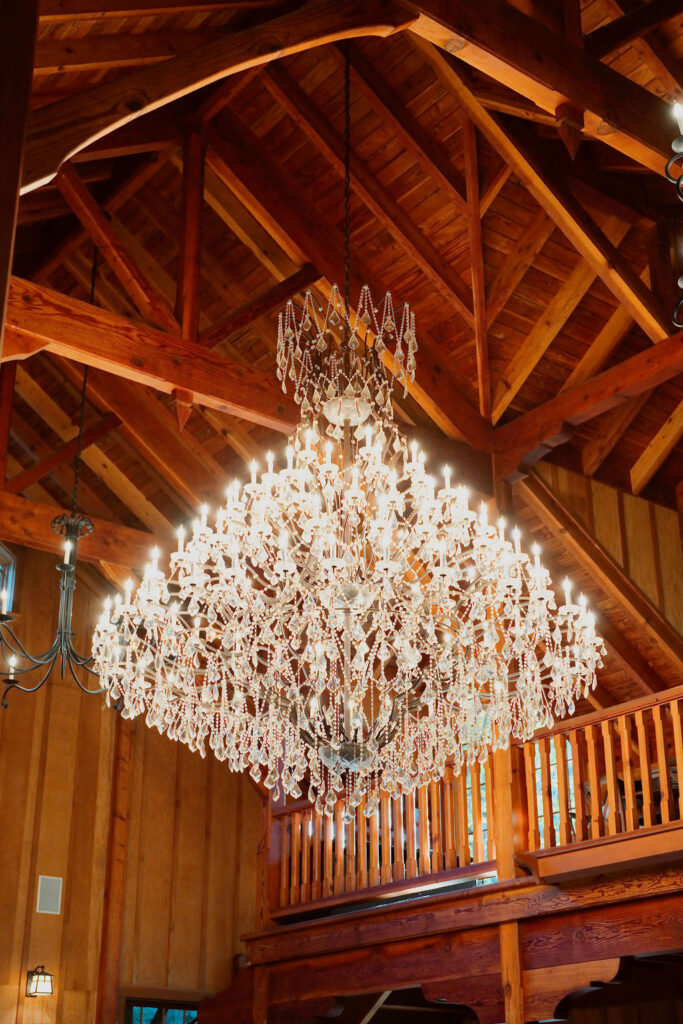
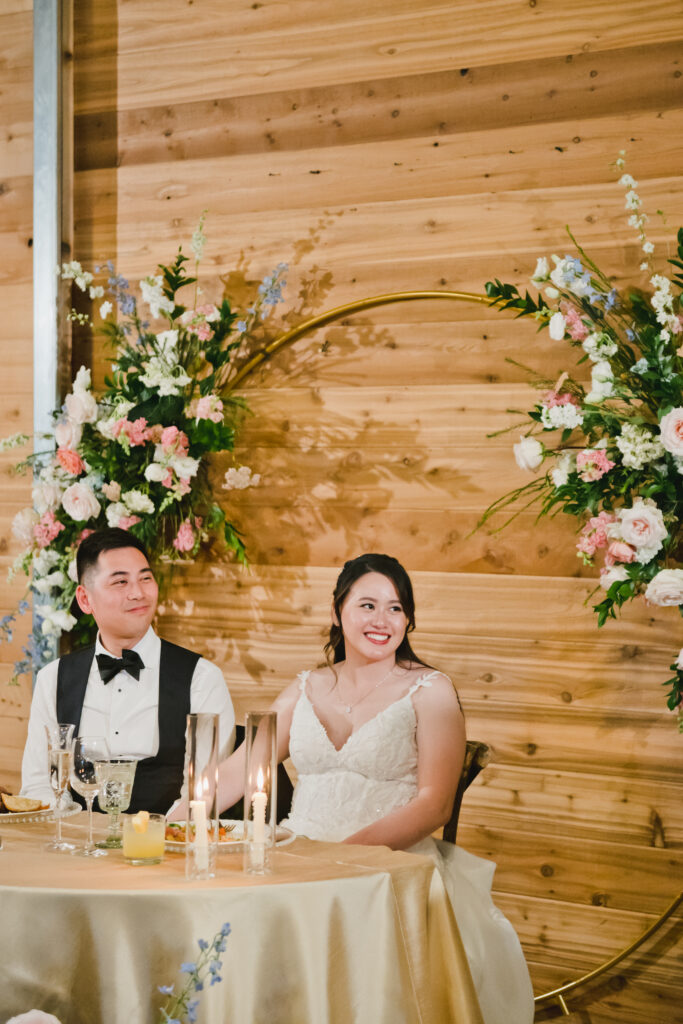
Isn’t that pretty?! Guests were then invited to dinner in the lavishly decorated Barn with tables, chairs and tabletop items from Alexis Party Rental...
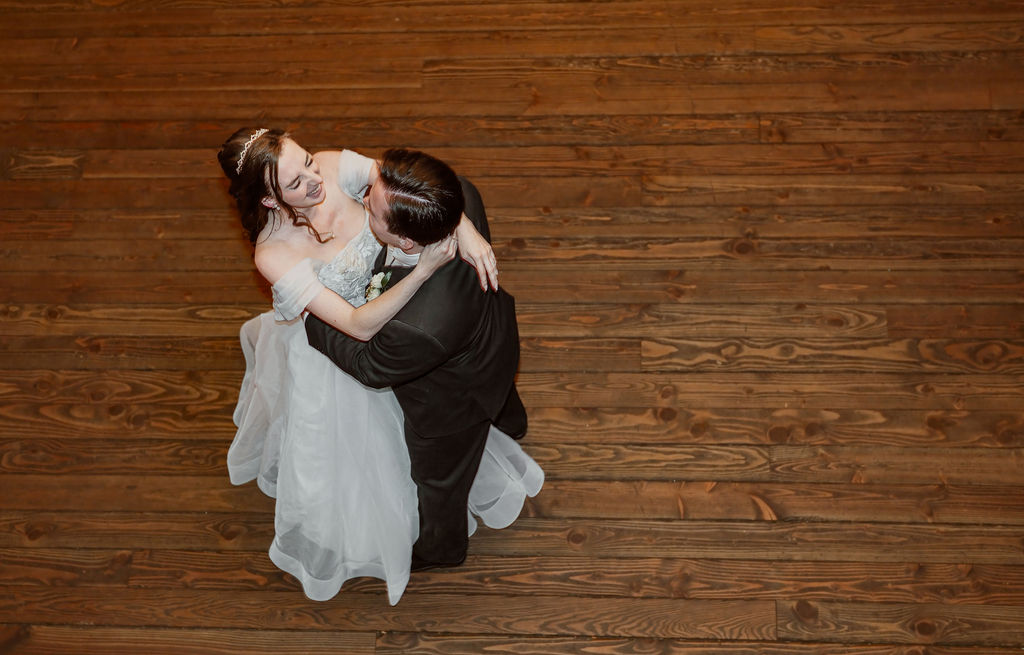
… where they also had their choreographed First Dance to tunes by Santa Cruz DJ …
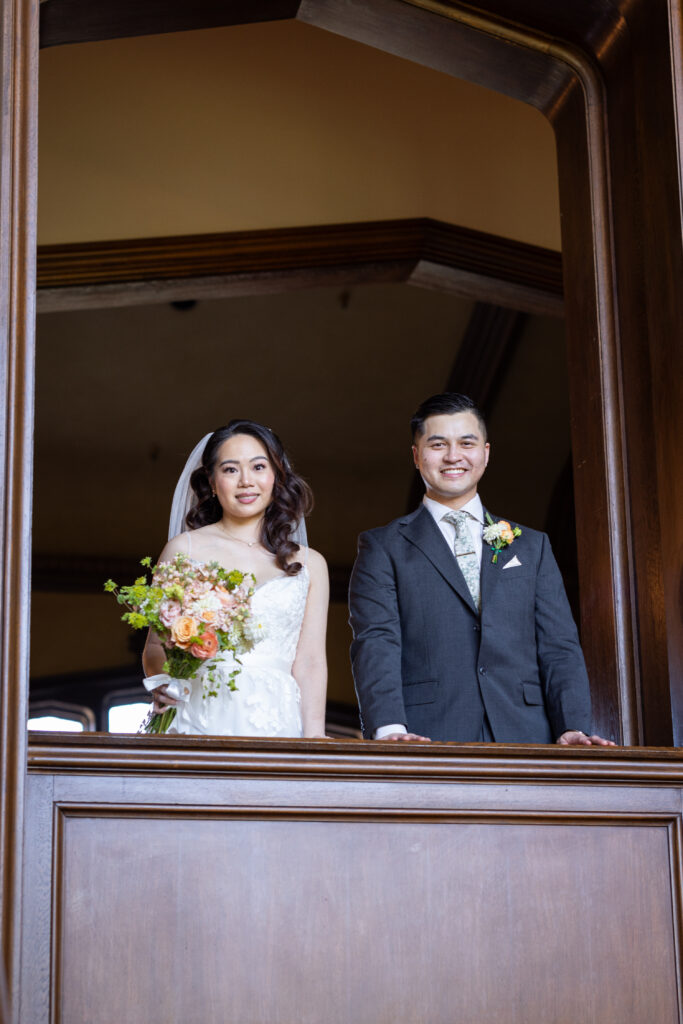
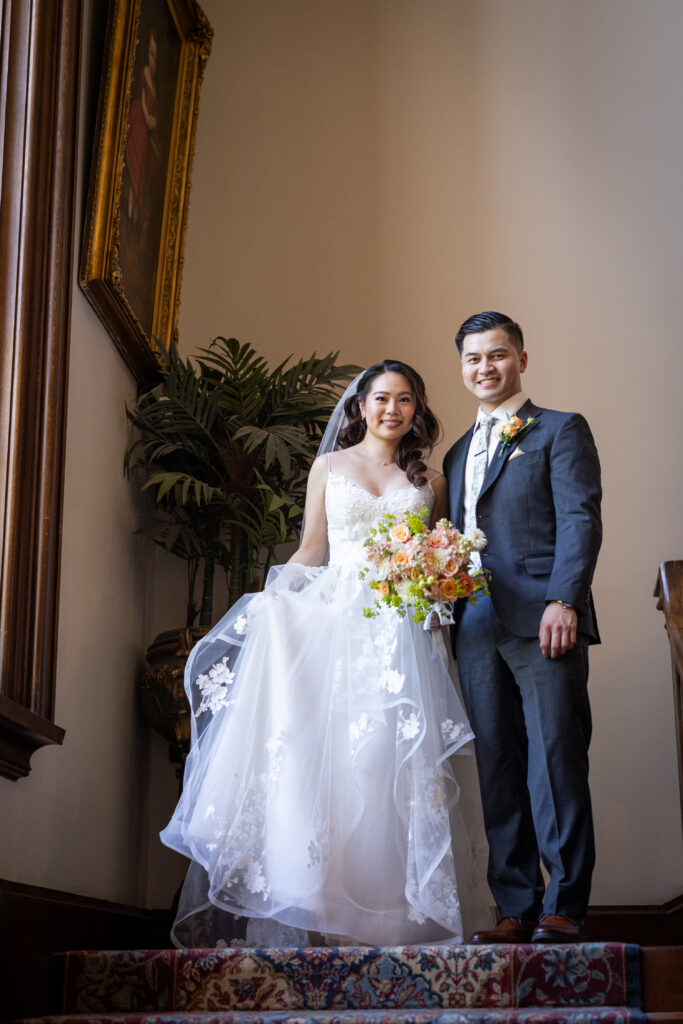
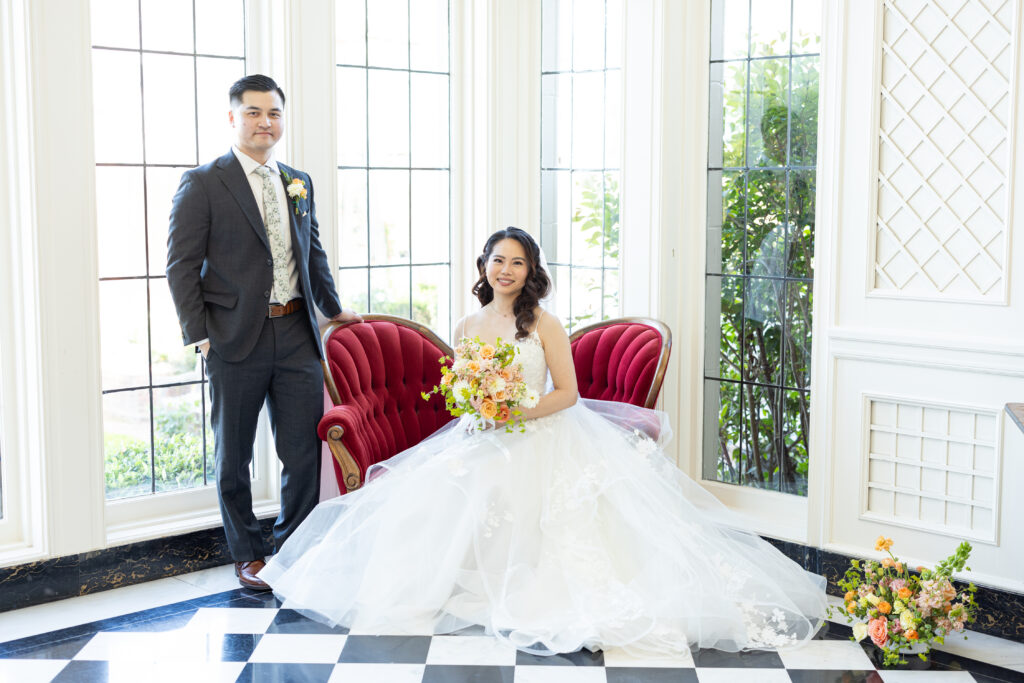
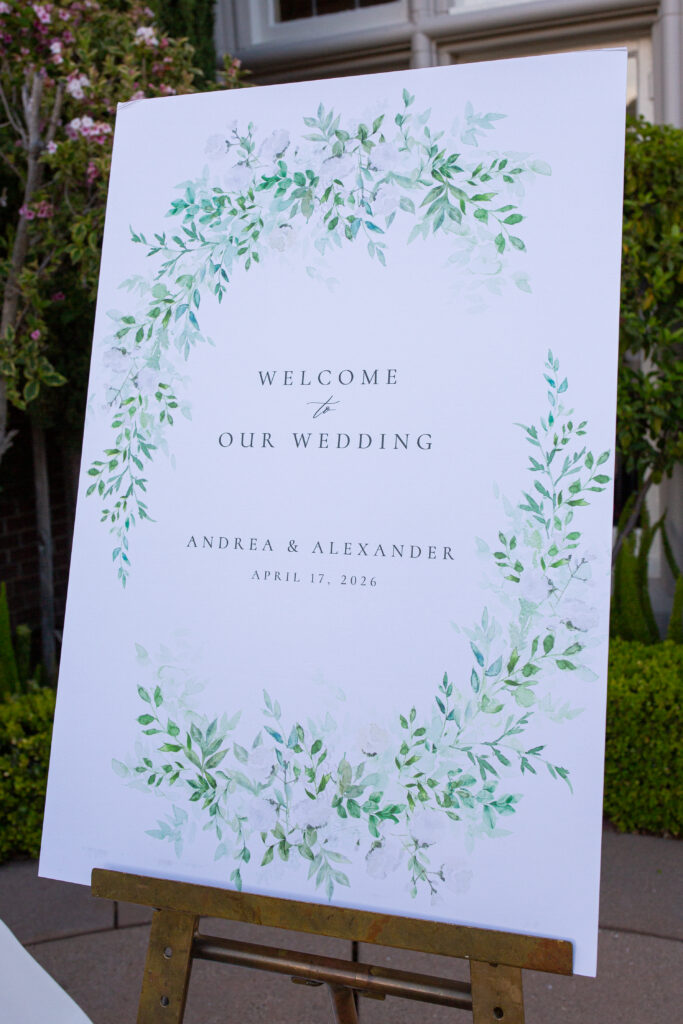
Andrea and Alexander had found their absolute dream venue – the historic Kohl Mansion in Burlingame – and then they realized that a lot more had to be done to actually host their wedding there… so they turned to my company, A Day Like No Other, to help them fill in all the myriad details that, in the end, come together to a great wedding celebration.
We had eight months to make it happen – and this time went by very quickly. On a breezy, sunny Friday in April, the Big Day had finally come!
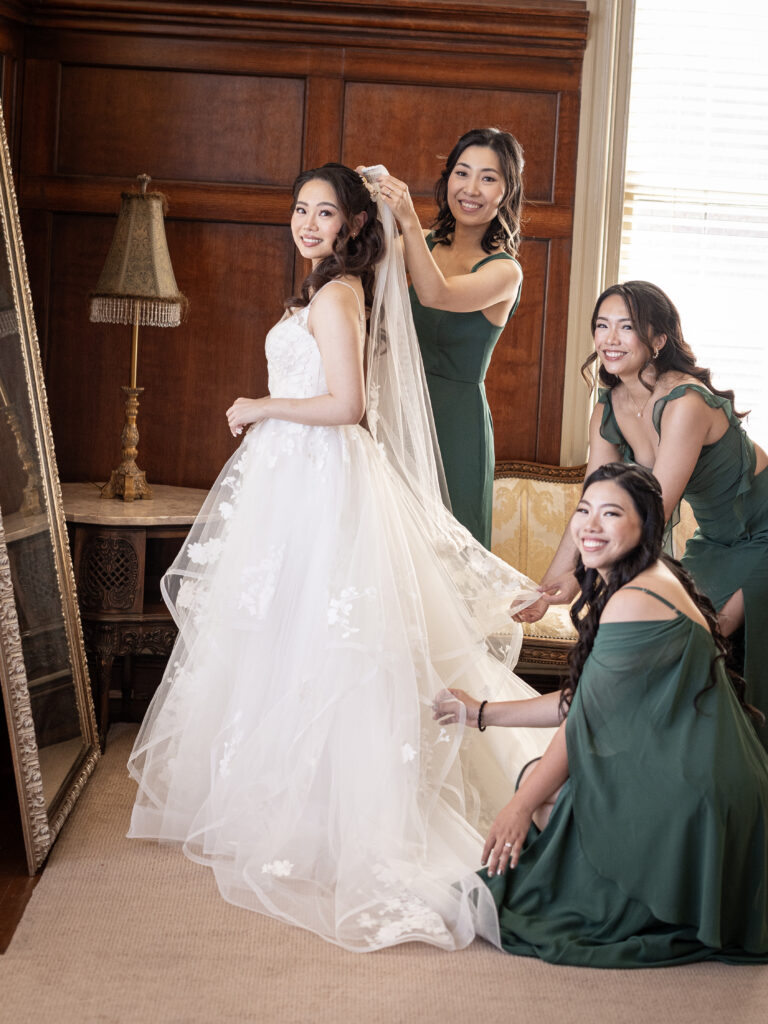
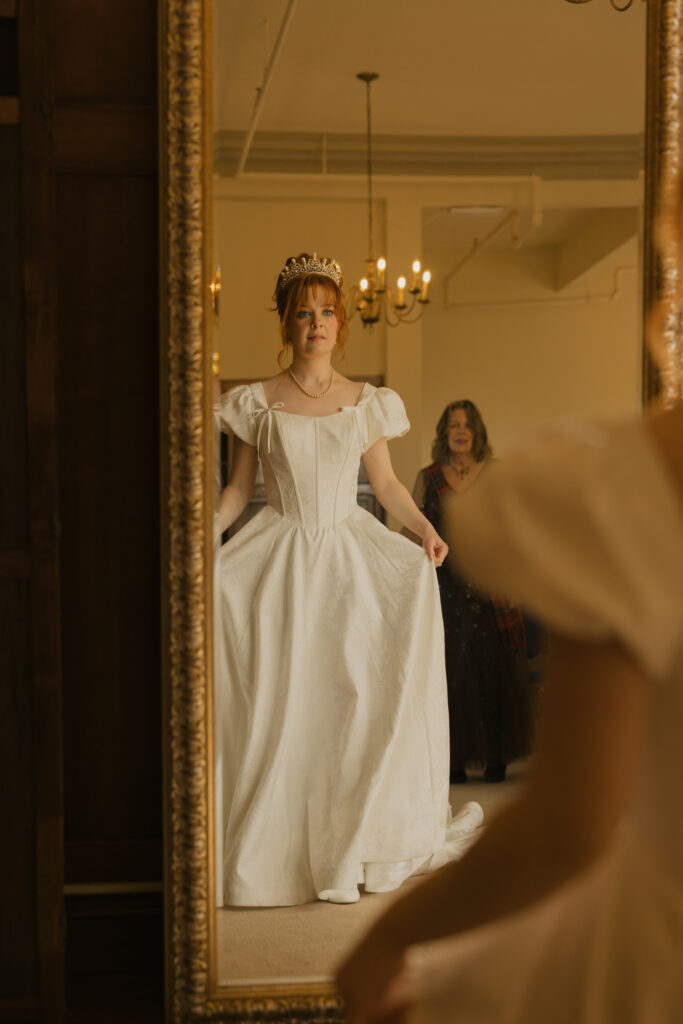
For bride Andrea and her bridesmaids, it began with hair and makeup services (Beauty by Cherie); then, with the help from her bridesmaids, she stepped into her elegant wedding dress… and look how radiant she is!
What’s missing? Her bridal bouquet, of course! (All flowers by Narose).
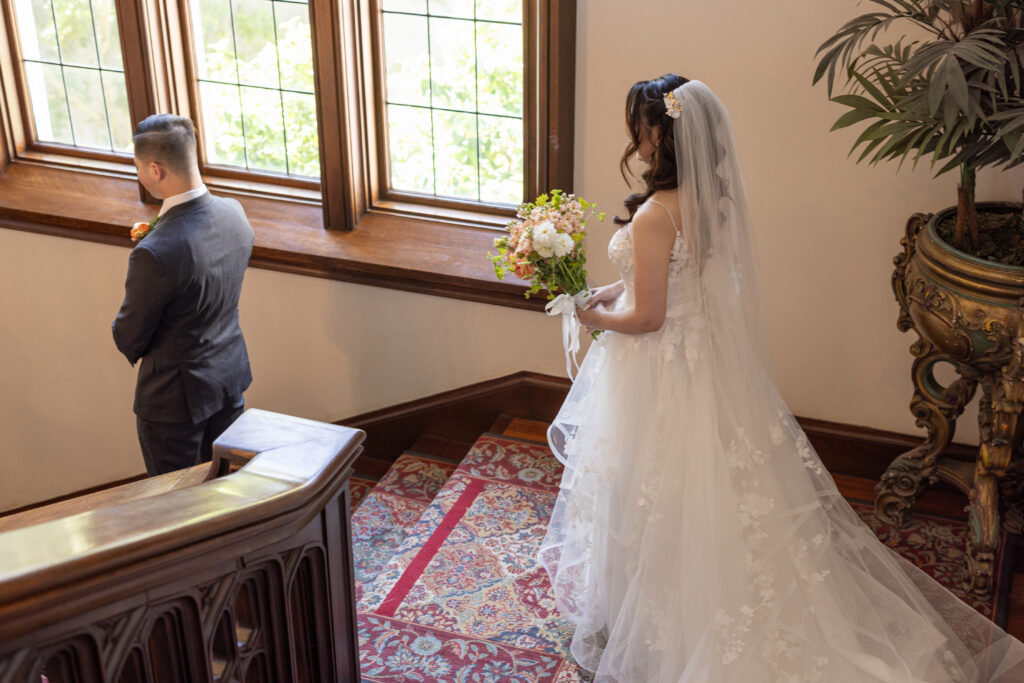
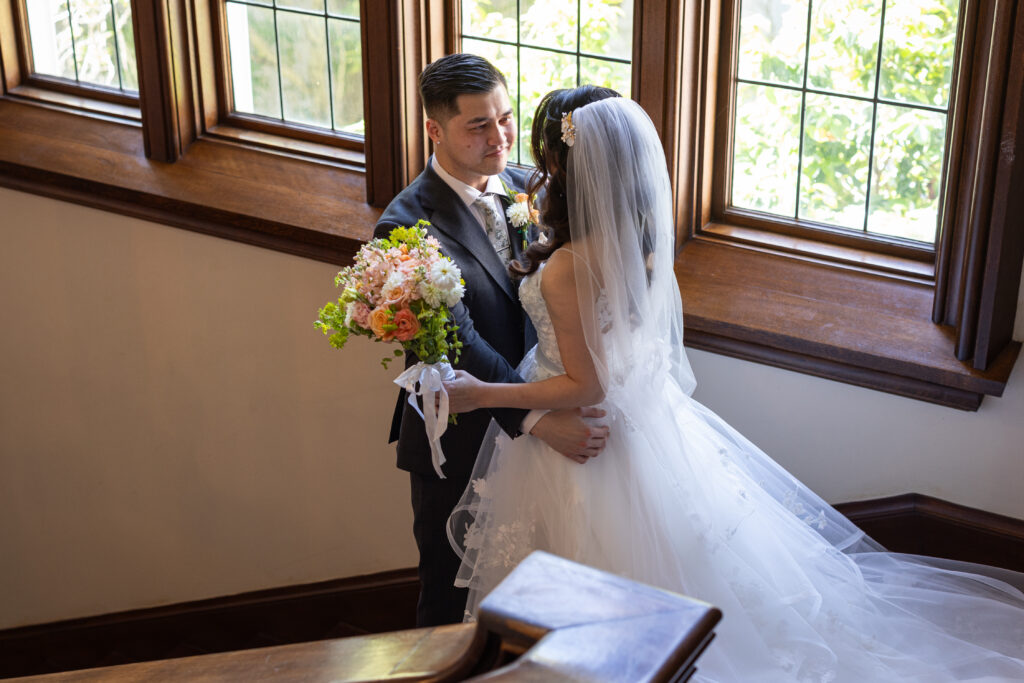
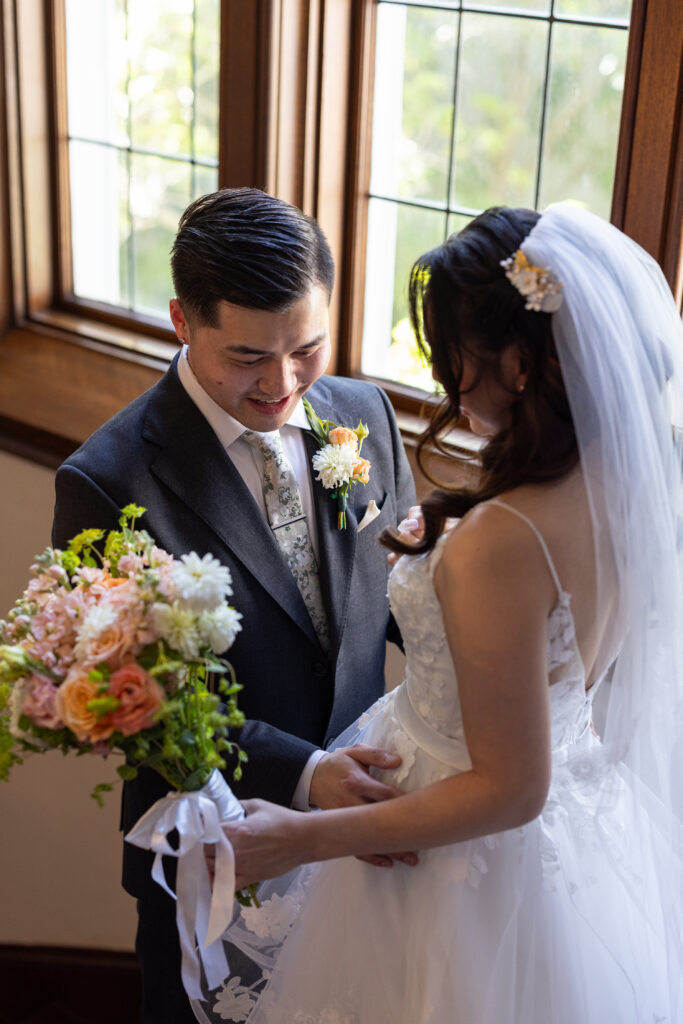
Now she’s ready for her First Look…
… on the main staircase of the Mansion.
Every single time, this is such a special, intimate moment between bride and groom. Truly priceless.
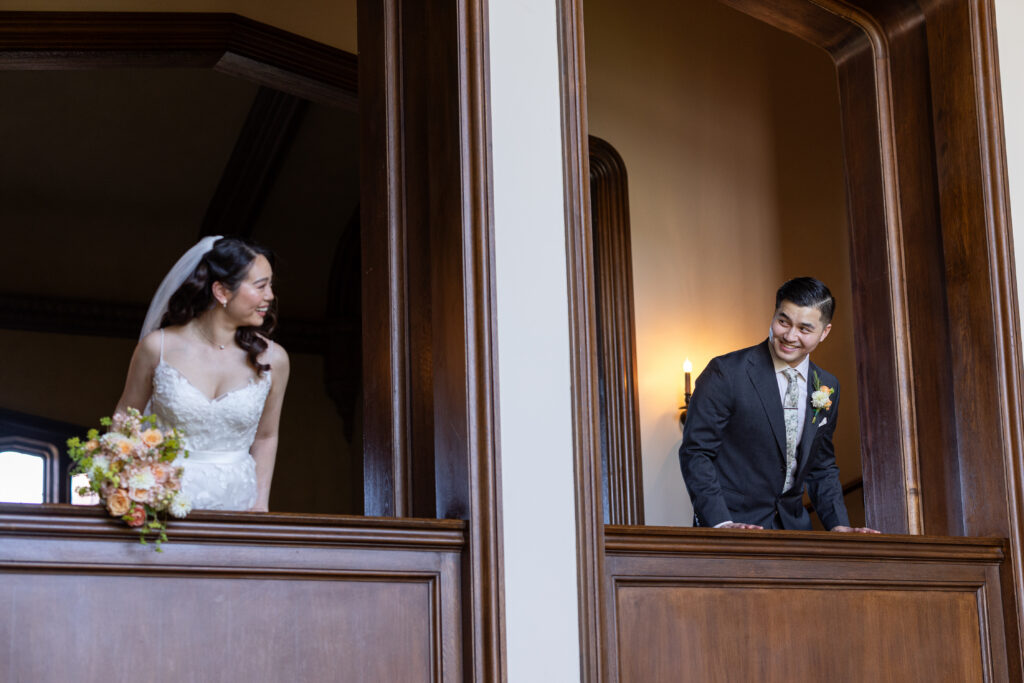
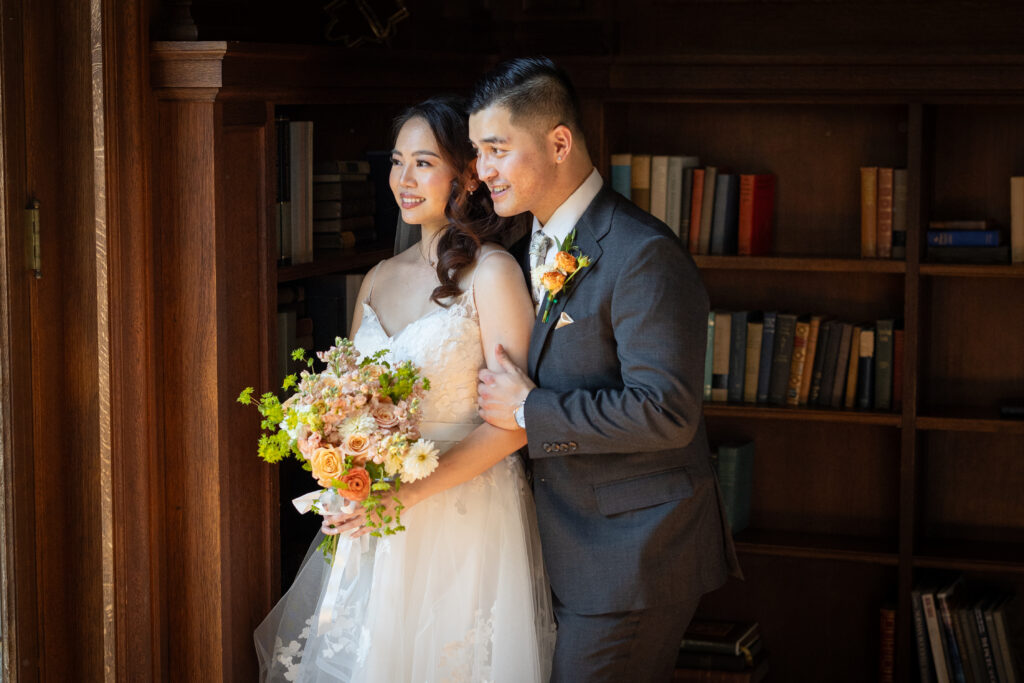
And now, it’s couple’s portrait time! Having fun …
Peekaboo!
On to more official wedding photos…
… like this…
… or this…
… or that one!
Soon enough, guests were arriving (all 200 of them!!)…
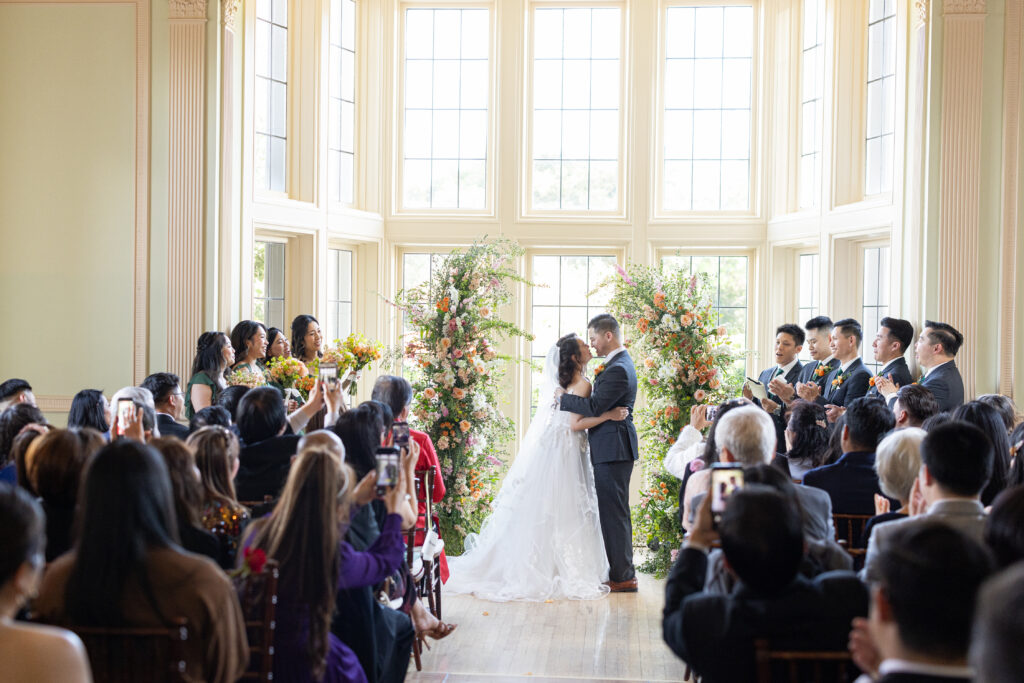
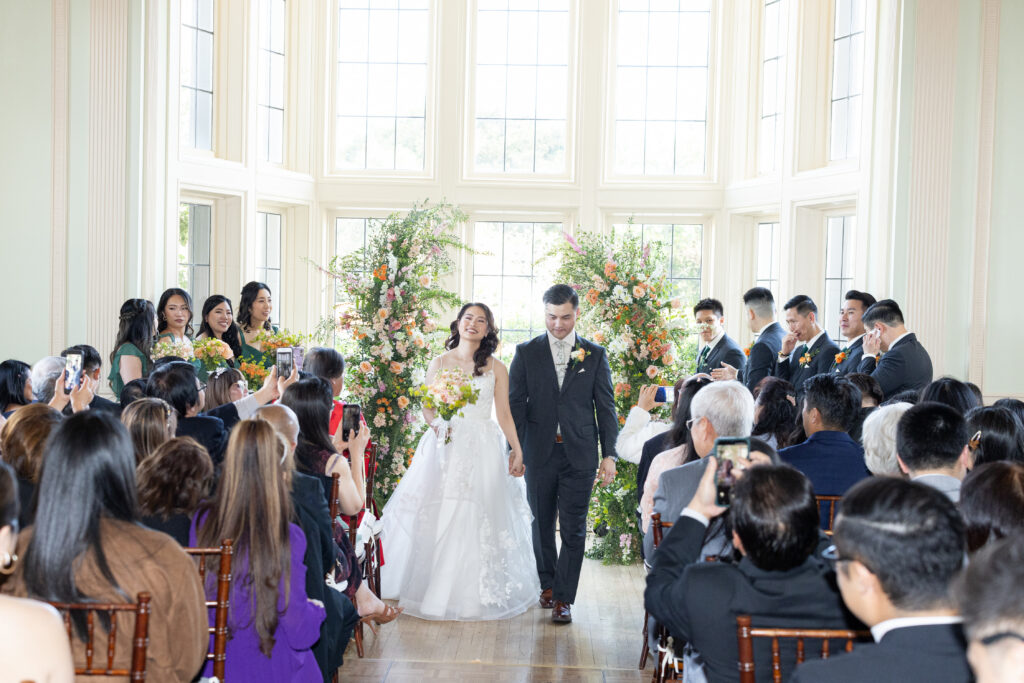
… and the ceremony began in the elegant Green Room of Kohl Mansion, with a friend of the couple officiating.
The Kohl Mansion staff under the leadership of Events Director Denise Severi had done the complete setup – not only for the ceremony, but for cocktails and dinner as well, florist Narose had prepared impressive altar arrangements, and our DJ/MC Paul Burchfield of Big Fun Disc Jockeys provided beautiful music – while photographer Frank Lee and videographer Martin Meyer of martinFILMS captured it all.
Meanwhile, Lucia’s Bar Company had set up the bar in the Courtyard, ready to serve guests right after the ceremony, and Ginger Cafe Catering was ready to serve hors d’oeuvres.
The newlyweds had, of course, even more photos to take:
Time for dinner in the double-height Great Hall at Kohl Mansion!
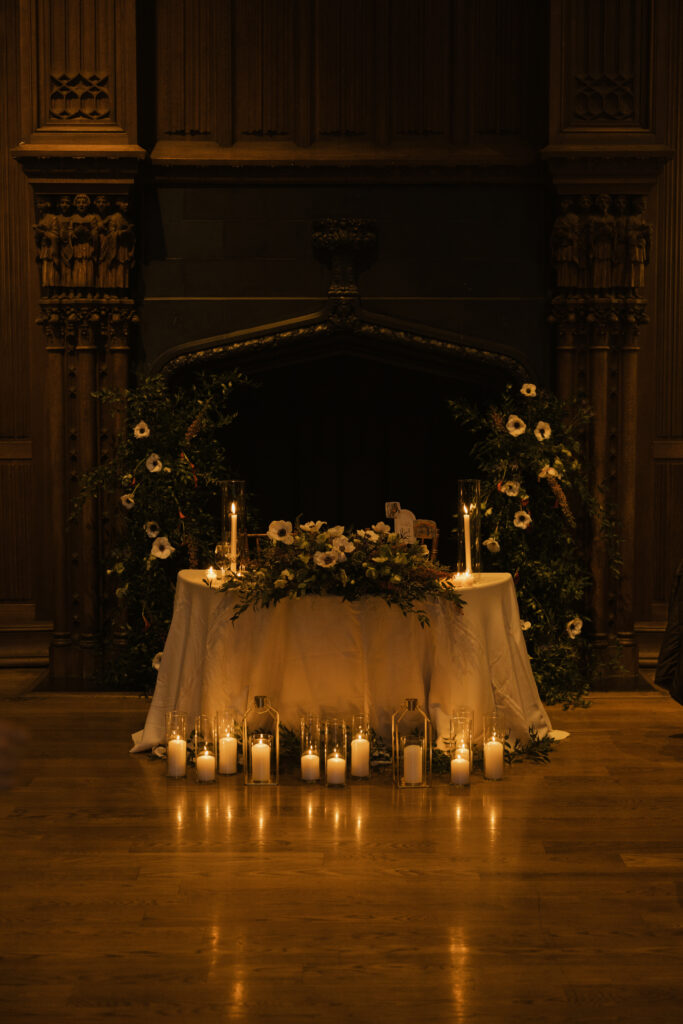
The dinner table centerpieces by florist Narose were literally glowing in fresh Spring colors, and the Sweetheart Table got special treatment.
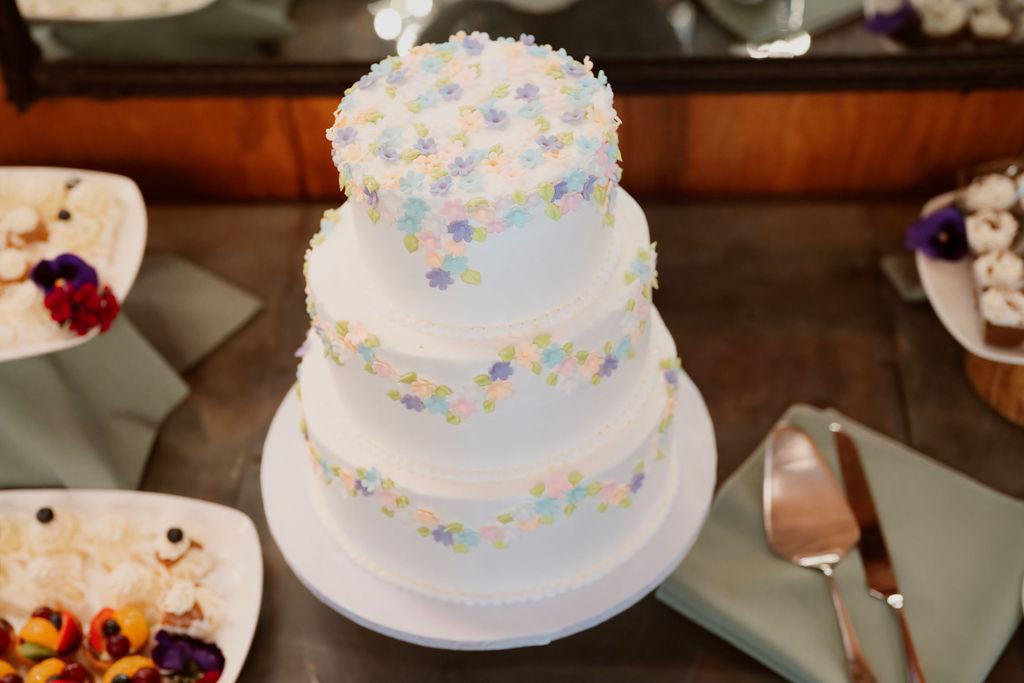
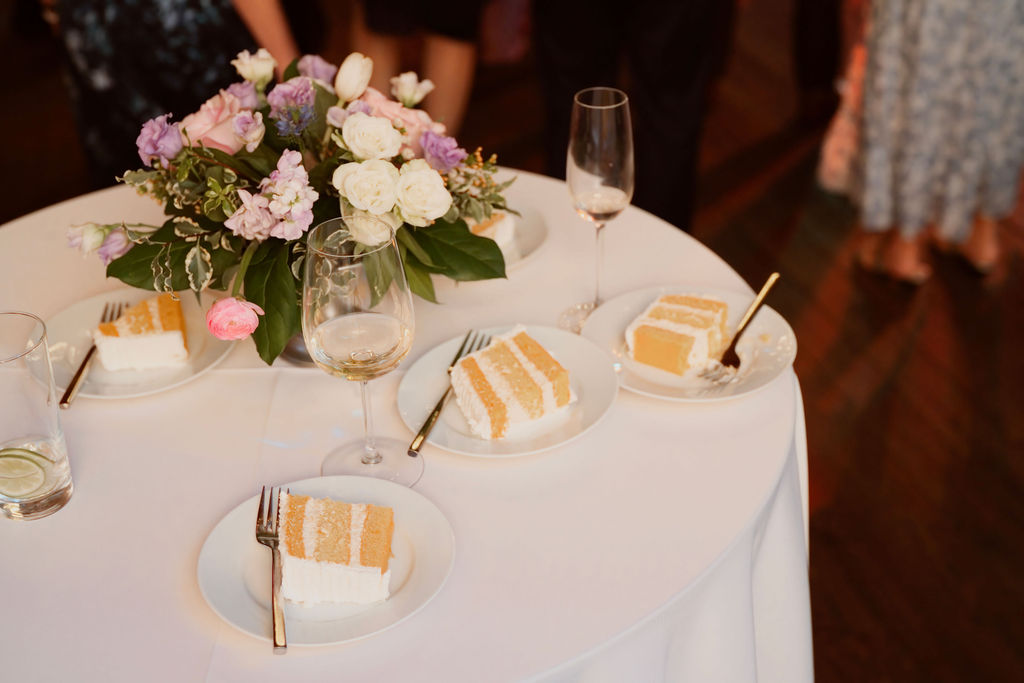
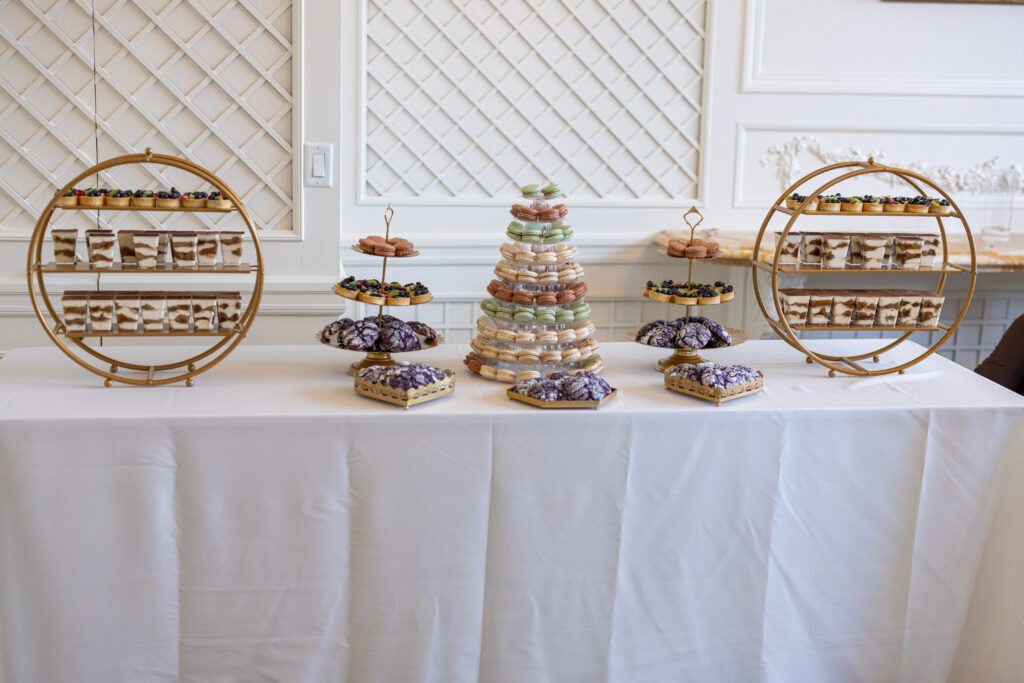
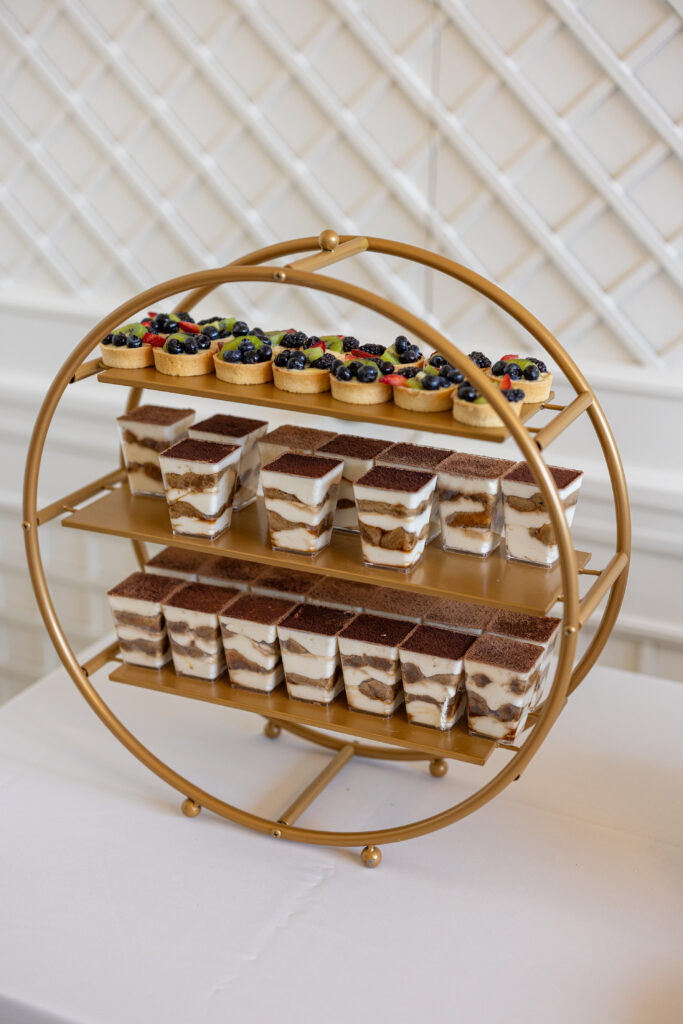
What’s happening after dinner? Cake Cutting! The cake and an impressive dessert buffet had been provided by Always Your Bakery Cafe – look, how pretty!
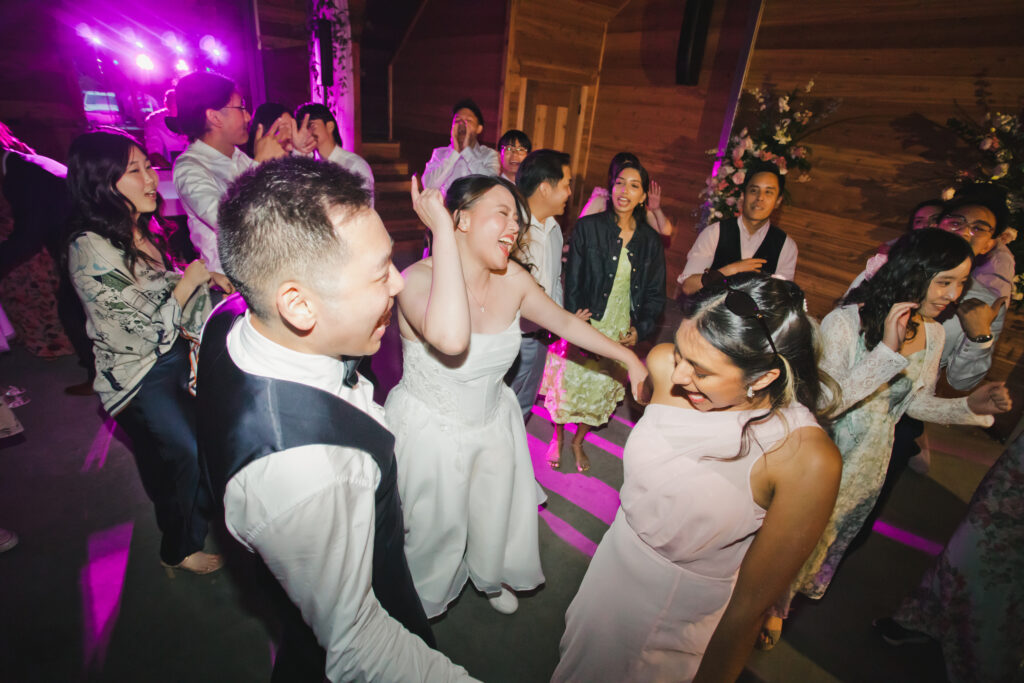
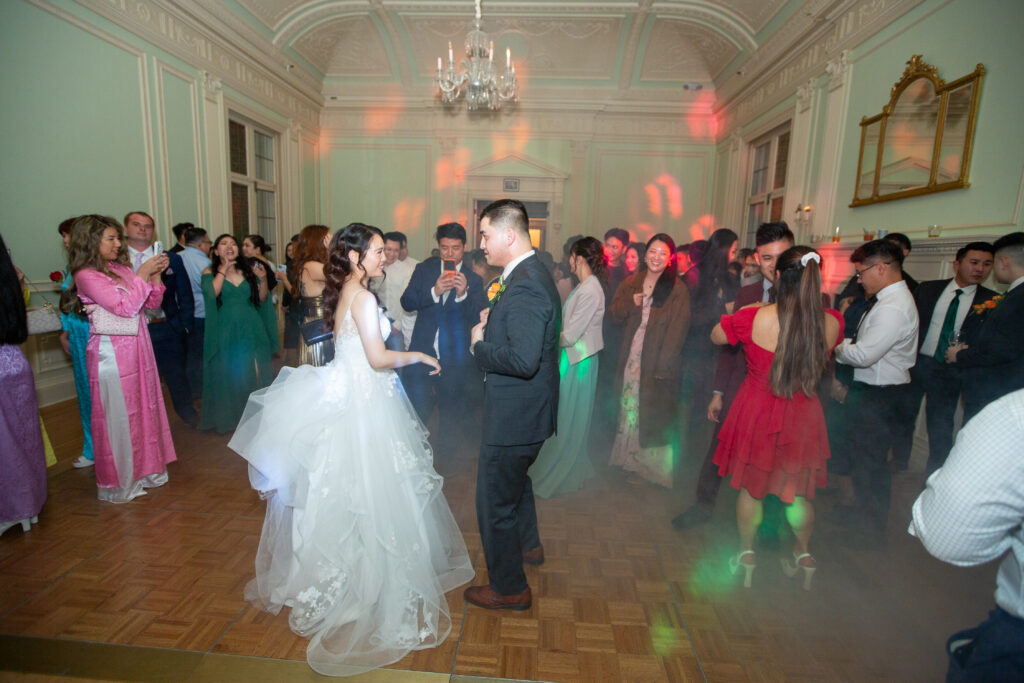
There was one more highlight of the celebration, of course: dancing – and for those who’d take a break, a photobooth.
One thing’s for sure: Andrea and Alexander GOT their dream wedding! Congratulations!
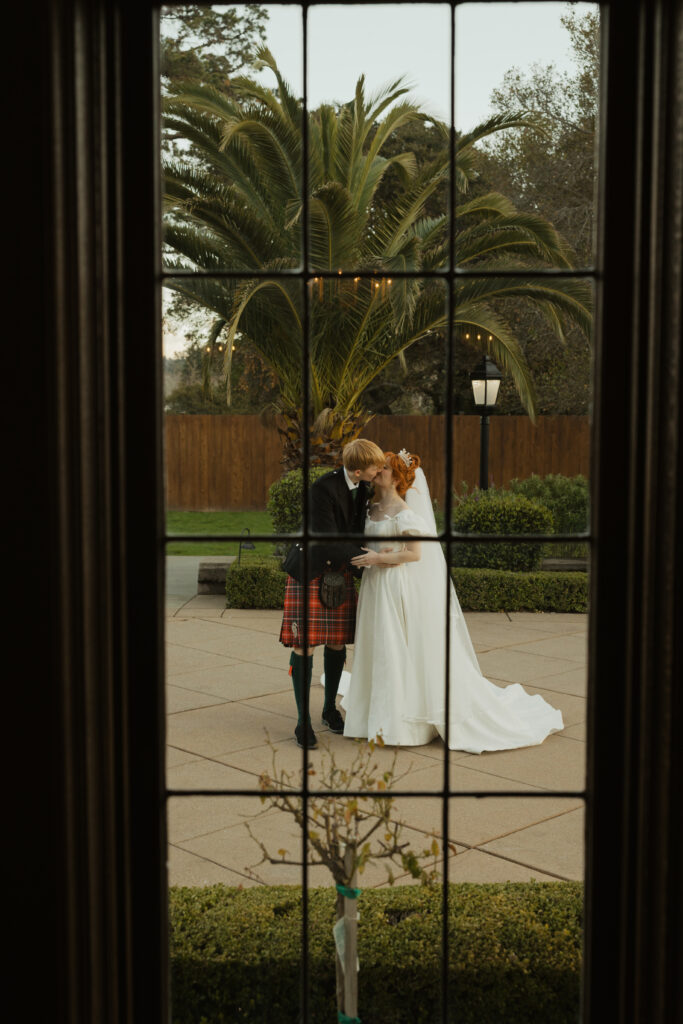
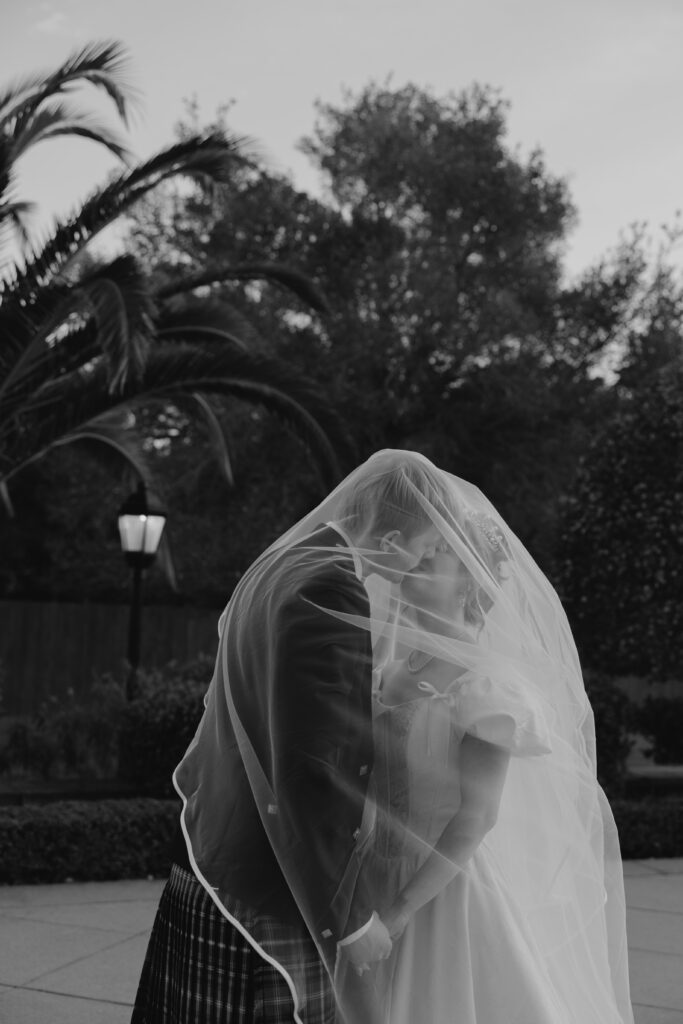
Catherine’s and Jacob’s one-of-a-kind wedding at Kohl Mansion
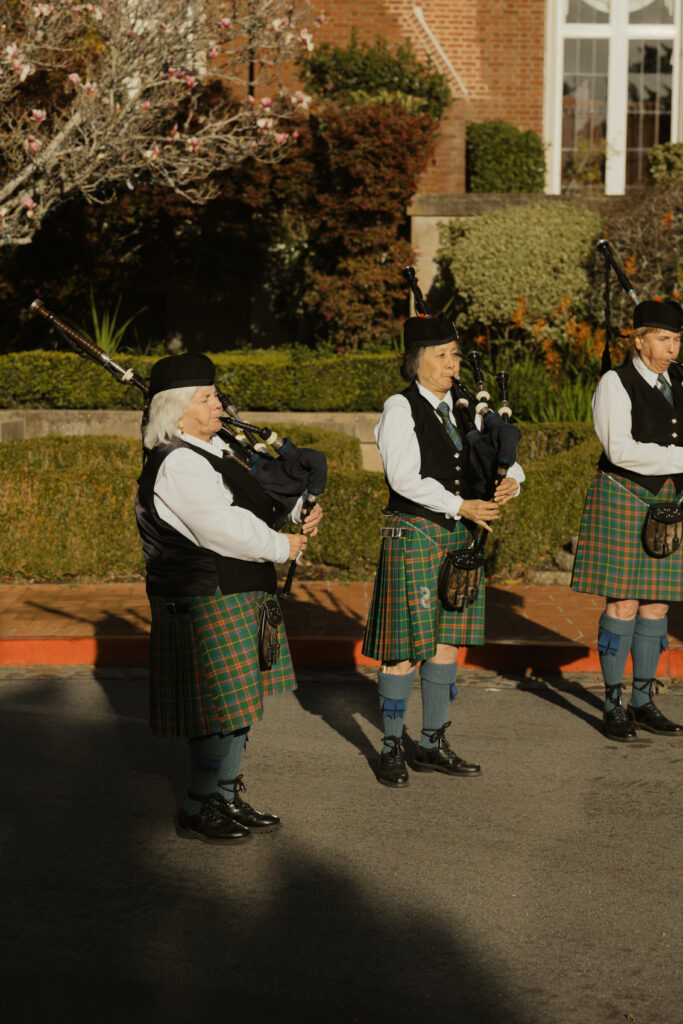
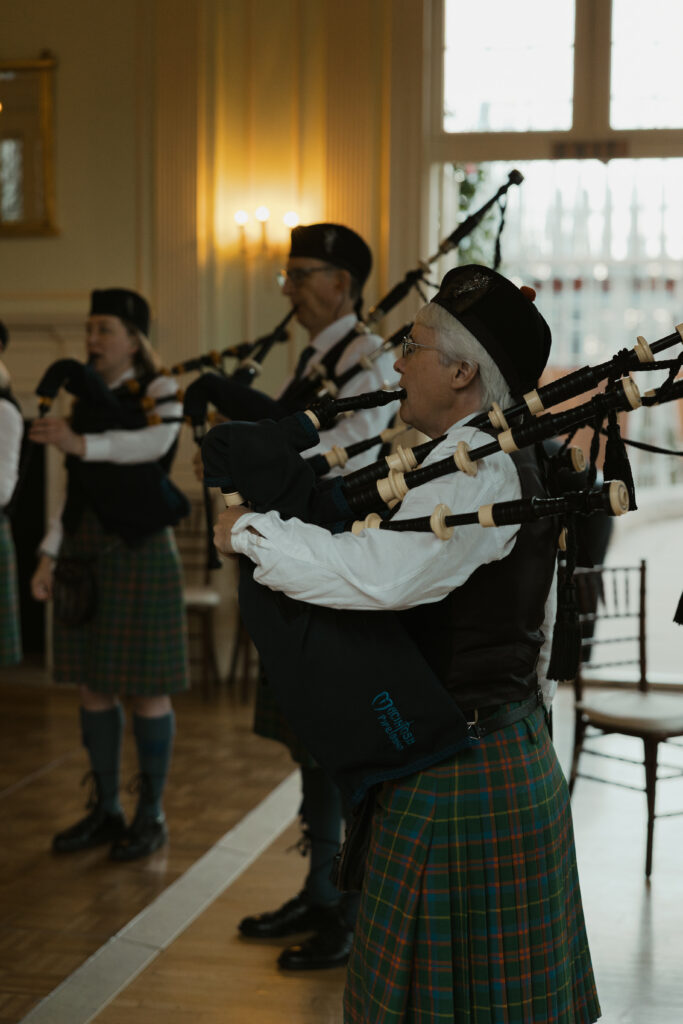
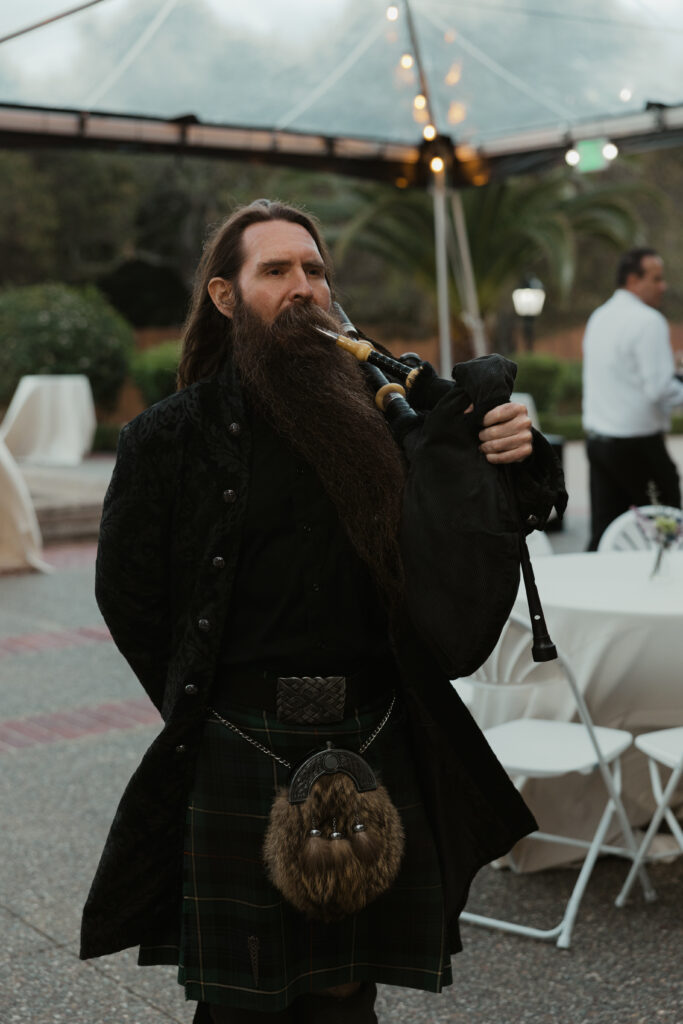
A bagpipe band for the processional? Check.
A Scottish Highland dance performance to entertain the guests? Check.
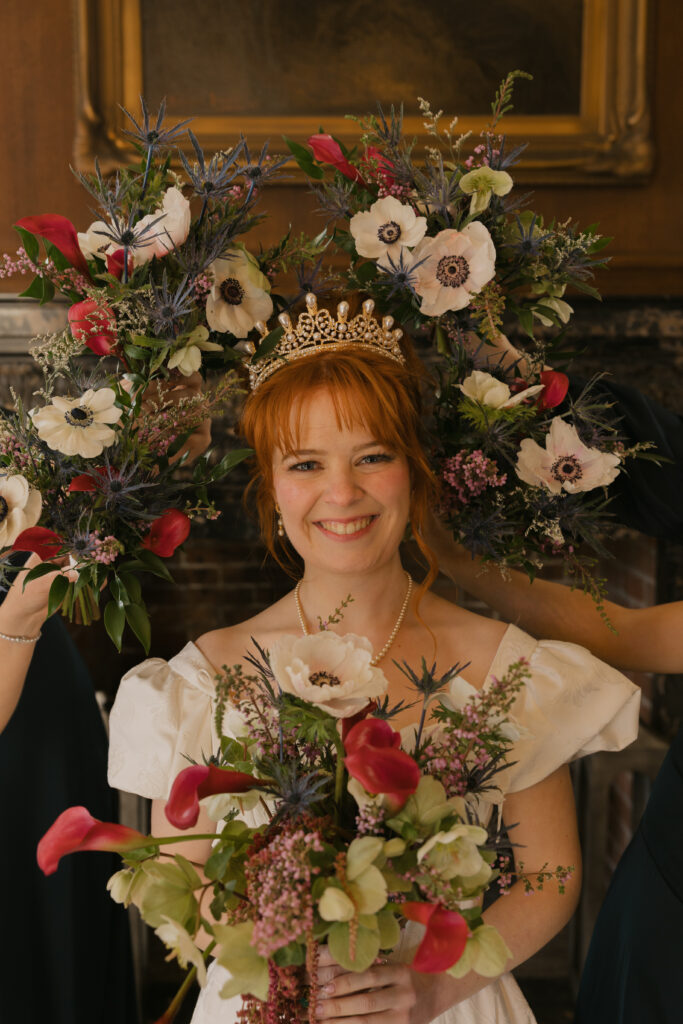
Authentic Scottish-only flowers for all bouquets? Check.
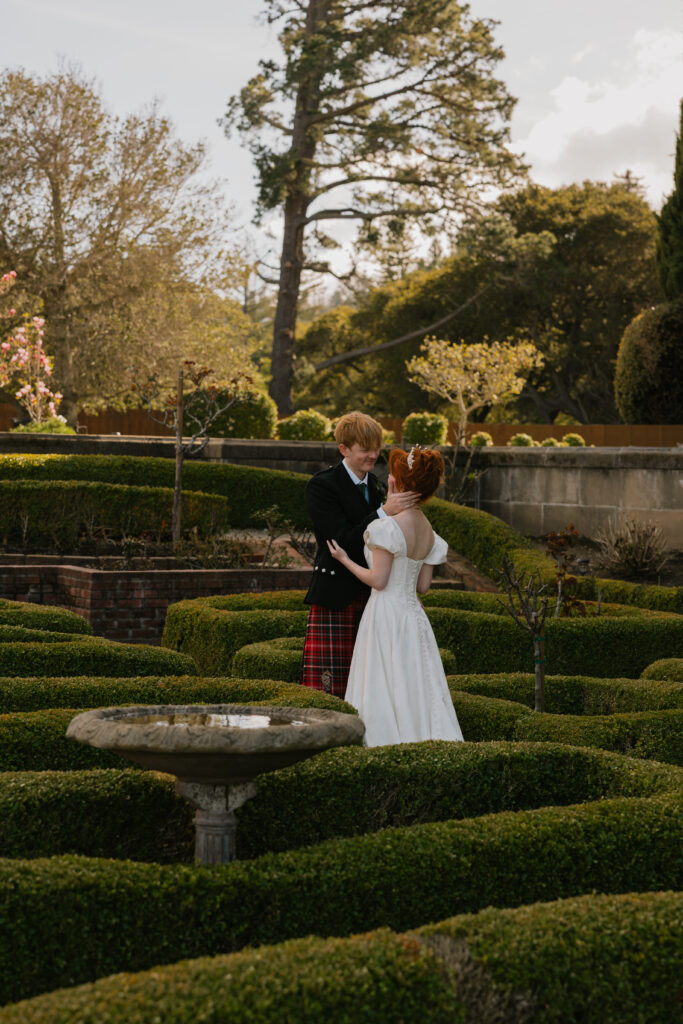
All the gentlemen in kilts? Of course!
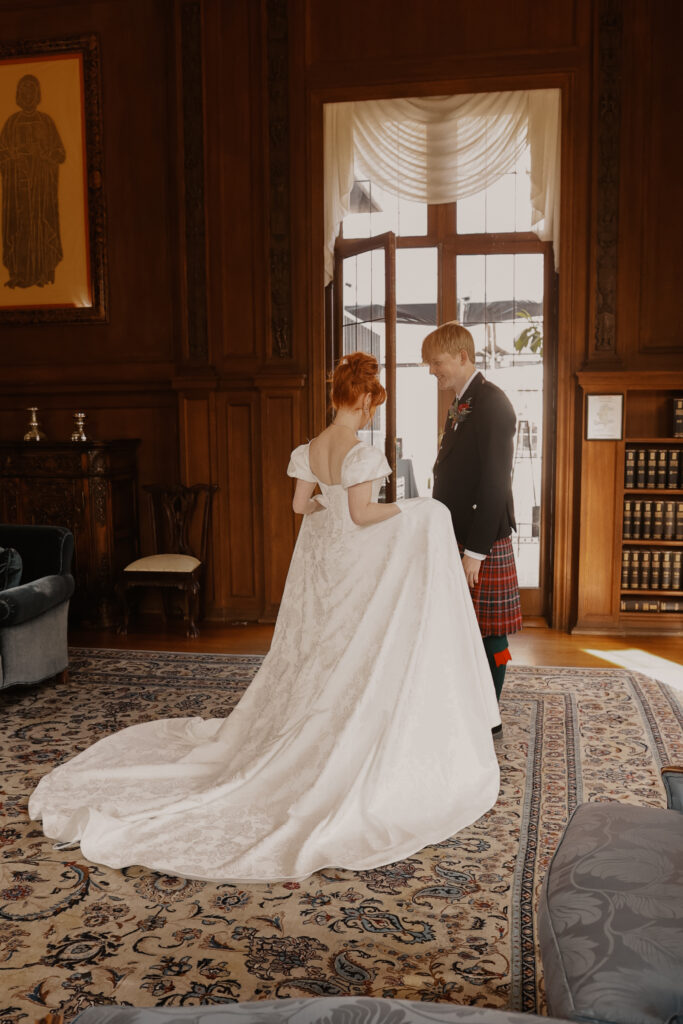
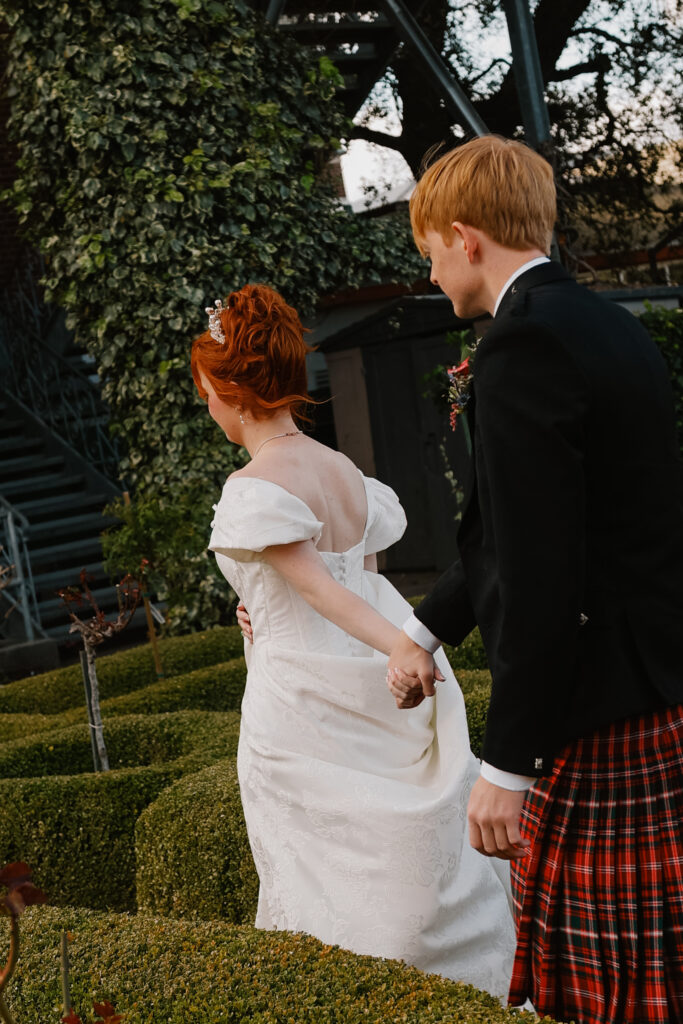
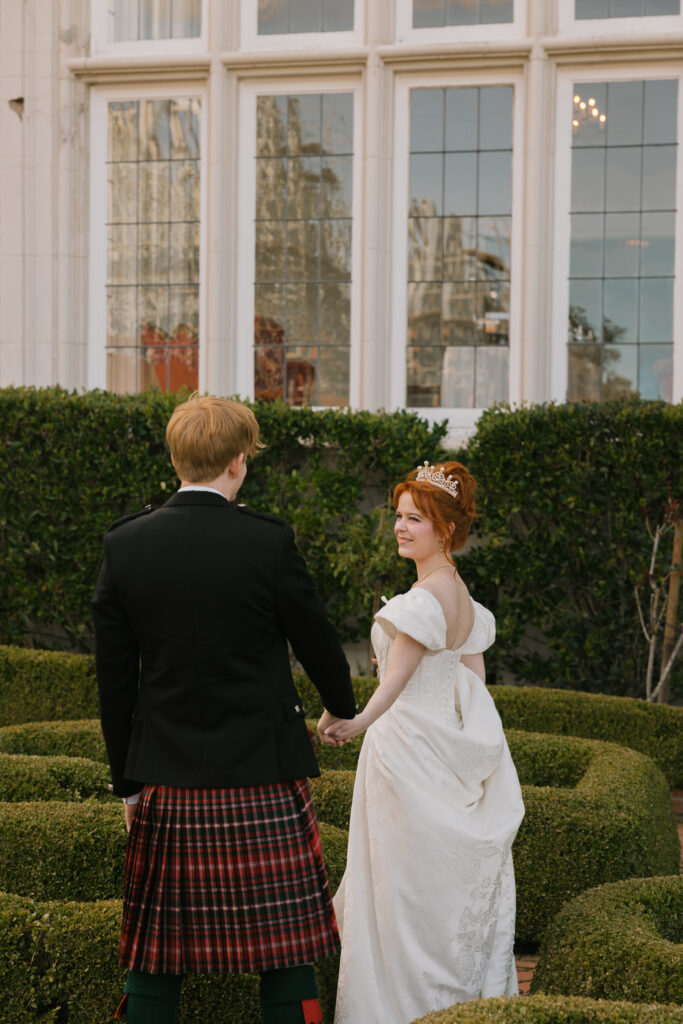
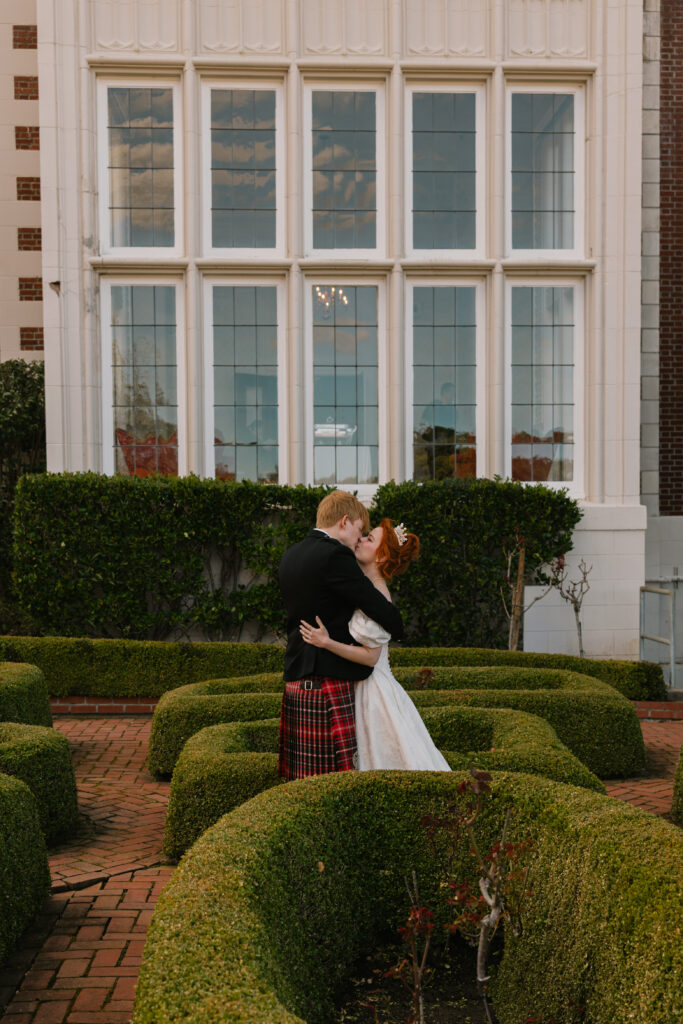
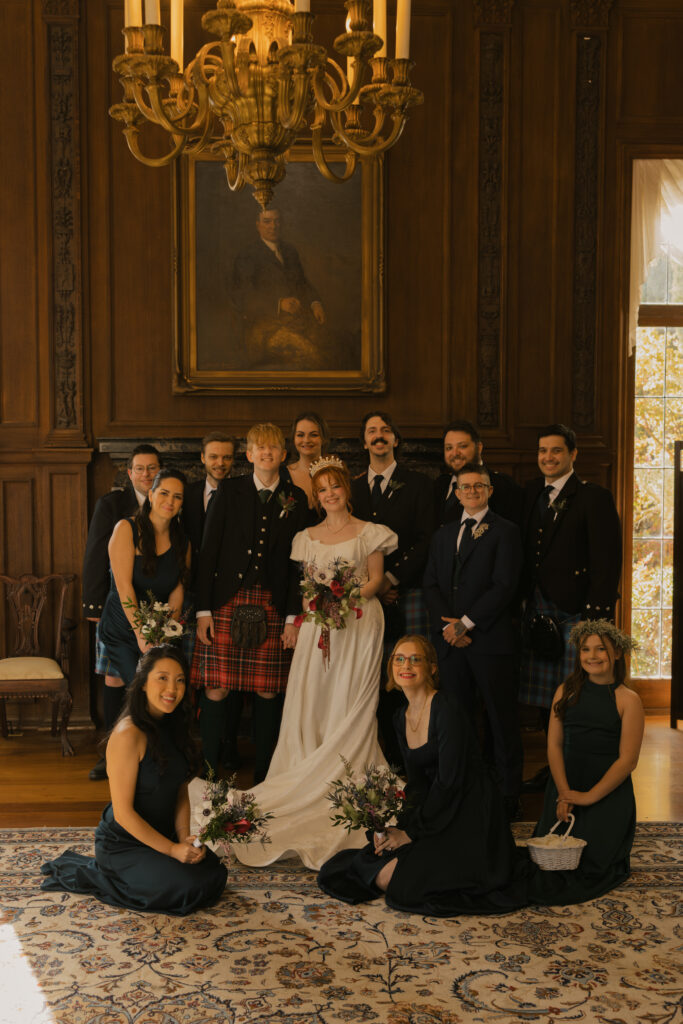
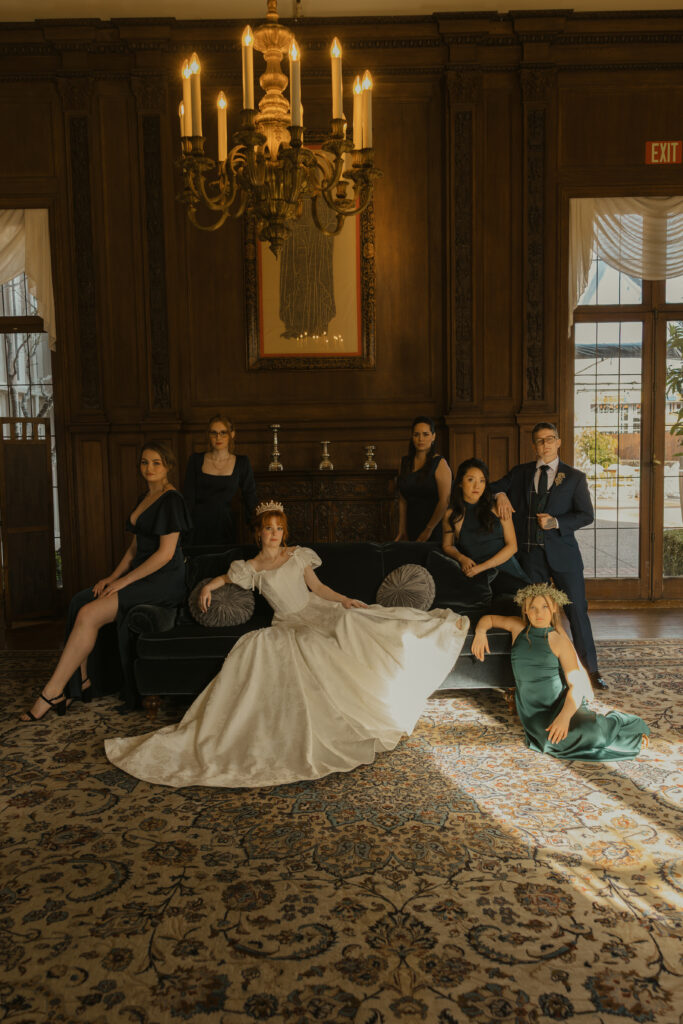
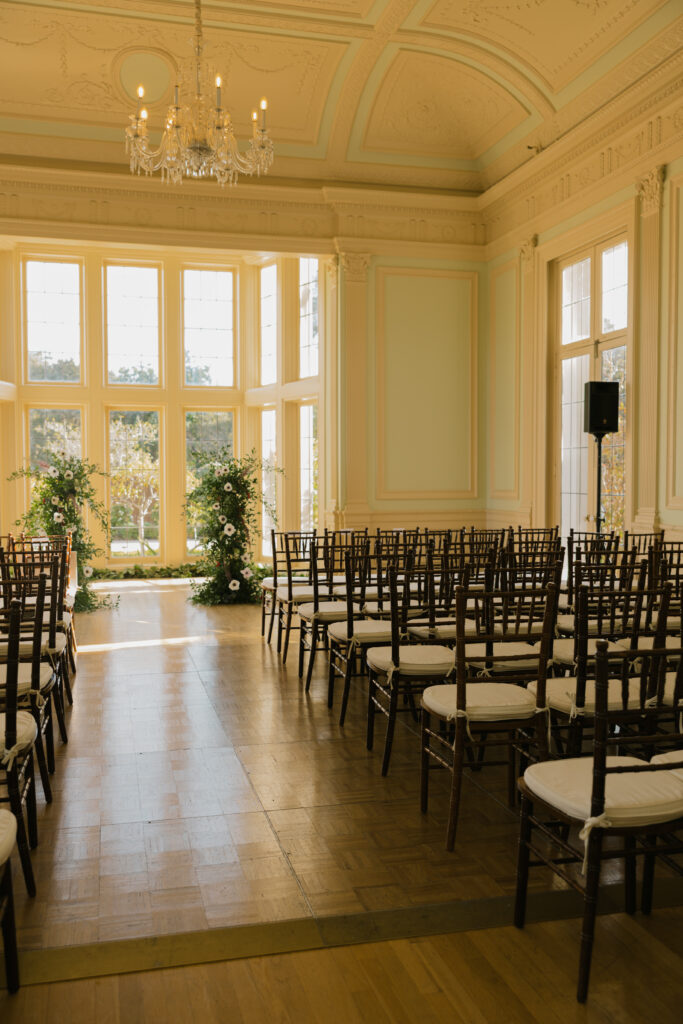
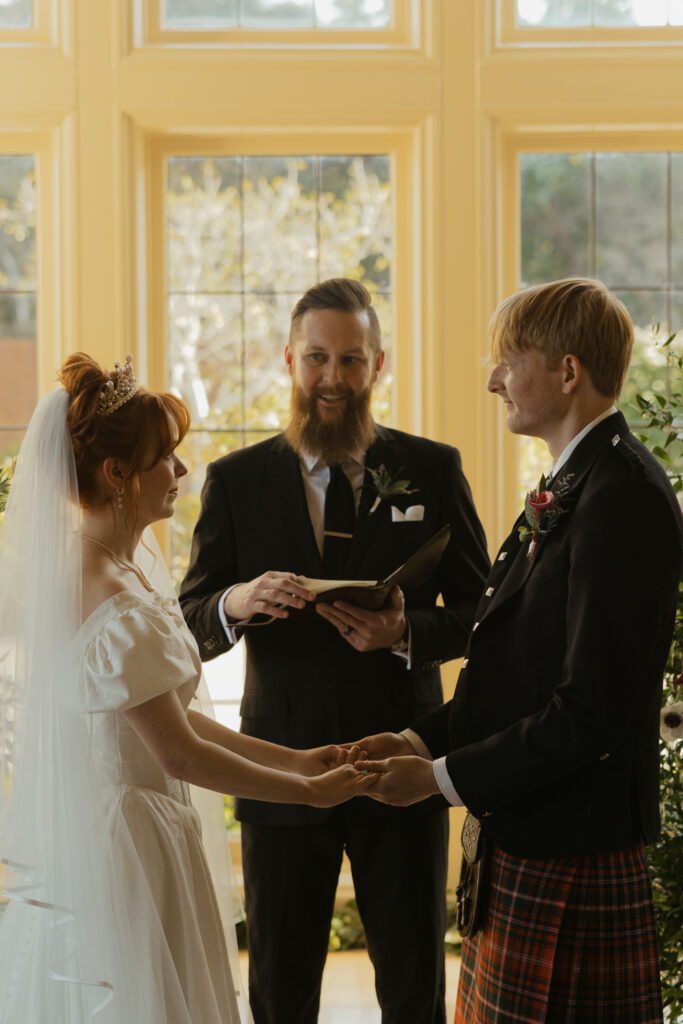
And so on, and so forth. This wedding was “one for the ages!” Bride Catherine, of Scottish-Danish heritage, and an accomplished professional Scottish Highland dance instructor, pulled all the stops for her authentic, traditional nuptials – and historic Kohl Mansion in Burlingame, with its double-height Great Room and dark wood paneling, was the perfect setting for her vision. And Jacob, her groom, was fully onboard with this vision from Day One!
So we (at A Day Like No Other) got started, with nine months to go. Selecting authentic Scottish Highland flowers took intense, deep research (by Laurel & Vine) – sourcing these flowers (or their closest substitutes) in California was yet another story… Bride Catherine took responsibility for all other things Scottish, especially the gentlemen’s traditional attire (kilts in the bride’s family tartan!), a bagpipe band (complete with kettledrums!), a Scottish Highland dance performance … AND a traditional Danish wedding cake (to honor the “other side” of her cultural heritage). Suffice it to say that planning this wedding was very intense and involved, and we just made it to the finish line!
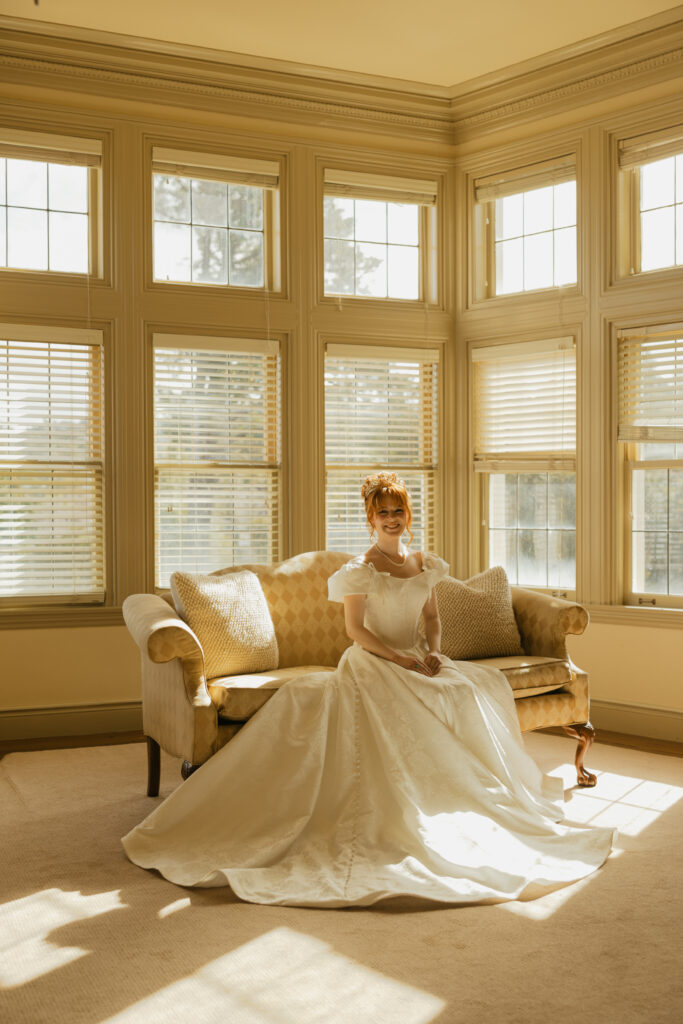
Finally, the big day had arrived, and Catherine began the day with hair and makeup services by Tiffany Chiang of Design HER Image, then getting into her classic, very feminine wedding dress.
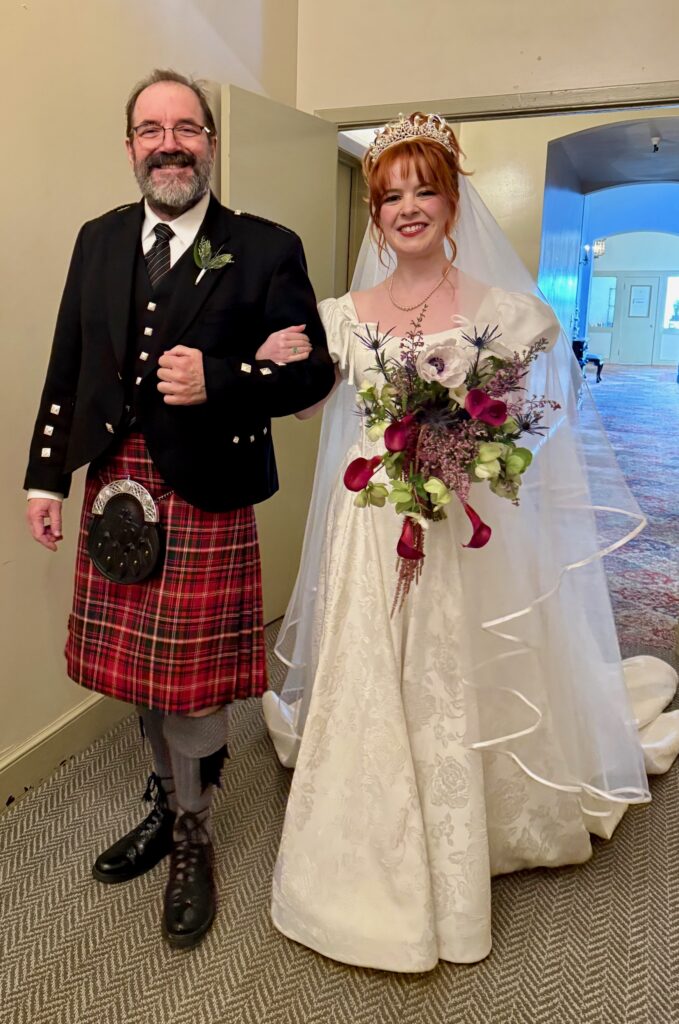
Here she is, at Kohl Mansion, in timeless beauty – and poise:
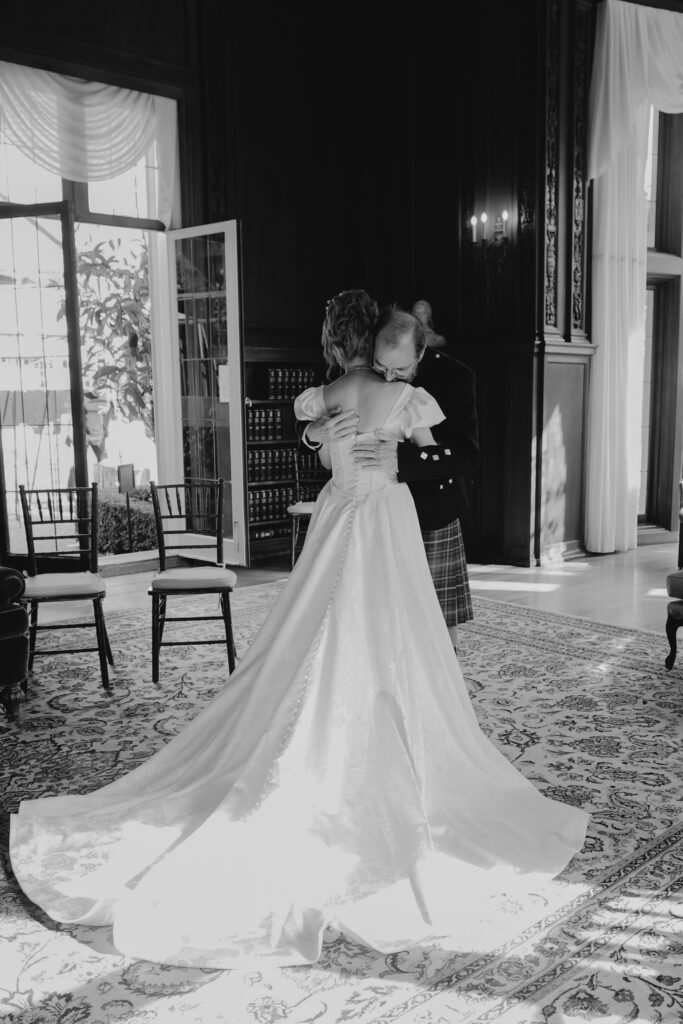
She could easily be royalty, don’t you think? Time for a very emotional First Look with her Dad…
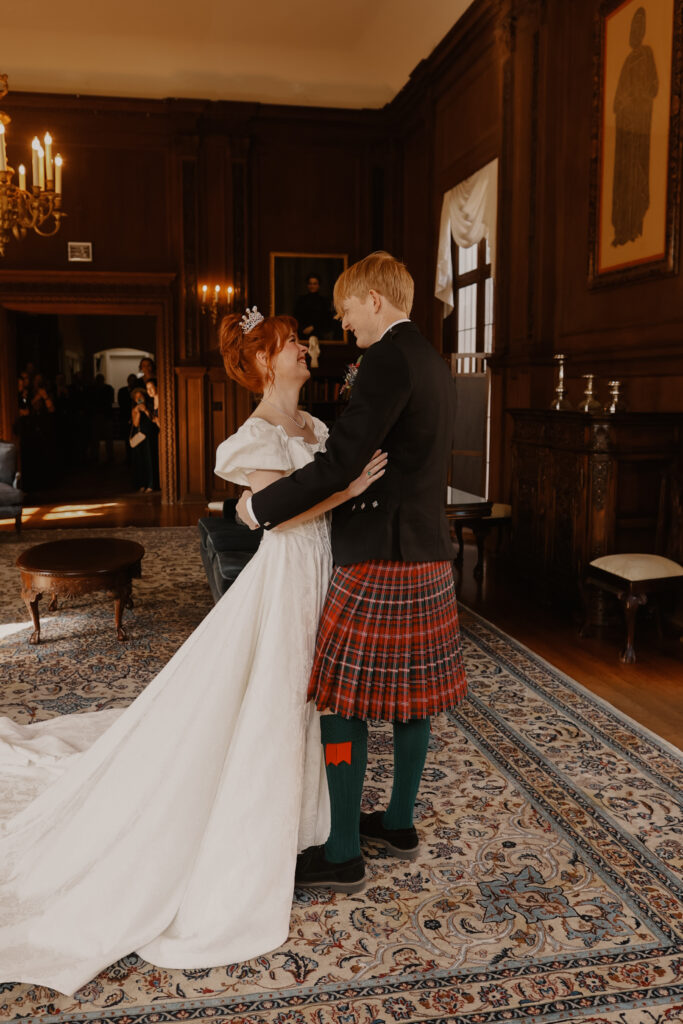
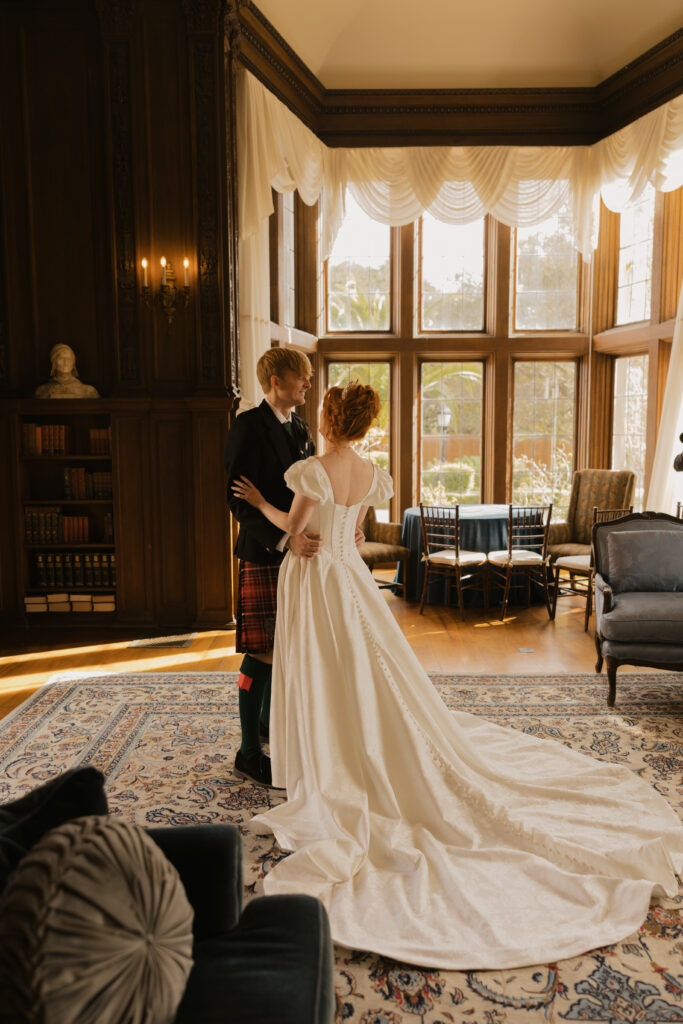
… followed by a First Look with her groom, Jacob.
Had you told me that this was the wedding of a Scottish duchess at her castle – I would have believed it!
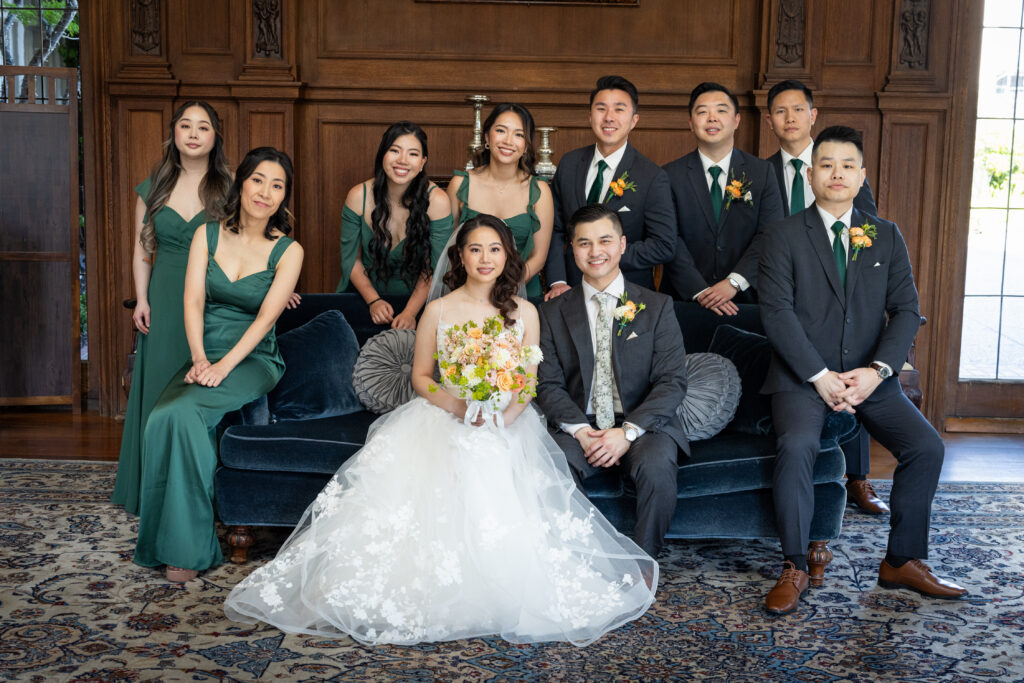
Of course, there were also photos of the bridal party…
… and of the radiant bride with her flowers!
Soon enough, guests were about to arrive, and they were greeted in style by the Macintosh Pipe band:
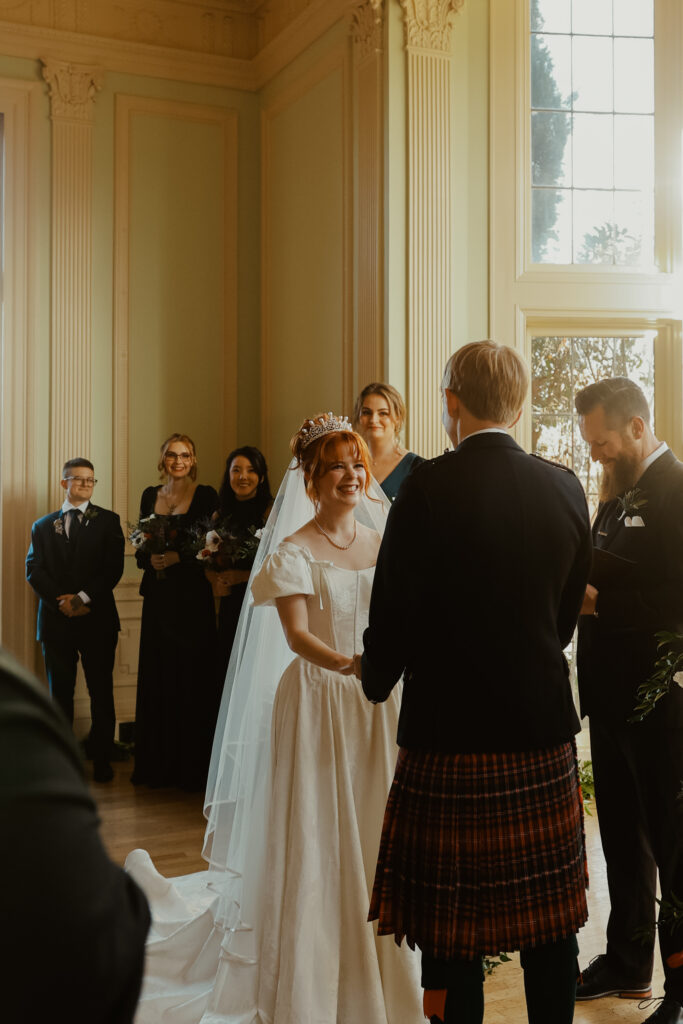
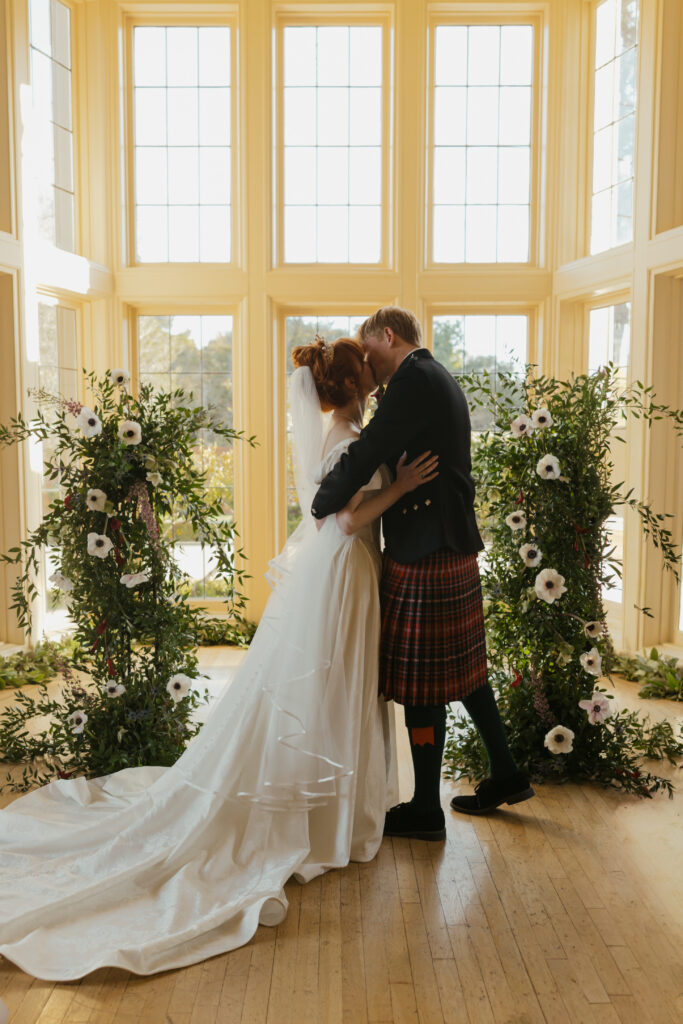
… something definitely so far unheard-of at this venue! As the wedding fell in the colder season in California, Catherine and Jacob held their wedding ceremony indoors, again accompanied by bagpipe tunes.
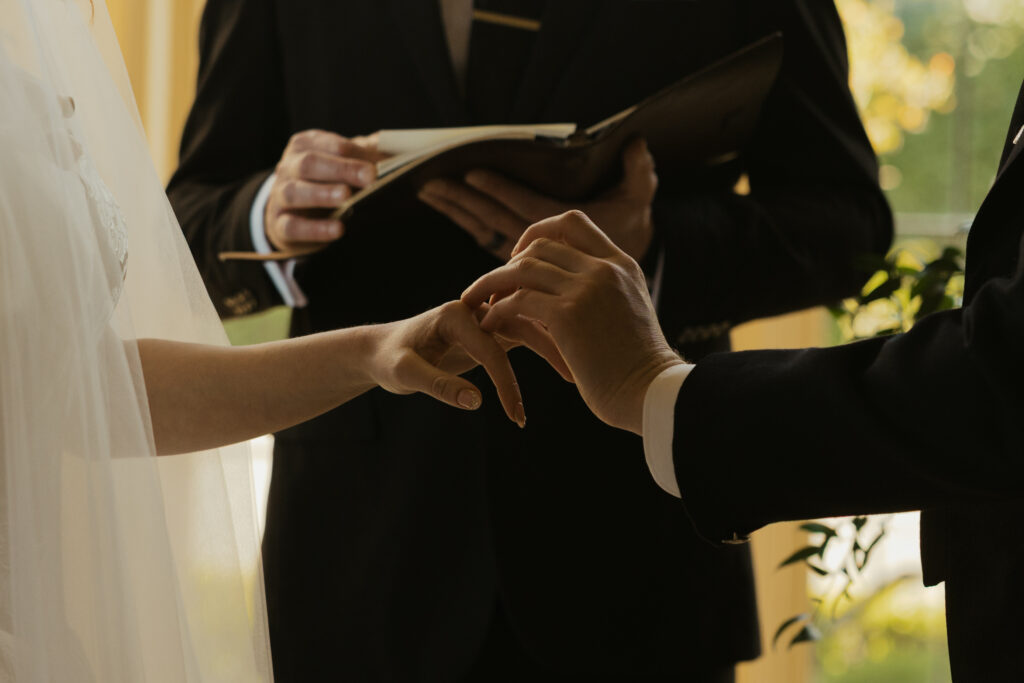
“With this ring, I thee wed…”
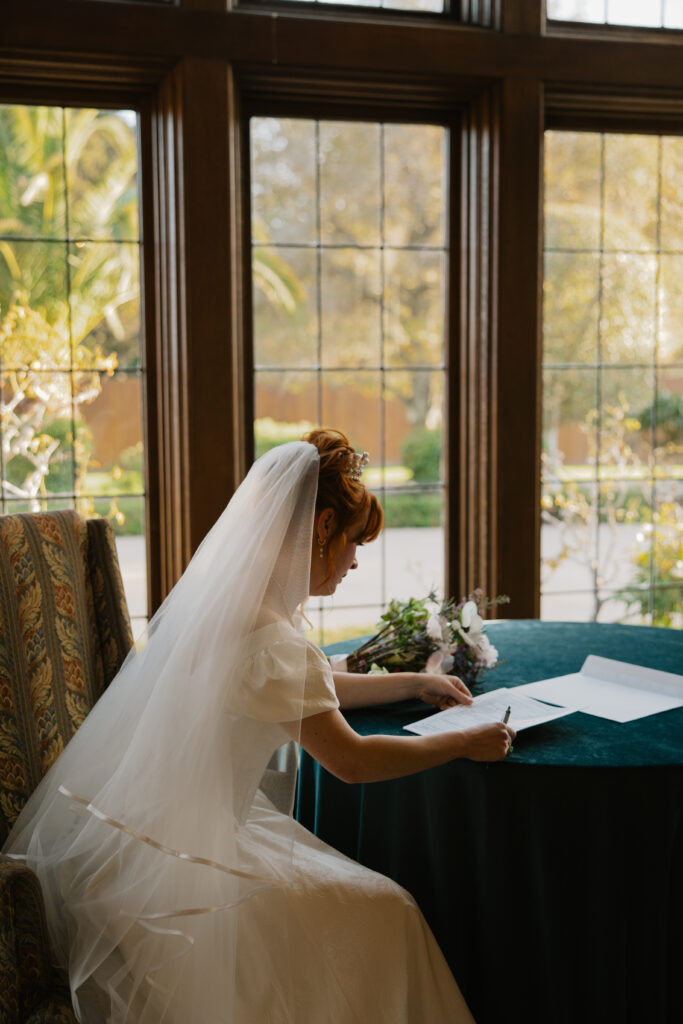
The mandatory signing of the marriage license literally “sealed the deal…”
… and the newlyweds had more photos to take…
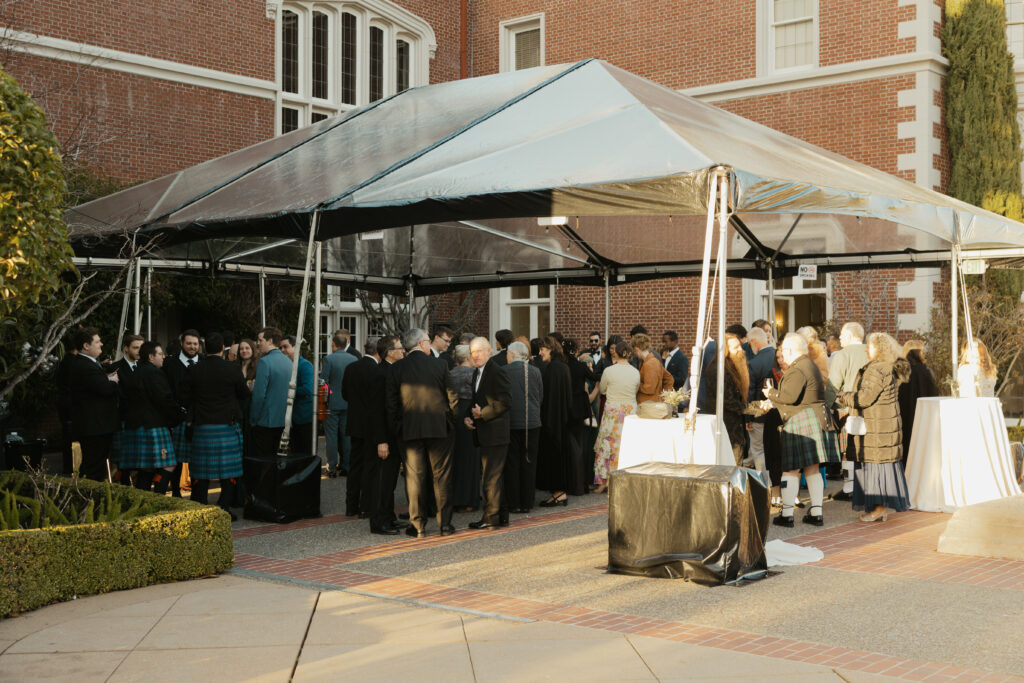
… while their guests enjoyed Cocktail Hour outdoors, protected by a tent (from Hensley Event Resources)…
… and entertained by more bagpipe music!
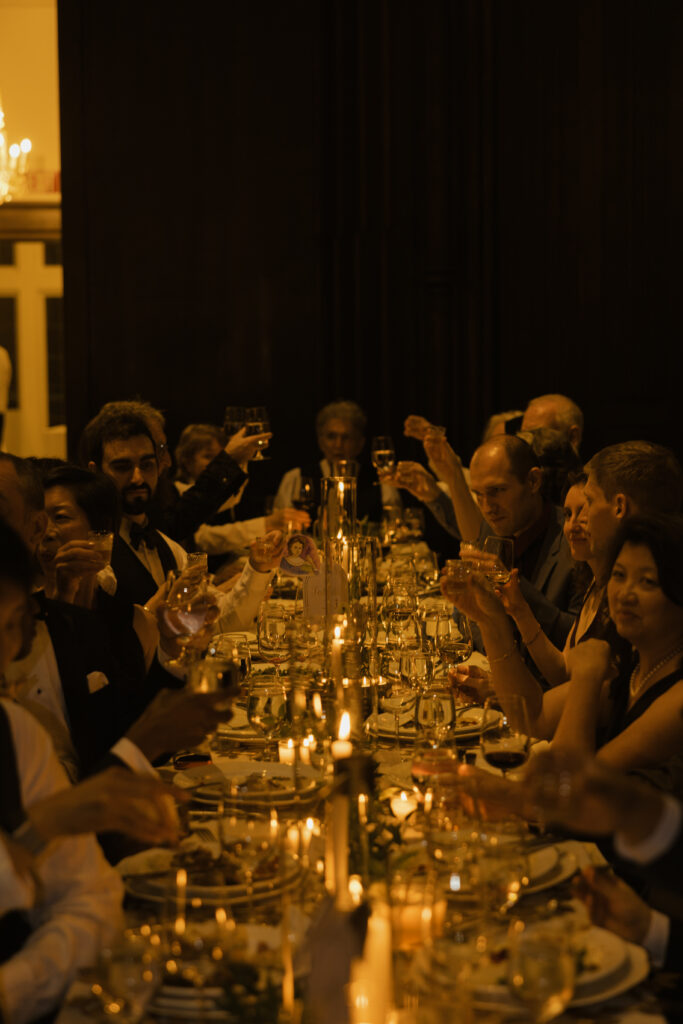
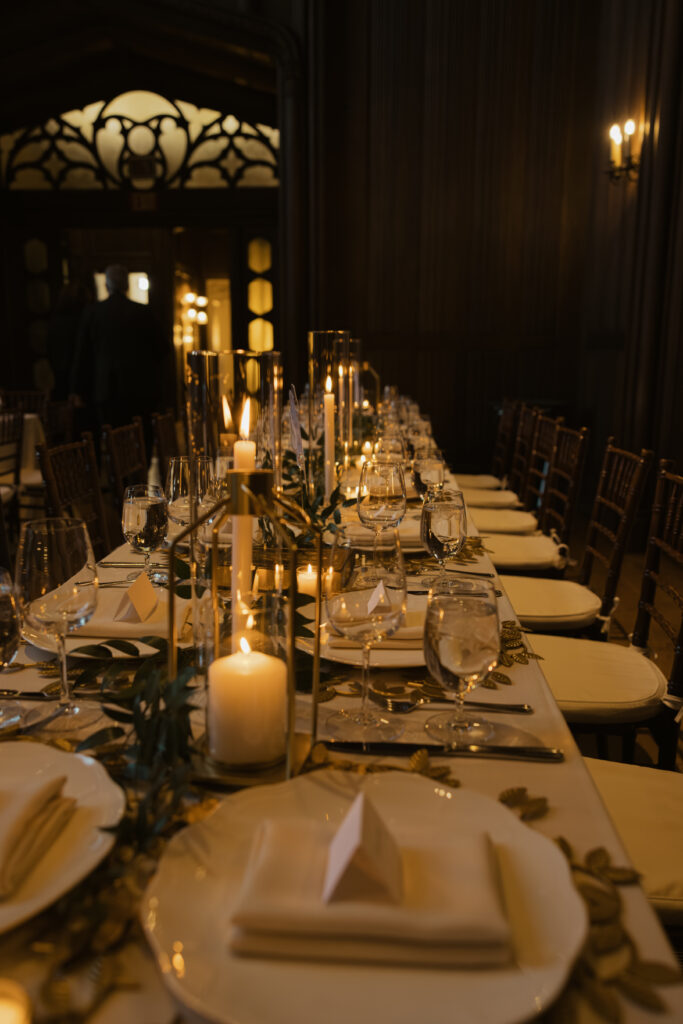
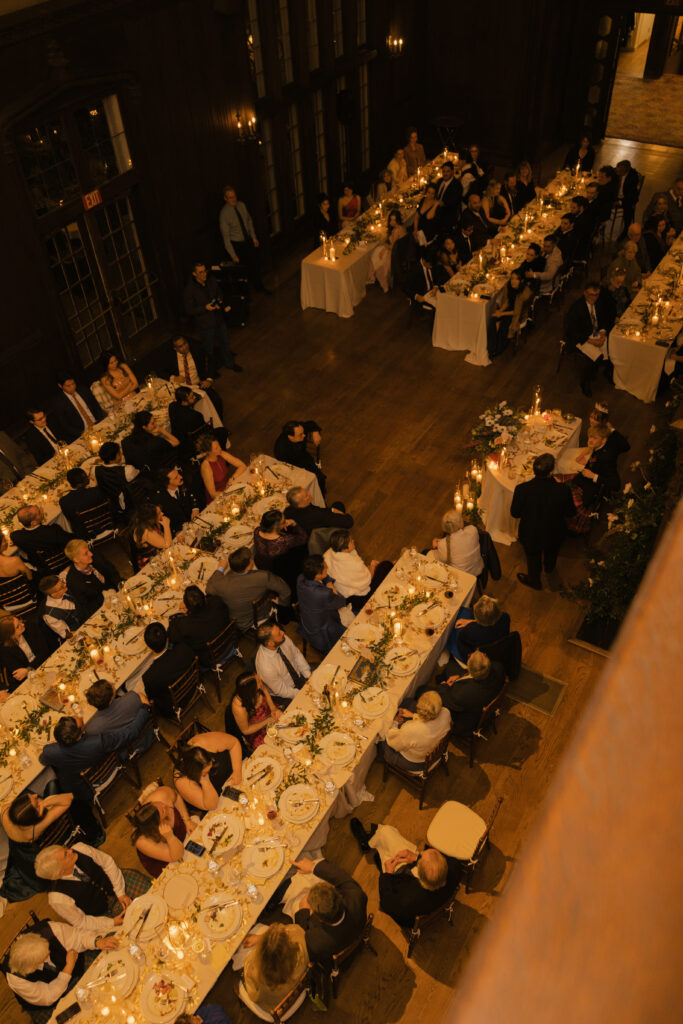
All the while, dinner preparations were underway behind the scenes – fast and furious! The team of Continental Caterers had the dining room set up (with beautiful rental items from Hensley Event Resources) and the kitchen going; florist Marie of Laurel & Vine set the long rows of dining tables with green garlands and a profusion of candlelight; DJ Paul of Big Fun Disc Jockeys was setting up sound and light both for speeches over dinner and then, of course, for dancing; and my production team of A Day Like No Other orchestrated it all.
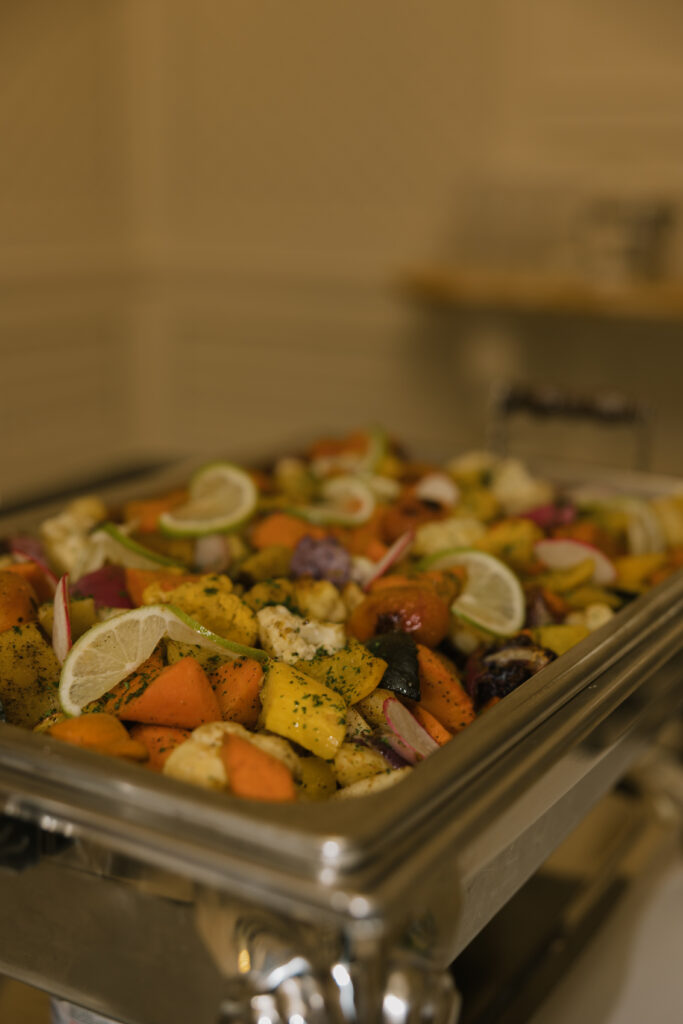
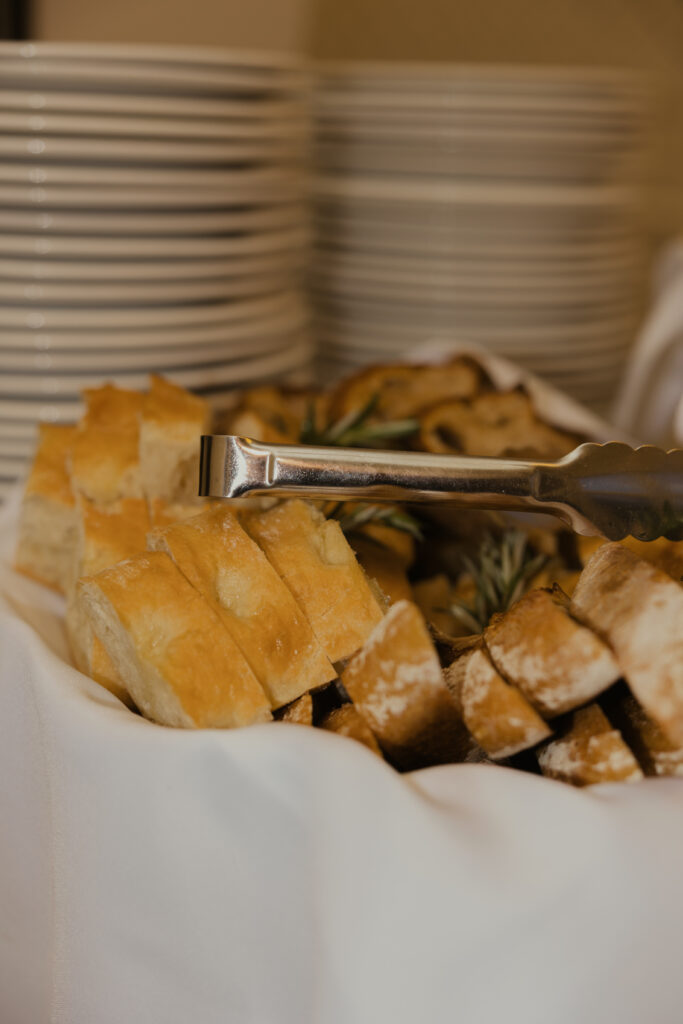
It was a feast of epic proportions, hearkening back to times long past… and utterly romantic!
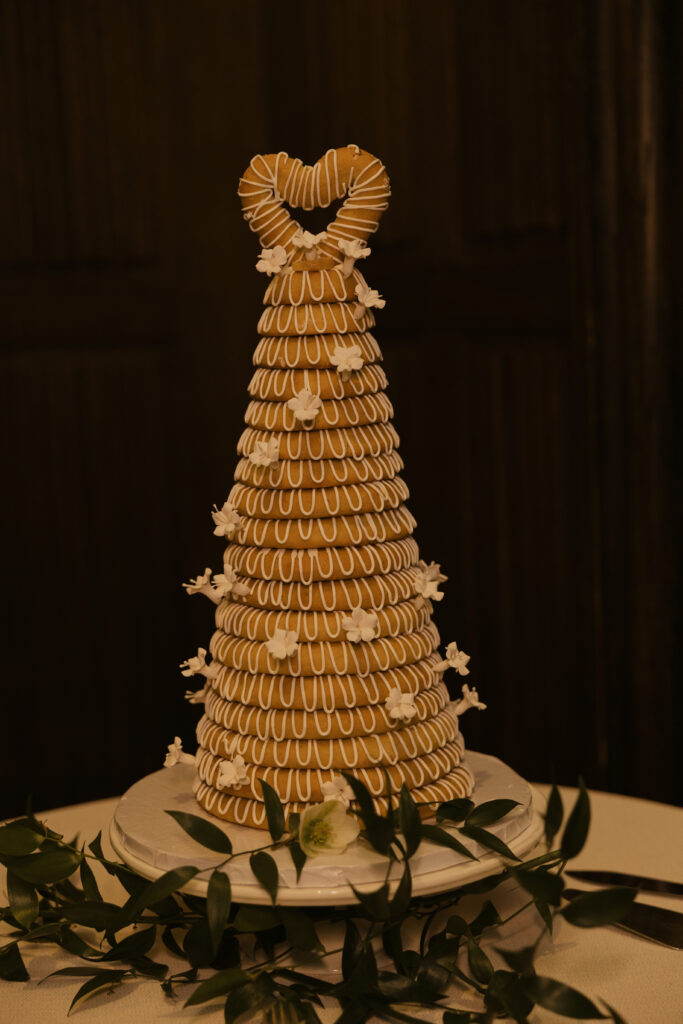
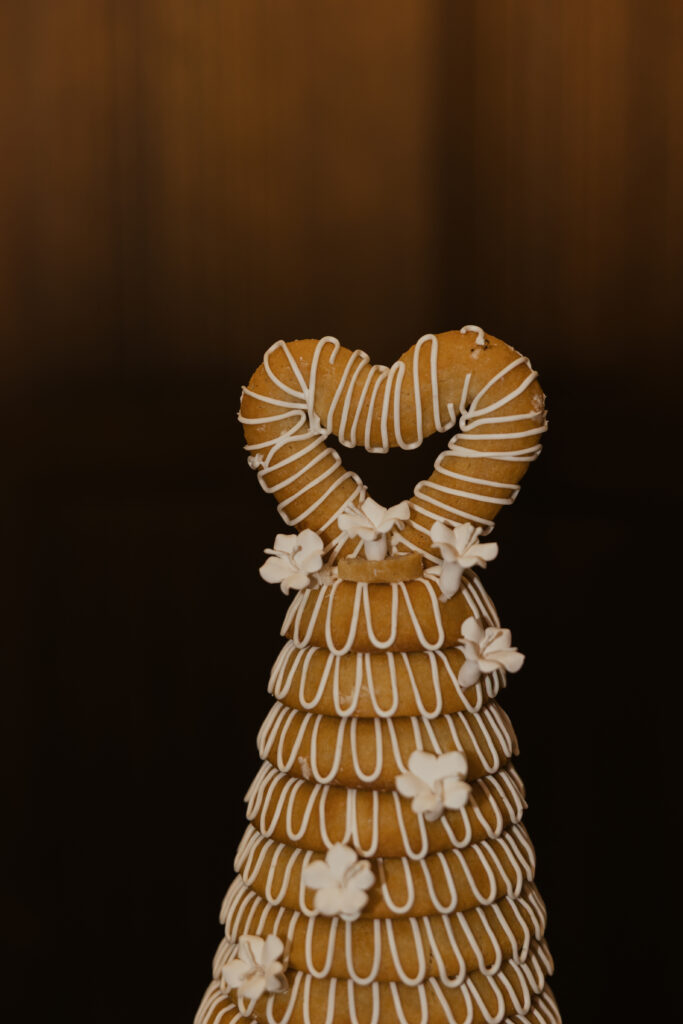
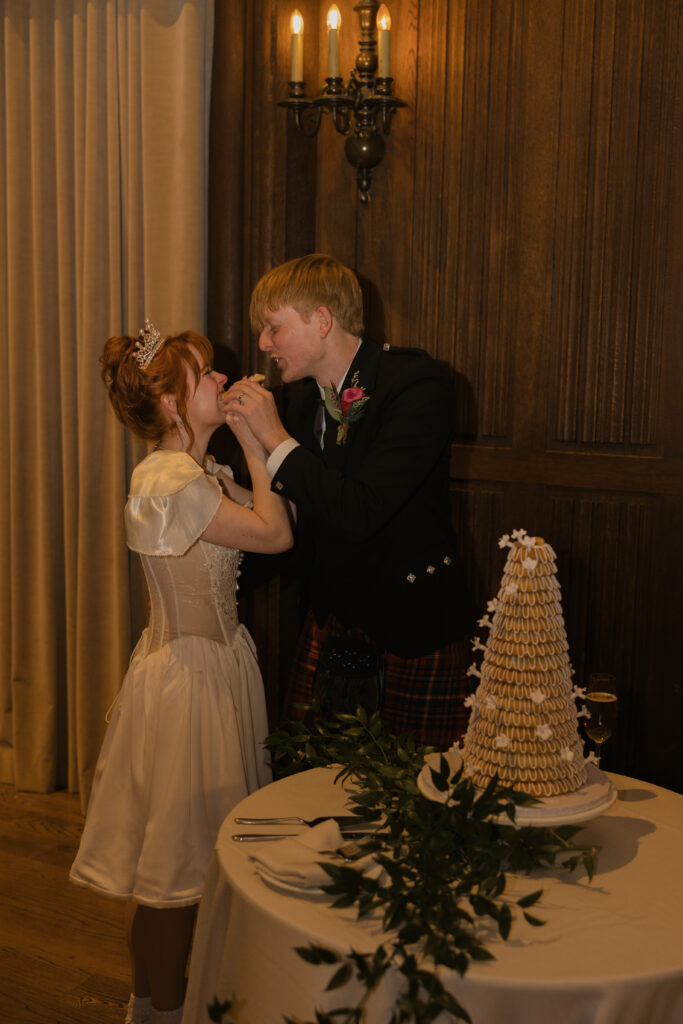
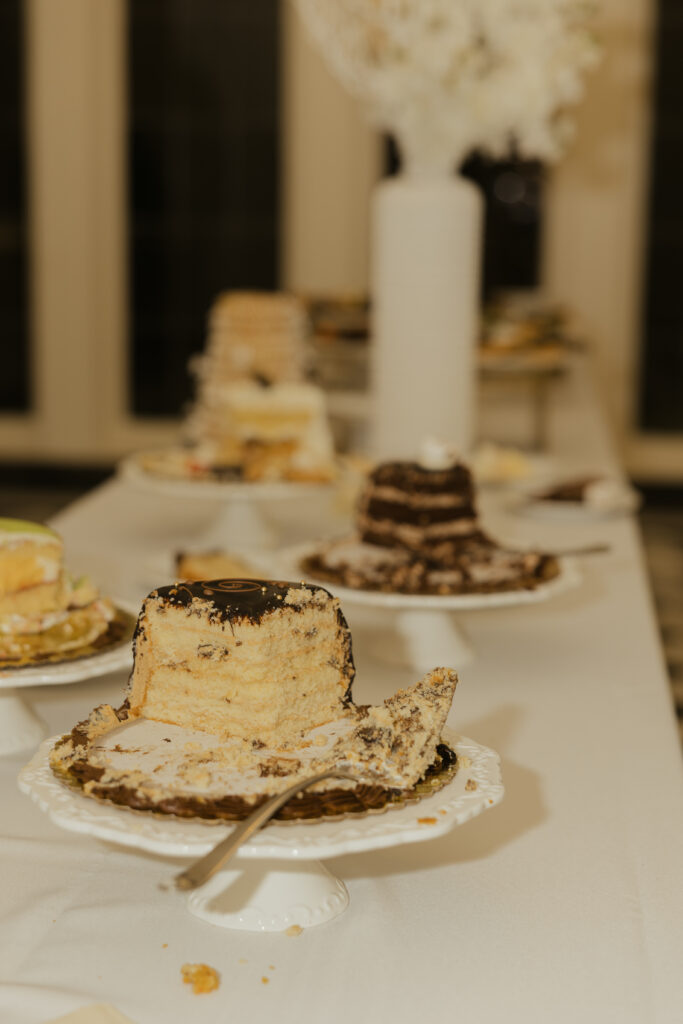
But the highlights of the celebration just kept coming – the next one being the authentic Danish wedding cake, a “kransekage” (from Copenhagen Bakery) – a delicious tower of marzipan-like layers, topped with a heart-shaped cookie for the newlyweds.
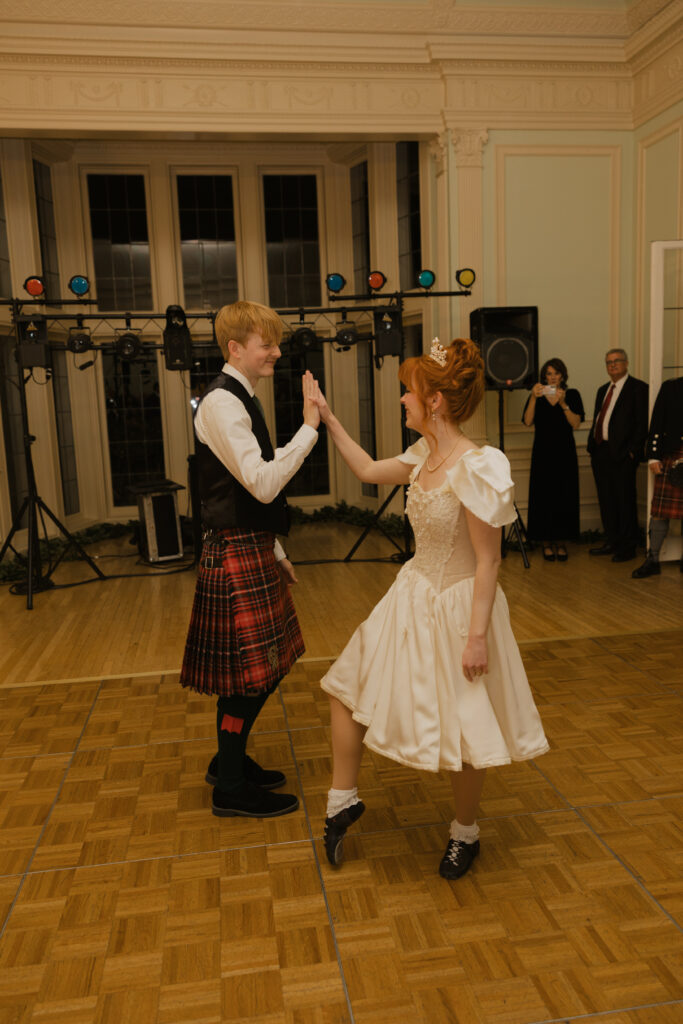
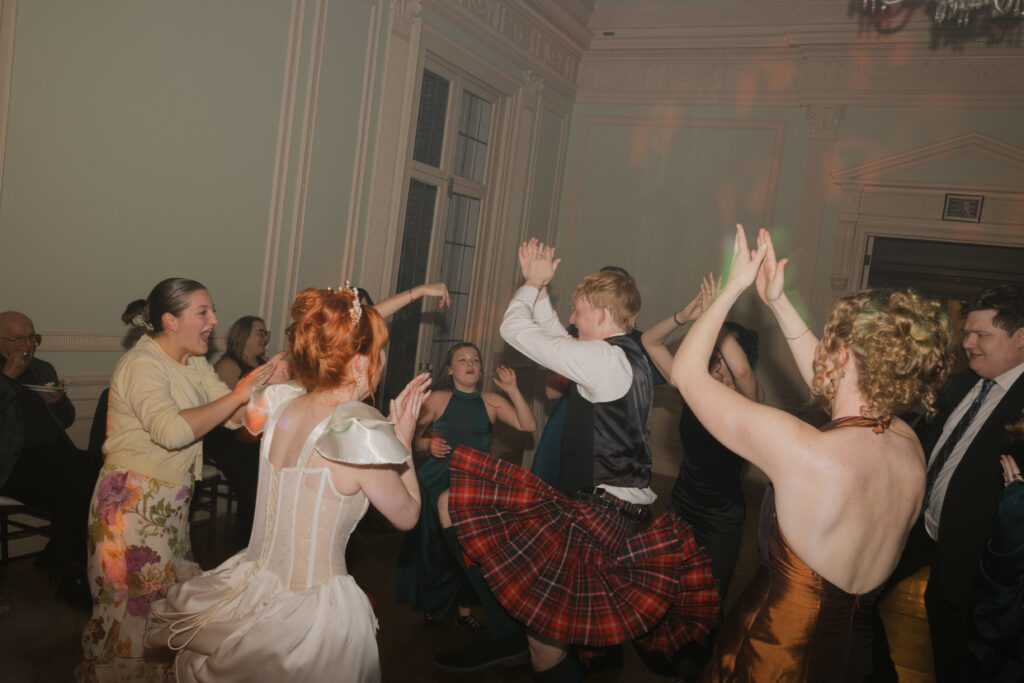
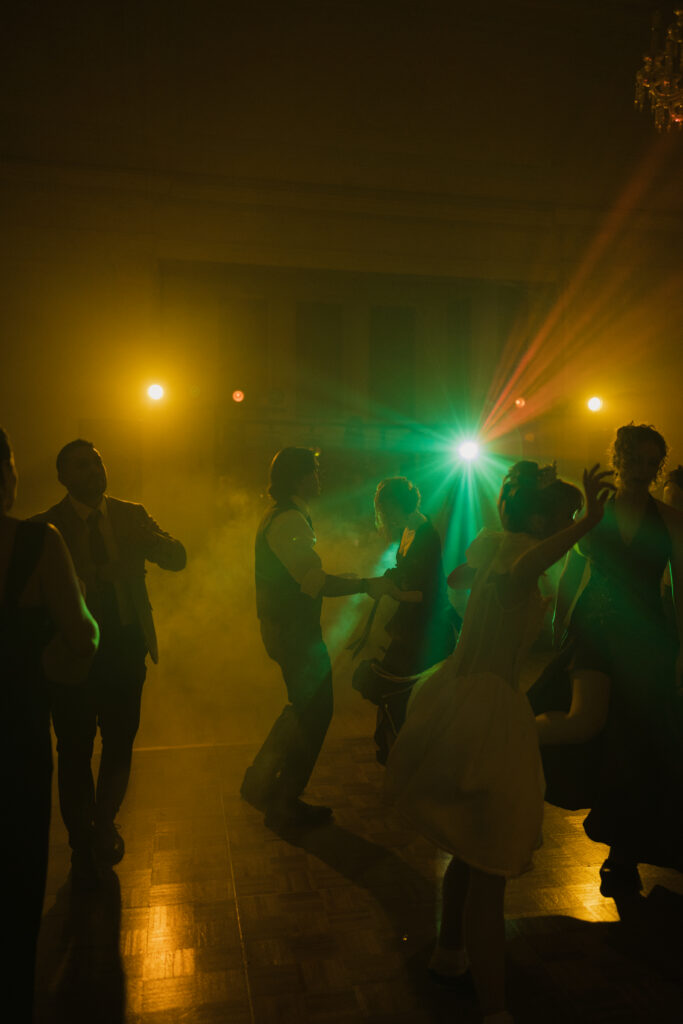
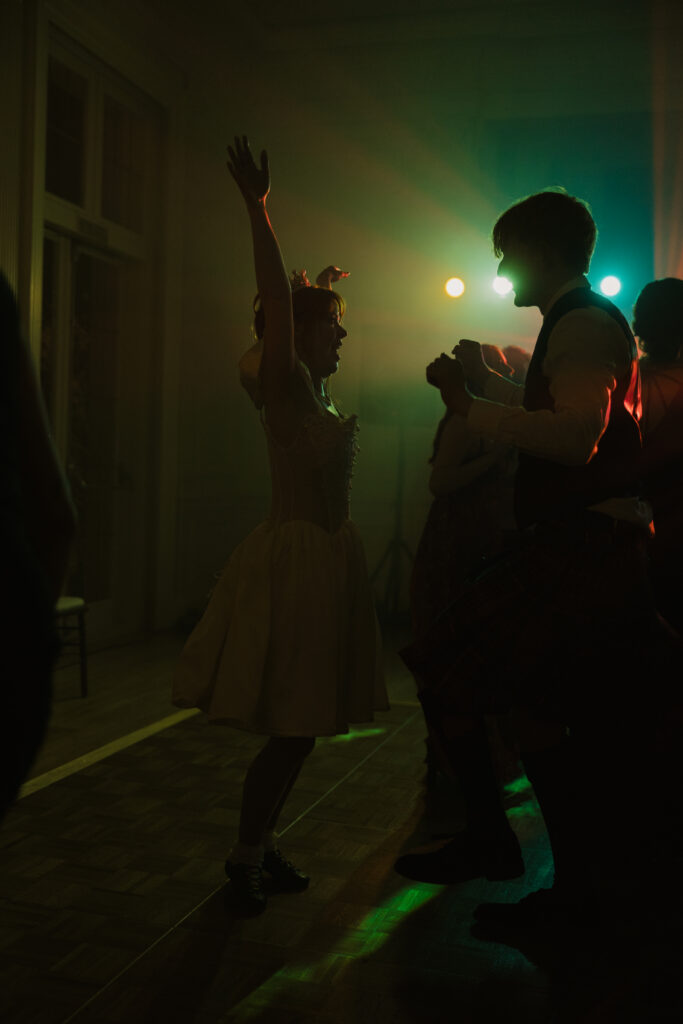
Having cut and shared this gorgeous cake, the newlyweds went on to what they love most: dancing.
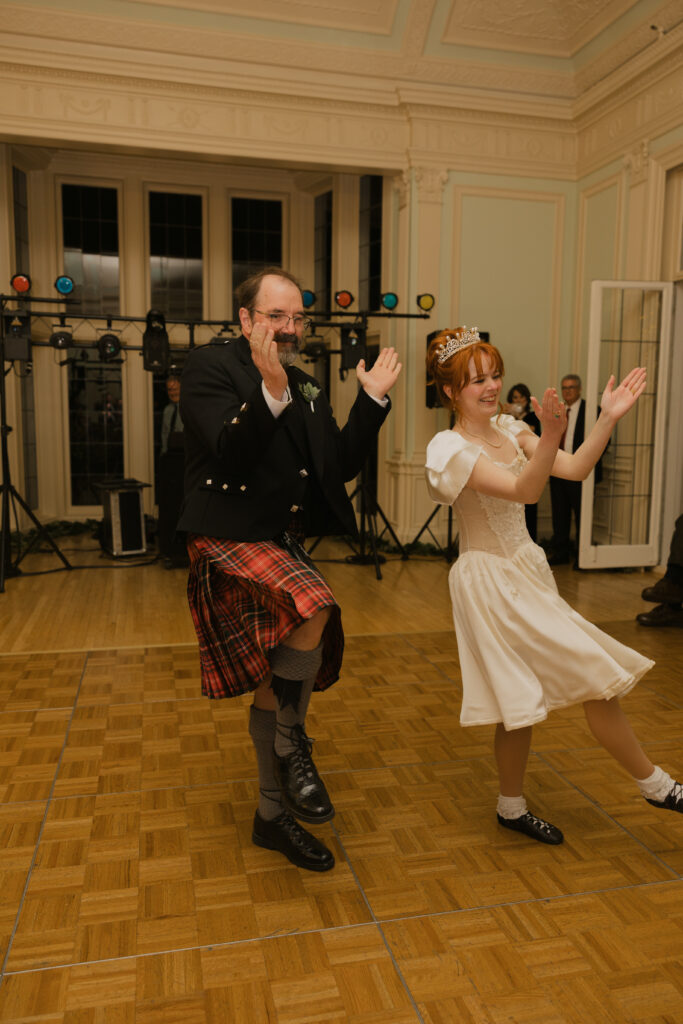
Of course, their First Dance was a highly choreographed routine (by the bride – who else?!), and the same held true for the Father-Daughter Dance.
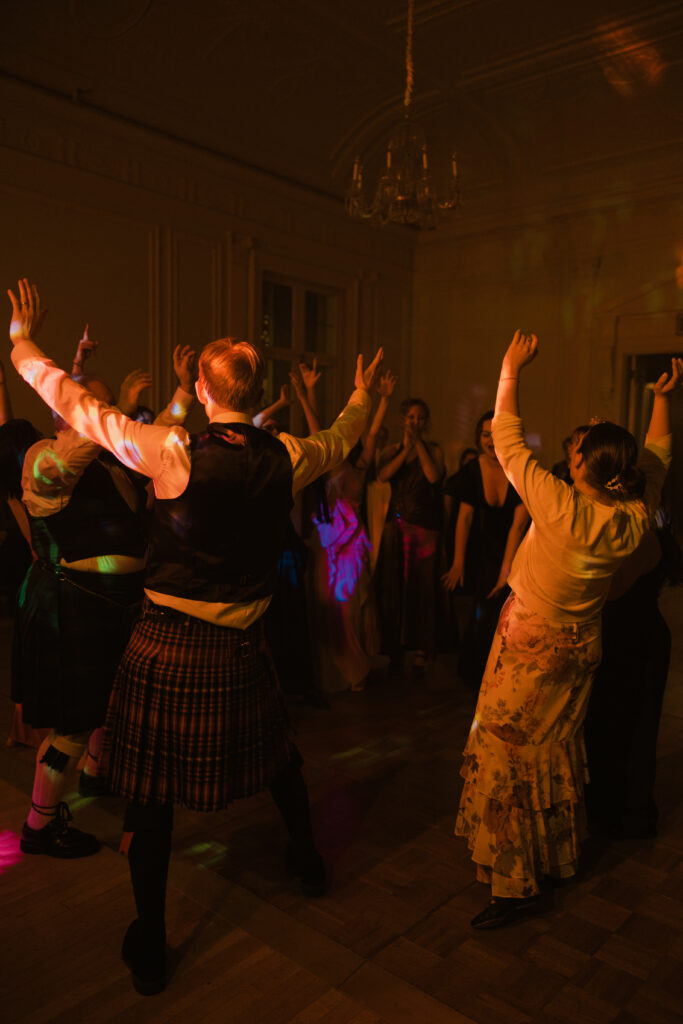
Guests were invited to join in the fun with a traditional ceilidh…
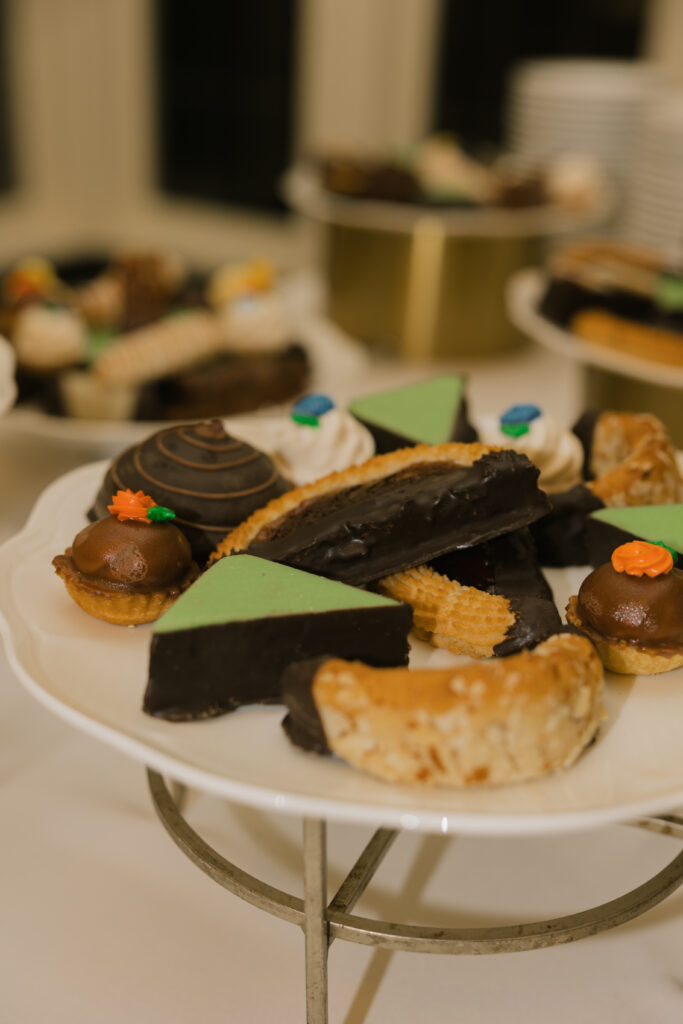
… and they left the dance floor ONLY to help themselves from the huge dessert buffet (also from Copenhagen Bakery)!
The rest of the night was spent just dancing, dancing, dancing – and celebrating!
So – one thing is for sure: this was unforgettable. Keep dancing, Catherine and Jacob, and celebrating your happiness for many, many years to come!